Americans are suspicious these days. According to a Gallup poll conducted just before the 2024 presidential election, only 31% of Americans express a “great deal” or “fair amount” of confidence in mass media.[i] And in April 2024, a Pew Research Center study found trust in the federal government at its lowest in 70 years: only 22% of Americans say they can count on the government to do what is right “just about always” (2%) or “most of the time” (21%).[ii]
Yet in this age of cynicism, there is one institution people seem to trust: museums.
According to a 2021 survey conducted by the American Alliance of Museums, participants ranked museums second only to friends and family for trustworthiness. Regardless of political affiliation, those surveyed counted museums significantly more trustworthy than researchers, scientists, nongovernmental organizations, the federal government, corporations, and social media.[iii] Reasons people gave for trusting museums: they are “fact-based”; they present “real/authentic/original objects”; and they are “research oriented.”[iv] Perhaps unsurprising to those who count themselves suspicious of quantitative surveys, the picture is less rosy when racial and ethnic backgrounds are taken into consideration. Households comprised of only white people were found far more likely to trust museums than households with people of color. Unfortunately, the survey lacks “stable samples” for people of color not identifying as Black or Latinx.[v] Hence, Indigenous perspectives are absent.
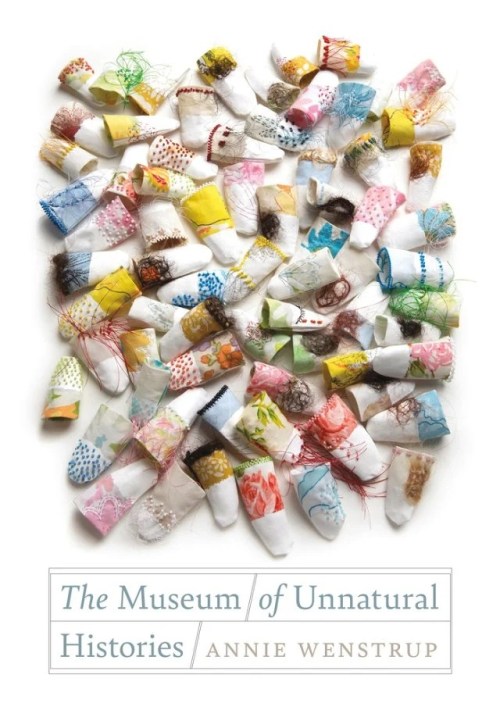
Annie Wenstrup, a Dena’ina poet whose collection, The Museum of Unnatural Histories, debuts this spring, offers a gorgeous corrective to that omission.
The Museum of Unnatural Histories is but one Native person’s nuanced perspective of the museum’s place in contemporary American culture. Even for those who seldom or never visit museums, this poetry collection can prompt reflection about interpretation and representation more broadly. Wenstrup’s grace, humor, and vulnerability are profoundly touching in light of the cruel role museums have played in the lives of Indigenous peoples globally. The Americans who trust these cultural institutions may not realize their grim origins, which critics classify as taxonomizing projects borne of colonialism.[vi] Wenstrup is undoubtedly aware that for hundreds of years Europeans—as a precursor to establishing museums—displayed Indigenous humans as living rarities at public fairs as early as 1501.[vii]
Wenstrup is descended from people native to the region where she held a Museum Sovereignty Fellowship. It was during her fellowship at the Smithsonian Arctic Studies Center in the Anchorage Museum that she wrote The Museum. The collection includes found text, poems, letters, and a screenplay synopsis for an imagined Lifetime movie. Each piece tells a story connecting to the whole. Wenstrup’s work explores how the Indigenous body gets imagined—from within and from outside sources. Woven into the different modes of storytelling, Wenstrup inserts sukdu’a, which the publisher describes as Wenstrup’s interpretive text. According to the Anchorage Museum, sukdu’a are Dena’ina stories about an ancient time when all animals were people. The sukdu’a about Ggugguyni is Wenstrup’s favorite and one that frames this work:
What I like about this story is that the body
becomes what it needs to be to tell its story
and be heard.
From “Sukdu’a”[viii]
So proceeds Wenstrup, who lets her words take the shape they need to be to tell a story about “the problem of empathy.”[ix]
In one poem Wenstrup imagines white interpretations of Indigenous bodies on display—Mattel’s Eskimo Barbie, Disney’s Pocahontas—facing each other after the lights darken. Poems such as this one foreground ways the acted-upon resist categorization even as they are affected by it.
Throughout the collection are Wenstrup’s dioramas: empty line drawings of squares accompanied by exhibit labels. The reader is left to imagine what they see as advised by the accompanying text, amusing for the way it captures a curatorial voice that engages even as it takes an infantilizing tone.
Watch! The Curator affixes labels to photos. This helps museum visitors understand what they’re seeing.[x]
Have you ever been observed but not seen? Tell me about it! Or draw a picture below![xi]
These descriptive labels bring into sharp focus the constructedness of curatorial work, which can never be objective.
Over the course of her fellowship, the poet asked museum staff questions. She says she learned that the museum is not “the housing of artifacts” but “an environment that fosters the possibility of encounter.”[xii]
For readers who may be intimidated by poetry and insecure in their familiarity with Dena’ina culture, The Museum of Unnatural Histories does what Wenstrup says she learned museums do: it fosters possibilities for encounter.
I’ve archived beauty all my life.
From “Ghost Pixels” [xiii]
Wenstrup’s archive of beauty provides a space for legibility and grace. The poet might have understandably rejected museums’ right to exist. Instead, she faces the imperfect institution and creates an imaginary one for ambiguous encounters. Wry meetings include spotting the curator walking briskly from exhibit to exhibit appearing “officially official.”[xiv]
Readers will find Wenstrup’s breathtaking imagined museum worth visiting and revisiting.
Always, I’ve known I embody that which harms me.
From “Exhibit D: Un-sent Memo” [xv]
[i] “Americans’ Trust in Media Remains at Trend Low” by Megan Brenan. Gallup. 14 Oct. 2024. https://news.gallup.com/poll/651977/americans-trust-media-remains-trend-low.aspx (accessed 3/6/2025)
[ii] “Public Trust in Government: 1958-2024.” Pew Research Center. 24 June 2024. https://www.pewresearch.org/politics/2024/06/24/public-trust-in-government-1958-2024/ (accessed 3/6/2025)
[iii] “Museums and Trust: Spring 2021.” American Alliance of Museums and Wilkening Consulting. 2021.P. 9. https://www.aam-us.org/wp-content/uploads/2021/09/Museums-and-Trust-2021.pdf (accessed 3/6/2025)
[iv] P. 12

[v] P. 43
[vi] For an example of what some contemporary museum workers are saying, see “Museums Are Not Neutral: We Are Stronger Together” in Panorama: Journal of the Association of Historians of American Art 5, no. 2 (2019) by La Tanya S. Autry and Mike Murakawski. https://journalpanorama.org/wp-content/uploads/2019/11/Autry-and-Murawski-Museums-Are-Not-Neutral.pdf (accessed 3/6/2025).For a history of museums, see The Birth of the Museum by Tony Bennett (1995).
[vii] Destination Culture: Tourism, Museums, and Heritage by Barbara Kirshenblatt-Gimblett (1998), p. 41
[viii] The Museum of Unnatural Histories, p. xvii
[ix] P. xi
[x]P. 16
[xi] P.18
[xii] P. 95
[xiii] P. 19
[xiv] P. 33
[xv] P. 73
POETRY
The Museum of Unnatural Histories
By Annie Wenstrup
Wesleyan University Press
Published March 25, 2025