


The Renaissance! At the word, we imagine a bolt of lightning flashing across Europe, illuminating the ignorance and stagnation of the so-called “Dark Ages.” New ideas! New philosophies! All hail this rebirth of ancient wisdom: a candle extinguished for centuries relit at last! The dawn of a new way of thinking and being in the world; the trailhead leading to that most important of destinations: the modern world.
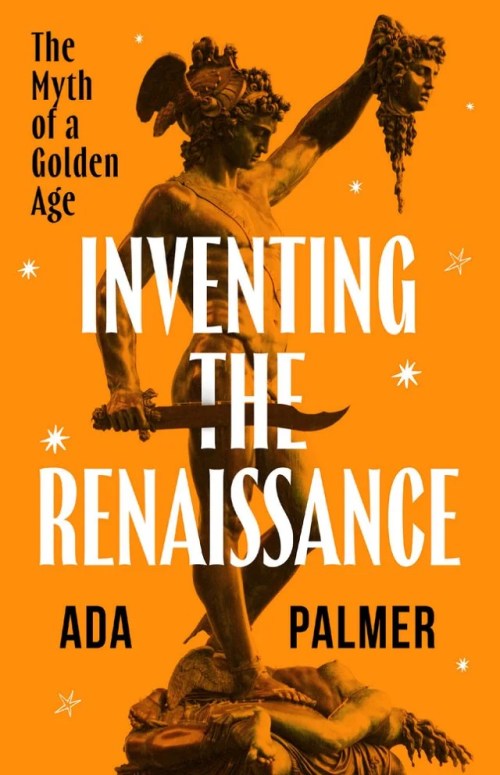
Not so fast, says Ada Palmer in Inventing the Renaissance: The Myth of a Golden Age. In this engaging, bewitching, and eminently readable doorstop of a book, Palmer invites us to reconsider the Renaissance, what it promised, what it delivered, and what it actually bequeathed to later generations.
There’s a certain amount of debunking implicit in such a project, which Palmer acknowledges. She asks at the outset: Was the Renaissance really a rebirth (the literal translation of renaissance), a break from the past? If so, how, and why?
Palmer isn’t the first to ask such questions. As historians of the Medieval period have long asserted, the period between the fall of the Roman Empire and the rise of the Renaissance had its own vibrancy. It was long (nearly a millennium), shaped by its ebbs and flows, “great men” and battles, inventions and intellectual discoveries. Medieval intellectuals were knowledgeable and rigorous in their own right. Like Francesco Petrarca, the virtual godfather of the Renaissance, they read the Classics (those they could access). They thought carefully and scrupulously about Big Questions and sought carefully considered answers. They employed a complex methodology (scholasticism) for analyzing text and thinking about history, theology, philosophy, and entered into spirited debates in their quest for the truth. Characterizing them as backward, small-minded, and mired in bias is not fair, complete, or accurate.
To illustrate this point, Palmer offers a characteristically charming and irreverent anecdote from a conference: Sorry, she says to a group of medievalists grousing about misrepresentations of their pet age, you can blame my guys for that.
But Palmer doesn’t simply debunk the myth of Medieval versus Renaissance. Instead, she invites us to join her in exploring and embracing a more nuanced, complex, and historically accurate vision of what the Renaissance actually was—both over and against the period that preceded it as well as in all its messiness, diversity, and confusion.
She lays the groundwork in Part 1: “Why You Shouldn’t Believe Anyone (Including Me) About the Renaissance.” In that title alone (so characteristic of her writing), Palmer decenters herself as authority (a deeply non-Medieval act) while foregrounding the innumerable multivalent and contradictory experiences of meeting “The Renaissance”—including her own.
It’s a paradoxical approach—both centering and decentering oneself as author/expert— but it’s powerful. In Chapter 2, “Everybody Wants to Claim a Golden Age,” she writes, “No matter how mythical golden ages are, they’re incredibly useful to later regimes and people who want to make glorifying claims about themselves.” Legitimacy, she says, and the need to establish it, is a driving force behind how historians, scholars, and others have sought to define the Renaissance.
Given that complexity, how do we tackle this fundamental question: What was the Renaissance? How is it not the Medieval? And, most powerfully, how does (or does it?) plant the seeds for our modern sensibilities, achievements, and society?
Palmer’s solution is elegant and engaging. Translating the question to modern parlance, she asks, “What is the Renaissance X-Factor?” That is, what is the single-most significant identifying factor that sets the people, culture, and actions of this time from what came before. And just as critically: How did that X-Factor birth our modern world? (Again, it’s always all about us.)
Spoiler: There isn’t one X-Factor. Or rather, there are as many X-Factors as people looking for one. When we ask, “What was the Renaissance?”, we’re really asking “What was the Renaissance for me?”
This framing allows Palmer to identify the many X-Factors that have stood out as the defining feature/impact of the Renaissance, each dependent on how that scholar/era/discipline defines itself. This multiplicity explains why the Renaissance can be defined as: a turning point in world economics (banking and all that); arts and culture (At last! Perspective painting and elephants that look like elephants!); theories of government (Big forces or big men?); modern notions of selfhood and self-fashioning (and resultant social mobility); a precondition for modern science (Have you tried observing and experimenting?); and on and on.
Each of these X-Factors reflects a different set of values, priorities, and spheres of action, and each offers a different definition of the Renaissance. When did the Renaissance start? When did it end? There are as many answers as there are X-Factors.
A myriad of questions cascade from this starting point. Was Lorenzo de Medici a hero or a villain? Was Machiavelli a soulless and godless monster of utilitarianism or the first modern political thinker? Palmer carefully lays out these cruxes, painting a detailed picture of the sociopolitical world of Europe between the fourteenth and seventeenth centuries, zooming in to offer context that brings new color to received opinions. So—was Machiavelli a monster? Before you can answer, you have to consider the man, enduring decades of constant war and plague, the leader he was required to support, his own hopes and dreams, his despair while enduring decades of chaos in his beloved homeland.
And that’s one of Palmer’s signature moves: Recount an event or person we think we know or introduce a less familiar one, then probe each, digging to test its veracity. The answer? Typically, a Yes, but … .
But isn’t that a debunking? You said this book isn’t a simple debunking. It’s not, and here’s why: Behind Palmer’s project is a larger intent. She doesn’t simply want us to question the notion of the Renaissance; she wants us to contemplate what the Renaissance is to us. Our answer should be so much more—and so much more powerful——than “The Renaissance gave us banking,” or “The Renaissance gave us individualism and social mobility.” Thinkers in the Renaissance wanted a golden age; so do all societies, all eras. When we reckon with the failure of the Renaissance to create a golden age, what does it say about our quest to do the same? Are humans capable of meaningful change? Do our efforts toward a golden age matter at all?
Palmer’s conclusion is hopeful, while at the same time recognizing the work that lies ahead and the inevitable disappointments and setbacks. In part, her book asks, Why does the past matter? Why should we bother studying history? Her answer evokes the famed quote by Spanish philosopher George Santayana: Those who cannot remember the past are condemned to repeat it.
But Palmer’s conclusions are much more profound, optimistic, and far-reaching. There is much from the Renaissance that we should repeat. And likely much more we should eschew—or at least be forewarned about. Palmer deploys a powerful metaphor, one she realizes in retrospect she first encountered in the writings of Machiavelli: that of the flood. The flood will come, she says of the onslaught of war, economic collapse, plague, all the terrors of living in the world that no single person can defeat. But the wise leader, state, and society know the flood is inevitable, so dig channels to divert and direct its force. And therein lies the bittersweet lesson of the Renaissance.
To embark upon Palmer’s journey is daunting. She makes it as inviting, engaging, and entertaining as possible. Her writing is chatty and fun without sacrificing academic rigor. It’s like the most brilliant person you’ve ever met has invited you over for tea to chat happily about her deepest obsession. Or maybe you’re at a club drinking Cosmos. She’s just so happy you’re there. And while she is obsessed, she good-humoredly recognizes the delightful absurdity in any obsession, even one with far-reaching implications.

But there’s a caveat, or maybe a heads-up, in order. This is, first and foremost, a history book. You won’t need to memorize dates, but you will meet tons of Renaissance luminaries, scholars, leaders, popes, warriors, nobodies, and bystanders. The book’s largest section tours through fifteen of Palmer’s Renaissance “friends,” who run the gamut from a prophetess to an assassin, a talented woodworker to a wild-eyed religious fanatic. The stories are fascinating, complex, and—occasionally—a bit overwhelming. A hundred pages on, you’ll have to flip back to remind yourself who friend #2 was to understand a reference to them in the story of friend #13. This is unavoidable, of course, and at times far from a stroll in the park for readers.
My advice? Sally forth. Flip those pages. Stop yourself from creating timelines and character crib sheets. Let it all wash over you. Use the book’s index to keep you oriented. But do keep reading. The lessons are too important and too hard-won to skip.
Can we reach our own golden age? The reward is in the attempt, and in its not-quite-perfect outcomes that take us—tiny step by tiny step, painful lesson by painful lesson—to small advances that add up. And that is worth the striving.
NONFICTION
By Ada Palmer
University of Chicago Press
Published March 28, 2025


