


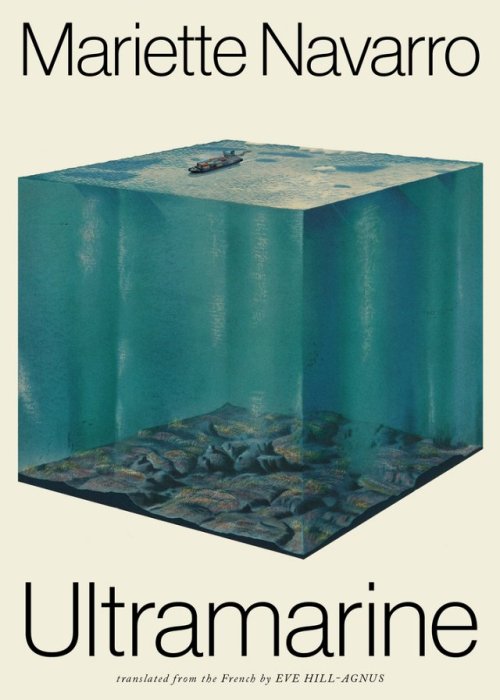
About halfway through Ultramarine the captain of a massive cargo ship crossing the Atlantic reflects that, when you are in the water, an “extreme coherence” envelops your being. The sea is around, beside, and very deep below you, moving like a steady pulse. A similar sense of rapt containment defines this new novel from the French writer Mariette Navarro. Translated with equal skill by Eve Hill-Agnus, Ultramarine is a taut exploration of how the imaginable confronts the unbelievable. And the novel’s beauty rests in figuring out which is which.
The book starts with a ship in the middle of a journey across the Atlantic, seemingly alone in the ocean. Seemingly alone in the ocean, a ship is in the middle of its journey. The captain is confident and authoritative. Her confidence is almost genetic: “she belongs to water the way others are proud of their distant origins.” Her authority, gained through a steady competence and respect for a ship’s procedures, is over a crew of twenty men. They are moving cargo from one side of the Atlantic to another. In the middle of their journey, this crew asks for a break so they can still the boat and swim in the ocean. The captain reluctantly agrees. After their time in the ocean, they clamor back on the board, and the crew of twenty now has twenty-one.
Who is this mysterious new crew member? How did he appear out of nowhere, or, more accurately, out of the water? It’s only a slight spoiler to share that the search for this extra sailor is more important than his identity. We see the captain under duress during the search, something that affects the rest of the crew and, seemingly, the boat itself. Or is it the boat affecting her? As we learn later in the novel, the captain is struggling with the pain of losing someone close to her. It becomes clear that the captain has avoided thinking about it and doesn’t want to share it with even her closer colleagues. Ultramarine uses the abstracted representation of the sea and the search for this mysterious new crew member to conjoin the captain and the reader into feeling the grief, not just reflecting on it. What is more difficult to comprehend: the loss of a life or the gaining of one?
Ultramarine is Navarro’s first novel, although she has been a dramaturg and playwright for many years in France. Perhaps it is Navarro’s background in the theater, but the novel seems like an inversion of play in its structure. The prose’s sparseness mimics stage directions or blocking – “she listens to this body, “they slide into the water” – that are brought to the fore, while bits of mostly uninterrupted dialogue are interspersed throughout but never dominate. It serves the novel’s interest in navigating depths within us, those things submerged below the surface of our lives. It seems, like the ocean, somehow both in control of these characters’ fates but disconnected from any judgement of them.
Navarro’s artfully terse perspective could seem at odds with a book about the wide open ocean. But her fascination is with the expanse of the depths, not its wideness. I hope it’s not my own mind’s limited scope that led me to think of the comparison to a French film by a female director, Beau Travail. But that film’s patient imagery and focus on a sergeant’s obsession with a new recruit, shares something with Navarro’s novel (indeed, Beau Travail was itself inspired by Melville’s other story set on the sea, Billy Budd). And like with the desert imagery in Clare Denis’s film, Ultramarine’s setting in the barren sea frames the human impulses attempting to break through people who have been trained to ignore them.
“There are the living, the dead, and sailors,” Navarro writes at the beginning of the book. Like so much else in this novel, this line is not exactly what it seems. The reader might question up to the very end if these are true distinctions or merely points on a spectrum. Ultramarine give us the opportunity to navigate across those shifting tides.

FICTION
Ultramarine
By Mariette Navarro, translated by Eve Hill-Agnus
Deep Vellum Publishing
Published March 4, 2025


