


In her latest historical crime novel, Radha Vatsal has created a moving, nuanced portrait of New York City in the early 1900s, a place and time often misunderstood. “What fascinates me is how progressive this era was in many ways,” Vatsal tells me. “And then that progress generated backlash.”
No. 10 Doyers Street takes its inspiration from real events in 1907. Though never arrested, gangster Mock Duck is blamed for a deadly shooting at the Chinese Theater. When politicians vow to destroy Chinatown—citing an end to violence but motivated by less noble goals—Mock Duck outmaneuvers them. Retaliation is swift: authorities take custody of his adopted daughter, claiming that the girl is white and therefore cannot stay in the custody of Chinese parents. Archana Morley, a journalist from India, finds herself drawn to the mysterious crime lord, sympathetic to his plight despite his brutal reputation.
Like her protagonist, Vatsal was born in India and has worked as a freelance journalist. She received her Ph.D. in Film History from Duke University and has experience as a film curator and political speechwriter. Although Vatsal’s cinematic interests do not appear in this novel, they are present in her Kitty Weeks mystery series, which is also set in turn-of-the-twentieth-century New York City. We talked about her interest in the early 1900s, corrosive rhetoric surrounding immigration, and the surprises of research.
This interview has been edited and condensed for clarity.

Erica Wright
Your Kitty Weeks series is set in 1910s New York City, and this new novel is only a few years earlier in the same location. What is it about this time and place that speaks to you?
Radha Vatsal
The early 1900s were a period of great change in the United States. There was a lot of immigration and agitation for women’s rights. Women were also making great strides in the professional sphere—becoming journalists, filmmakers, doctors, and so on. New technologies like cars and movies were also becoming a part of American culture.
In many ways, this period is similar to our recent past. And what fascinates me is how progressive this era was in many ways—and then that progress generated backlash. My novels are set in this period because I think it’s important for people to realize that progress comes in waves. There is nothing set in stone about where we are today—that it results from several seemingly unconnected decisions and choices. And that popular notions about the early 1900s—that it was overwhelmingly more conservative, less diverse, less open to women—aren’t always true.
Erica Wright
How does Archana Morley’s unique perspective—she identifies herself as “both a foreigner and woman”—give this story momentum?
Radha Vatsal
Archana Morley is a traveler from India who comes to the US at the end of the 19th century, marries an American, and builds a life for herself as a journalist in New York. Again, I think many of us have no idea that people from India came to the United States as early as the 19th century and settled in places like California, New Orleans, and New York. They included some prominent Indian women, to whom Archana refers in the novel: Anandibai Joshee, who came to study medicine, and Pandita Ramabai, a reformer and public speaker. Both wrote about their experiences in this country.
I had no idea about any of this until I started to write No. 10 Doyers Street and increasingly felt that this story needed to be told by an Indian woman narrator. But since I’d never heard of Anandibai and Ramabai or others like them—I had to invent Archana out of whole cloth. In this case, imagination came first. And then reality confirmed the character I’d conjured up.
Archana’s perspective is crucial to telling Mock Duck’s story because it allows her to empathize with him as an outsider and parent in a way others might not. She is also able to speak to the people other reporters overlook—Mock Duck’s maid and his neighbors, for example. She sees him as a full person, not just a gangster.
Needless to say, Archana’s perspective mirrors my own in many ways. While writing, I couldn’t help but think that my foreign background (I was born and raised in India) drew me to Mock Duck’s incredibly unusual story.
Erica Wright
Dr. Morley warns Archana about romanticizing Mock Duck. Was that a concern for you as you wrote this story?
Radha Vatsal
Yes, 100 percent. Particularly because his custody battle for his child is so moving. And again, I incorporate those concerns into the novel. Dr. Morley’s warning isn’t just directed at Archana, it’s directed at me, the author, and at the reader. We all need to be careful when we read. We all need to make sure we’re not being taken in by what we read and hear. Your attention to detail really brings this setting to life.
Erica Wright
Can you tell us about your research process? What surprised you the most?
Radha Vatsal
I loved researching this novel because it is both a book about Mock and Archana and about Chinatown and New York City and how it transformed into the modern city we know. The research took me in many different directions, from birthright citizenship—the first case was brought to the Supreme Court in 1898 by a Chinese man, Wong Kim Ark, who the courts deemed a US Citizen—to pamphlets written by the “Playground Association of America.”
I looked at old newspaper records to learn about Mock Duck; I read Mayor George B. McClellan’s typewritten memoir at the New York Historical Society. I also retraced the route Archana Morley would have taken from her offices on “Newspaper Row” to Doyers Street.
There’s so much I learned that is fascinating that it’s hard to pick out just one surprising thing. But the idea that water flowing beneath the surface of Manhattan affected parts of its geography really resonates. For me, New York City is a character in the book and the notion of underground water gets to the idea that there’s more going on here than you can see on the surface…That holds true for New York City, Chinatown, and Mock Duck.
Erica Wright
You briefly describe the living conditions of Chinese workers in this era, with a dozen men sharing a single room and working twelve-hour shifts. What did you want to convey about the immigrant experience of this period in New York City?
Radha Vatsal
In the 1900s, there was a lot of talk about Chinese immigrants being criminals. What I wanted to convey was how hard most people worked and how much they had to endure—in terms of difficult living conditions, leaving their families behind, and racism—just to be here. Devastatingly, a lot of the same rhetoric against immigrants is being repeated today. There is a heroism to that experience that I hope I conveyed.
Erica Wright
What were the challenges of writing about real historical figures like highbinder Mock Duck and mayor George B. McClellan?
Radha Vatsal

With Mock Duck, most of the information comes from newspapers, which were very biased. With Mayor McClellan, there’s more information out there, but I got a lot of the personal information about him from his memoirs.
If you take a step back and think about it, that makes sense. That’s how history and life work: the people on top leave behind the most substantial paper trails. So, we would know a lot more about a former NYC mayor as compared to a Chinese gangster. So for McClellan, I had to decide what information to cut. His father was a Civil War general, so there’s a lineage with information there that I also had to condense.
With Mock, on the other hand, it was a question of filling in the gaps. We don’t know who his parents were, the circumstances of his birth and childhood, anything like that. I built that uncertainty into the novel. Because they don’t know the facts about him, the newspapers and other characters in the novel are always spinning yarns about Mock Duck, making him seem larger than life. Archana (and the reader) must decide which stories to believe.
Erica Wright
Early in the book, you write, “I headed home, marveling at the age in which we lived. The eviction of an entire village from their homes only merited a paragraph or two, while the trial of a millionaire who shot his wife’s paramour in public generated endless pages of reportage, analysis, and gossip.” Do you see parallels between our media’s interests and those of turn-of-the-twentieth-century newspapers?
Again, yes. If you’re like me, the O.J. Simpson trial springs to mind. But closer to the present moment, we see social media and regular media, tailoring content to what’s likely to generate the most clicks and views. So it’s not the most important stories we’re seeing, it’s the most popular, sensational ones. And those are the stories that seem to get endless attention. And that’s how really awful things can happen without us noticing.
Erica Wright
How did your interest in contemporary politics influence this book?
Radha Vatsal
It’s woven right through the book. In this novel, politics is part of life and affects everyone whether or not they want it to. It certainly affects Mock Duck, his family, and Chinatown. And I try to paint as realistic a picture as I can of how local politics works because in addition to thinking it is important and relevant—I find the backroom deals and negotiations perfect for a mystery novel like this one!
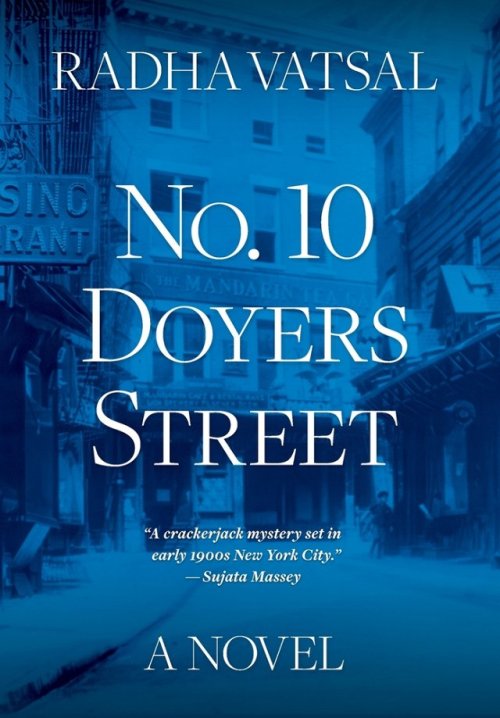
FICTION
By Radha Vatsal
Level Best – Historia
Published March 4, 2025


