


You’d be hard-pressed to find a book-length work of memoir or personal essays in which the author doesn’t revisit their childhood. It’s like the therapy cliché where you spew out a litany of personal problems and troubled relationships in your adult life, only for the therapist to say “tell me about your childhood.” It’s basic psychology: if we want to understand ourselves better, we must return to our beginnings.
This feels especially true for queer and trans folks writing creative nonfiction. Gender and sexuality can be huge parts of our identities, but we don’t just magically wake up one day in adulthood with a perfect understanding of those aspects out of nowhere. Our experiences and relationships help us to form that understanding as we grow, starting as far back as our days as snotty-nosed kids. Our cheek-blushing crushes, our awkward too-much-tongue first kisses. For writers, the challenge becomes balancing the lived experiences of our adolescence with our analysis of their impact on our identities as adults.
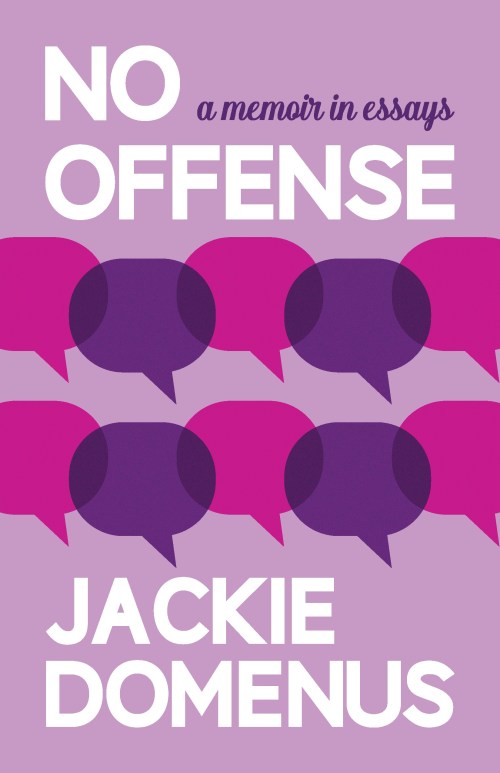
When I first started drafting the personal essays that would eventually become No Offense: A Memoir in Essays, I knew that I was writing toward the topic of microaggressions against LGBTQ+ people, but I also knew that there were key moments from my childhood that impacted my understanding of queerness, moments which in their own ways, were micro (and sometimes macro) aggressive. I knew that writing those moments was not only crucial to the “arc” of the memoir, but to my understanding of myself and my identity, so I got to work on revisiting my childhood self and putting her on the page authentically.
One of the craft elements I experimented with early on, in an attempt to bring the reader closer to the kid version of the narrator, was the present tense. Writing a childhood scene in past tense can give the reader a sense that they are still with the adult version of the narrator, listening as they recall a story—a “back in my day” or “I remember when” vibe. But with the present tense, the reader is forced closer, in scene with the kid narrator, experiencing that moment with them, at that particular age.
For example, No Offense opens with the essay “Tomboy,” which jumps back and forth between seemingly small, but extremely impactful moments from my childhood and young adulthood which ultimately informed my understanding of my gender and sexuality. Rather than writing “When I was eight years old, I shopped for clothes in the ‘Boys’ section,” I chose to place the narrator, and thus the reader, in the present tense, writing instead: “I am eight years old and shopping for clothes in the ‘Boys’ section.” This short scene continues in the present tense, allowing the reader to experience the moment with the child narrator—their conversation with their mother about whether the clothing they want is too “boyish,” the comfort they feel no longer having to wear frilly Easter dresses, etc.
Of course, I could have made the writerly choice to go into an analysis of precisely how my mother’s acceptance of my taste in clothes as a little kid allowed me to defy gender norms from an early age, and why it felt so much worse when others called out my “tomboyishness,” causing me to repress so much about my identity during my teenage and young adult years. But instead, by remaining in scene with the child narrator, the reader is invited to experience that moment and feel the emotions child-me did, authentically and without commentary from adult-me. Instead of being spoon fed my analysis, they have the opportunity to form their own. By beginning the book with this essay written entirely in the present tense, it allowed me to detail these moments as unedited and pure, instead of manufactured memories with forced meaning. This approach allows the reader to trust the narrator and leaves them wanting to find out how the adult version of the narrator turns out.
Eventually, adult analysis of childhood experiences becomes necessary in memoir. Another practice I adopted throughout writing No Offense in order to accomplish such analysis while still honoring kid-me’s actual experiences, was admitting what I didn’t know as a child. Sometimes this means effectively switching back and forth from child narrator to adult narrator. I look to books like Long Live the Tribe of Fatherless Girls by T Kira Māhealani Madden or Heavy by Kiese Laymon for stellar examples of that unspoken switching and immaculate balance. But sometimes, for me it meant literally writing phrases like “I couldn’t know it then, but…” or “I was oblivious to the fact that…” before delving into whatever epiphany I had about a given childhood memory as an adult. When I am reading memoir or personal essay, I am more inclined to trust and connect to a narrator who admits they didn’t realize the weight of something in their childhood, rather than claiming they had it all figured out at seven years old.
An essay that implements this strategy in No Offense is the borrowed form piece, “What Does Your Halloween Costume Say About Your Gender?: Quiz Results.” As the title implies, it’s an essay in which I analyze my Halloween costumes over the course of my life and what they meant in relation to my gender, written in the form of results you’d get from those early aughts teen magazine quizzes. Recalling my third-grade costume, the piece reads, “Wizard – You’re nonbinary. Of course, you’re like eight, so you don’t know what that means yet. But you’re neither a girl, nor a boy. You’re magic. No one can judge your royal blue cape, decorated with shiny silver stars and crescent moons or your matching pointy hat. No one can say it’s too girly or too boyish.” While I was an extremely observant child and overly aware of other people’s judgment of me from a young age, it would be a stretch to say that I understood what it meant to be gender nonconforming or nonbinary in 2001. Though it felt like an “aha!” moment when drafting the essay, it was also important to admit that this realization came as an adult, not as the little kid in the wizard costume.
Putting these sorts of realizations on paper and including them in a memoir is sometimes scary and vulnerable, but it can also be cathartic. Especially when the realization comes from a moment or piece of your childhood that was missing something. Sometimes, we use the written word to fill in the gaps in our memories or to daydream about what could have been. In creative nonfiction, some folks refer to this practice as “perhapsing.”
Lisa Knopp writes of “perhapsing” in her 2009 craft essay for Brevity, “[It] can be particularly useful when writing about childhood memories, which are often incomplete because of a child’s limited understanding at the time of the event, and the loss of details and clarity due to the passage of time.”
But I learned to experiment with “perhapsing” in a slightly different way. While studying with Heather Lanier, author of the brilliant memoir On Raising a Rare Girl, I was having difficulty figuring out how to end “A Learned Behavior,” the third essay in No Offense—an exploration of LGBTQ+ representation in media (or lack thereof) during my childhood. The essay opened by detailing my obsession with the character Mary Poppins, and after weaving threads of my subconscious crush on Michelle Pfeiffer in Grease 2, harmful stereotypes perpetuated by TV and movies, and my struggle to identify a single queer role model from my childhood, Heather suggested ending with a re-imagining of Mary Poppins’ character. A means of “perhapsing,” her suggestion challenged me to ask what might’ve been different had I actually been given the chance to watch a queer character on the screen in my formative years. The essay now ends:
“But I often wonder what else she could have inspired in me, had she been a queer character.

She’d float on down, her umbrella boasting the colors of the rainbow, wearing a power suit and clunky Doc Martens. She’d take one look at that pathetic Mr. Banks and throw her head back in a fit of laughter. She’d still be neat, precise, a hell of a singer. She’d still make friends with Bert, the chimney sweep. But in the end, she’d entice Mrs. Banks to leave her miserable husband and the two of them would fly away, the children hanging onto her boot straps with big, bright smiles across their faces. They’d move into their own little house in London, one that’s always clean, but full of joy. If this had been the Mary Poppins I knew, or any character I knew for that matter, perhaps I might have known myself.”
This sort of “perhapsing” is a great way to balance the playfulness of a child narrator with the longing of an adult narrator. For queer and trans writers especially, it gives us an opportunity to rewrite parts of our childhood that were harmful or traumatic or missing altogether. Inventing a “what if” allows for experimentation and imagination in a genre that is often pigeonholed into “true stories.”
Writing about childhood in creative nonfiction can be difficult, but sometimes it’s necessary to the overall story we’re trying to tell. Sometimes it’s necessary to be able to understand ourselves. No Offense wouldn’t exist had I not set out to understand myself and the world better by examining moments from my adolescent and teen years that felt confusing or uncomfortable. Striking a balance between the adult narrator and child narrator in memoir or personal essay is a great way to honor our kid-selves and all they’ve been through. It’s a great way to honor the experiences that have shaped our past selves, and in many ways, continue to shape our future selves. The more we honor those experiences, the more worlds we open up inside ourselves to keep writing, to keep telling our stories.
NONFICTION
No Offense
By Jackie Domenus
ELJ Editions
Published February 21, 2025


