


Carvell Wallace’s memoir, Another Word for Love, draws its greatness from an alchemy of the personal and the universal, a book somehow wholly about the author and about the human condition.
His background as a decorated podcaster and cultural and political critic has given him a special eye for storytelling, and he uses “cold opens,” flashbacks, braided structures, and an ability to lead the reader to an idea and make her feel that she created it to add to the vaunted canon of unforgettable memoirs.
I spoke with Carvell about his award-winning memoir and its beautiful balance of the monstrous, the frightful, the aspirational, and the sublime, as well as a writing career punctuated with disparate topics unified by a focus on humanity, grace, and a sometimes-veiled beauty.
This interview is excerpted from Episode 265 of the Chills at Will Podcast. Listen to the complete conversation here.
This interview has been edited for length and clarity.

Pete Riehl
You’ve done some incredible work with Andre Iguodala, the former [Golden State Warriors] basketball player. You’ve done the award-winning podcast, “How to” [with Slate]. [You deal with topics] like finding the perfect mattress and how to prepare for forever parenting. It’s quite a variety of things and you’re such a consumer of pop culture, with literature as part of that and you’re just so well-rounded.
I wonder where the muse has come from for you to go from doing a podcast about forever parenting, which is obviously so crucial and so topical, to something more lighthearted like the mattress, to working with Andre Iguodala, who’s in the public eye.
Carvell Wallace
A lot gets assigned to me because people write in with their questions and we decide which questions to pick up on. But then we go and seek out experts and then we have a conversation around those questions. Certainly we choose questions that we feel like are going to be interesting or layered or have legs enough for an episode.
I’m interested in the throughline, which is people. I was writing the Andre Iguodala book and yes, I’m smart enough to sort of learn the general linguistics of most formats.
I grew up watching basketball enough, and what I didn’t grow up watching, I could figure out by Googling, watching YouTube videos, and talking to Andre and figuring out enough to understand the principles and then learn[ing] that language.
You can learn the language, but what’s underneath it is the people: so in the Andre story, it’s like the basketball is important, but it’s a platform on which he has a human struggle, which is I want to achieve at my best, but it’s not possible every night, and that hurts. That’s a struggle for me, and that freaks me out and that makes me feel sad. These are the challenges that come up. And here’s where I push too hard and here’s what I’m looking for, and here’s what it used to be like when I was playing as a teenager and as a kid and when I was young, and so much of that is gone. How do I get that back?
These are human stories. So once I’m in, whatever the genre, whether it’s music writing like I did for Pitchfork or I’m doing television writing like I have for New York Times Magazine, or I’m doing sports writing: in the end, you’re looking at a person trying to do something and whatever it is that stands in the way of them doing it.
Pete Riehl
I wonder if these essays/chapters were all separate pieces originally. There are three parts in the collection, and I wonder about them being linked tangentially or thematically, and how purposefully you did so.
Carvell Wallace
They weren’t all written at once. They were written all over the place.
Sometimes some of these chapters were written just on their own, and I didn’t know they were going to end up in the book.
Later, I knew that I was going to chart a recovery from childhood trauma. I knew that was going to be the focus of the memoir. So, at the beginning, [I] ha[d] to lay out what the traumas are. I knew that the way that we would talk about recovery was going to be poetic. You were going to feel the recovery. It was not going to be described to you. [I wasn’t] going to be like, “And that’s the day I realized that I was no longer responsible for the things that happened to me.”
I was going to describe a moment in a relationship, in love and in nature, in sex, and that moment itself would bring about a recovery.
Once I knew what I was going to do, and I had written a little bit of the other sections, I went back and started to shape the book and see which piece was going to go with what. Then I went back into my archives and found pieces that I thought might do what was missing, like, oh, here, I need something about this.
I would find a piece that I wrote that was sort of halfway there, and I would chop it up, and then I would it was like making a collage.
I would write some more, [thinking] this needs like five more paragraphs where I explain this, you know, or this just needs one or two sentences to help make this link.
I didn’t need the links to be super explicit, and I didn’t need everyone to always follow exactly what was going on.
When I was a kid, I used to read the Choose Your Own Adventure books. Do you remember those?
Pete Riehl
Oh, yeah!
Carvell Wallace
Those were always cool to me. Not necessarily that I’m going to actually write one, although maybe I will one day. I liked that they engaged the reader, and when I think about doing that at this level of writing-giving the reader stuff to figure out as a way to keep them engaged in the thing-I [remember] that if everything is too explained, it’s a passive experience for them. [Readers] find it boring.
I want to give the reader some ideas to think about, questions like, “Why are we here? What does it have to do with the other thing?”
I want people to be involved with me to help tell the story-like we’re doing this together.
So when I was writing chapters that were connective tissue, or when I was adding extra paragraphs or shaving things to make them fit, I was also careful not to make things too prescriptive and explanatory, because then it doesn’t leave the reader anything to do.
Pete Riehl
One of the last people you thank in the Acknowledgements is June Jordan, and an epigraph is “thin skin protects the part/ that dulls from longing.”
I wonder about choosing to start with that epigraph.
Carvell Wallace
June Jordan sits next to my writing desk; she’s here all the time. I had a bunch of epigraphs in a big [iPhone] Notes file, and some of them were absurd. I had entire paragraphs from War and Peace that I was going to try and chop up, but none of it hit.
At a certain point, it just dawned on me that I should do a paragraph from June’s work because she was one of the only writing teachers I ever had. My friend Sheila Meneses, Menezes who was June’s assistant when June was teaching at UC Berkeley, snuck me into June’s class, which was the last class that she ever taught. Sheila said that [I] could just sit in the back, and “get a semester of June.” I showed up every class day, three days a week.
As I was finishing the book and we were wrapping up things, October 7th had happened and Gaza was in the forefront again. I thought about what I had heard June say about Palestine back in 2001, and it occurred to me that when I sat back and thought about it, she was a huge influence on my understanding of how politics is everything and how the antidote to political harm doesn’t just exist in making political analysis, although that’s one [part]. It also exists in a way of loving and a way of creating art and a way of being, of showing up. June was very courageous and very sensitive and very fearless, and that combination of being sensitive and fearless was mixed with the heart of a poet.
Pete Riehl
The book starts with “We had been homeless for about a year,” with you around eight years old. It starts with a temporary housing situation, where the homelessness has ended [but the housing situation is tenuous].
You write about loneliness and literal hunger and the “encroaching of shadows.”
I wonder about that feeling that seems so specific to a kind of loneliness [where you feel that] you’re just so small in the universe.
You may not [have been] able to put it that way [at the time], but then add to that the fact that you were between homes and homelessness had been an issue.
I wonder about that encroaching of shadows and that darkness that came with that loneliness and how they’re connected.
Carvell Wallace
I think of TV a lot, and I like to write cold opens. That’s a cold open and it’s going to be a little mini-story that covers all the forthcoming themes of the story.
Yes, there’s this loneliness, there’s this overproduction of feeling inside of me, and these external circumstances give me a lot to feel about-what we need to know about this character is that he has an overabundance of whatever little hormone produces feelings. The circumstances around him give him a lot [to project] those feelings onto.
The other thing that happens in that chapter is there’s already some question about what is real and what isn’t, because the first line is “We’ve been homeless for about a year,” and then three lines later, it’s “Well, maybe it wasn’t a year, maybe it was a little less,” and so this is about the unreliability of memory. It’s not that the main character’s a liar, but that memory changes things.
Pete Riehl
You reference your mom early in the book-at the time, at around 27 years old, and you literally taking drinks of her soda. Even though it was gross, it was hers, even with the ash from her Coke cans.
Carvell Wallace
(Laughs) When she wasn’t looking, I would take sips and it would be like lipstick and like cigarette ash and flat Coke.
Pete Riehl
I mean, that’s a son and a mother, right, a desire for approval,
Carvell Wallace
For approval, for intimacy. You just want to be close to her. You want her to smile on you and tell you that she loves you and that everything’s okay.
Pete Riehl
You do so well with not dealing in tropes. You might have written something like, “You know, and from then on I developed a taste for Coke…” It wasn’t about the Coke.
Carvell Wallace
No, it wasn’t. I think as writers we get to engage with tropes, like I might acknowledge that a trope exists or I might not acknowledge it exists, but I’ll write something knowing that you’re going to go to that trope as a reader.

I’m going to maybe switch it up on you because I know you’re expecting the one thing and I’m going to give you the other.
Pete Riehl
It seems trite to say that his book was healing for me, and-I don’t want to put words in your mouth-I’m guessing you might not say that was the point of the book.
I wonder about the way you’re describing such emotional, traumatic scenes: were you able to be a little objective in writing about yourself?
Was that healthy, or helpful?
Carvell Wallace
Yes, absolutely, and I will also go so far as to say this is part of why I wrote the book. I absolutely want it to be healing for myself and other people for sure. That’s part of what I’m offering here.
I certainly wanted the book to have the effect of being healing, but I also felt like you could get a pamphlet on how to heal from trauma from your local clinic or whatever, and it’s useful and it’s helpful.
That’s not what I’m writing. What I’m doing is something a little different, which is not better or worse-it’s just a different thing. I’m using the magic of storytelling to write the classic “show, don’t tell,” so I could describe, “here’s exactly how I overcame all of my anxieties and fears” and “here’s exactly what my therapist told me.”
But I actually wanted to just tell stories that created that experience for the reader. I think there’s a magical alchemy that happens with writing and storytelling where you create an experience where if someone opens up a book, especially now when there’s such a competition for our attention, if someone goes to a book store and buys a book and opens it up and reads it, or puts on a pair of headphones to listen to a book, they’re giving you such a gift, I think, as a writer.
And so I want to return that.
I want to honor that by saying, “Now let me tell you a story or several stories, and you can just kick back and have the experience of receiving these stories.”
Pete Riehl
You talked about some tough times with your uncle and your aunt.
They ended up getting divorced and you were away from your mom, but you also said that they were “beautiful times” because of those fixations.
I don’t know if [there exists] a direct link to what made those such beautiful times.
Carvell Wallace
I think there’s a little clue in there about the book’s theory of recovery that [I see] when I step back. There’s a meta narrative like, “Oh, this terrible stuff was happening to you. You must have been so upset.”
And people actually still do this to me in interviews: “It must have been so hard,” And I’m like, “Did you read the book?”
Because actually what I said was, yes, technically it sounds like it was hard, but it wasn’t because the world had endless stuff to be interested in.
That’s a little bit of what I’m saying in the latter half of the book as an adult: the world has endless beautiful things to be interested in, and that is part of how we recover from our pain. It’s part of how we heal from our suffering, right? We recognize that, yes, I’m bummed and I’m hurt and I feel mad, but the world outside of us has endless stuff to be interested in.
Pete Riehl
You talk about reunion as in “re-union,” putting things together again, about being torn in two.
You write about that horrific picture with a Black American slave who had all the whip marks from the lashes. You explore how it’s the same way with lightning-lightning breaks in two.
Your [words] about reunion are resonant: “reunion is another word for love,” and you [write lovingly] of your family, going back to Sophie Blaylock, who would have been maybe the first in your family outside of slavery, born a couple of years after slavery had ended.
Carvell Wallace
I think so. I think she was born like two years later.
Pete Riehl
You go on to describe the beauty in seeing the stars, the same stars [as Sophie Blaylock], asking “Who was Sophie, and who would she have been without her last name, given to her by the slave owners?”
The book is not as great as it is without Part One-it has to have Part One-and in Parts Two and Three, there is so much beauty that builds [through exploration] of “what is another word for love?” and “re-union,” and stops and starts in recovery, and healing.
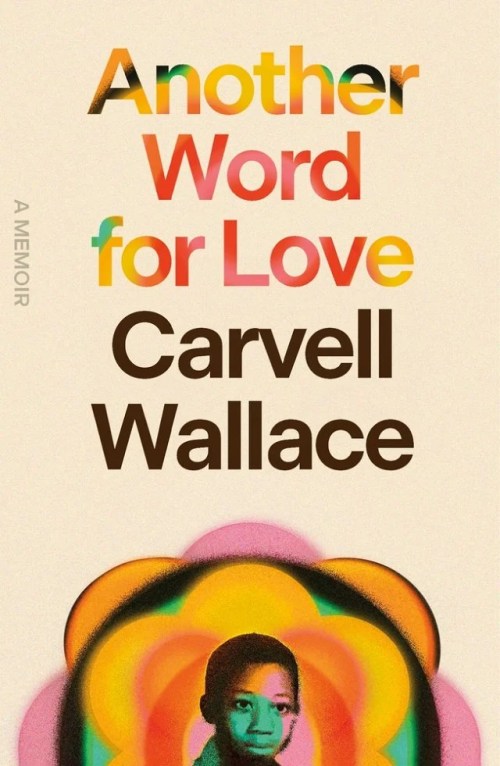
NONFICTION
Another Word for Love
By Carvell Wallace
MCD
Published May 14, 2024


