


If space is the final frontier, land is the first. As early humans turned from hunter-gatherers into farmers and herders, landowners held the advantage and the natural resources they needed to stay ahead. When permanent settlements yielded plentiful agriculture, those who controlled it evolved into lords, chiefs, and political leaders at the top of their social hierarchies.
In Land Power, political scientist Michael Albertus makes the case that who owns the land ultimately decides the fates of societies. Land ownership has the potential to empower peasants to prosperity but also entrench existing patterns of racism, poverty, and gender inequality in societies and stall development.
When the land titles change hands, the dice roll again. Massive land reallocation events, from the French Revolution to Soviet and Maoist collectivization, marked the last two centuries. He dubbed it the Great Reshuffle—covering moments of upheaval where land power changed hands over the past two centuries and changed the trajectory of societies across the globe.
It also marked great experiments in reallocating land—and the opportunity that comes with it. Some countries saw success in doling out acres from large estates to the small farmers who tilled them. Others experienced unintended consequences, from failed collectivization reforms to environmental catastrophes, in the shuffle.
When the lot you own defines your lot in life, the stakes of land reallocation are at their highest. Drawing on case studies and fieldwork across the globe, the book explores how land power shapes people’s livelihoods even when they leave their direct ties to land behind.
In our conversation, Albertus talks about what triggers land reshuffling, how societies can leverage land power for good, and why putting a dollar amount to dispossession is near-impossible but necessary.
This interview has been edited and condensed for clarity.

Reema Saleh
What originally shaped your interest in land?
Michael Albertus
I was interested in inequality and the relationship between inequality and democracy. It turns out that understanding and interrogating that relationship is especially difficult when we look back on history. It was once very difficult to reallocate opportunity in society because it was not that easy to reallocate income. It was easier to reallocate things like physical assets. Land was crucial, and that set the stage for modern state-building. I got involved in it from that angle, which made me more interested in learning about it in the modern day.
When I was doing fieldwork early on in parts of Latin America, I saw how land is still so critical to the livelihoods and lives of so many people, whether it’s because the land shaped that trajectory of leaving the land or because many people still have connections to it. Land is so central to people’s lives. It confers identity. It confers a sense of belonging, invoking all these broader issues in people’s lives and markers of social, economic, and political powers.
Reema Saleh
You characterize many land redistribution events between the 1800s and today as the Great Reshuffle. Why did you pick that word?
Michael Albertus
I call the Great Reshuffle this period of the last two centuries, and that has been marked by land reallocation around the globe in ways that have fundamentally changed the trajectories of societies. It’s this period in which life seems pretty different, and how this happens differs from what has come before. Considerable growth in human populations and advances in state-building increased the demand for land. That demand for land, twinned with states’ capacity to reallocate land among people, generated these enormous shifts in who owns the land and, with that, who holds power.
Reema Saleh
Where is the Great Reshuffle still going on?
Michael Albertus
It’s still going on in many places. When apartheid ended in South Africa, for example, the government promised to redistribute or reallocate a third of agricultural land in the country. Apartheid was a racialized system of domination, and Indigenous Black people were systematically removed from their lands and, for the most part, dumped in the homelands, which were far from centers of economic and political power. They were places where land was not high quality and where people were removed from society. To a large extent, it was a tool of marginalization.
As part of the shift away from apartheid, the government promised to reallocate land at a considerable scale to Black people who had previously lost it, and that is still ongoing today. I did fieldwork with a series of communities in Mpumalanga, in northeastern South Africa, involved in the sugarcane sector. In 1954, they were forcibly removed from their land but recently got that land back in the 2000s through the land restitution program. That changed those communities in many ways. People are now working on that land again. They struck a deal with the company that previously owned the land to lease it back, and some took certain leadership positions in the company. The company is now giving scholarships to people to train in aspects of agriculture associated with sugarcane. It’s generated this transformation that has shifted the landscape, and that’s one story among many in South Africa still working on reallocating land at a vast scale.
Reema Saleh
What triggers reshuffling? Is it something specific to nation-states as opposed to other kinds of human civilizations?
Michael Albertus
There are a couple of big forces that tend to trigger reshuffling. One would be population growth, which increases the demand for land. It puts pressure on land, and oftentimes makes it so some people have access, and other people don’t. But to reshuffle land, there must be some administrative capacity and force to carry it out. It could be a peaceful transfer or forcible, like Russian or Chinese collectivization, to complete that kind of reshuffling.
Oftentimes, you’ll get reshuffles when a new political regime comes into power with some rivalry with landowners or some reason to attack large landowners and redistribute power. Another example would be Russia. You get the Bolshevik Revolution, and a new elite comes to power with communist ideology and an extreme antipathy for the landed nobility, so they redistributed land on a massive scale to people who were previously working on large estates or who didn’t have access to that land, so it was a way of breaking the power of the nobility.
Reema Saleh
You talk about landownership before the Great Reshuffle and how most landowning societies were very unequal. Why did things trend towards large, very wealthy landlords and the peasants or tenants disempowered by them instead of something more egalitarian?
Michael Albertus
Starting at about 5000 B.C., societies shifted to settled agriculture and agricultural towns. That enabled agrarian surplus, and that, in turn, enabled social stratification and social differentiation. Over time, some people started to appropriate that surplus and use it to assert authority over other people and conquer new territories.
It’s hard to overstate how concentrated land was in Europe, Latin America, and other parts of the globe. Several hundred years ago, you had some of these types of landholding that are characterized by these inequalities. The hacienda system—the plantation systems that you get in Latin America, the southern U.S., or the Caribbean. You get landlord and tenant landholding, like in Ireland and China, and lord and peasant landholding in Russia, as some examples. Two fundamental forces were driving that land concentration. One was feudalism, and the other was colonialization. In each of those cases, you had this shift over time between the powerful and the powerless, and that was rooted in the land.
For example, in Europe, as populations started to grow in the aftermath of the dissolution of the Roman Empire, some people became unfree while others became free. The origins of feudalism are attempts to assert authority over some people, accumulate power, and create a social order. Some people end up at the bottom of the social order and lose their freedom. Others become specialists in coercion, violence, and conquest and ultimately are the ones who gain ownership of the land. Because Europe was full of conflict at the time, it was a tinderbox between neighboring city-states, towns, and massive empires, and that conflict between those drove this effort at extracting surplus and creating these social and economic hierarchies.
Reema Saleh
I’m curious why you chose the case studies that you did. Were there any that surprised you the most going into writing?
Michael Albertus
I wanted them to illustrate the fundamental importance of land in the construction and exercise of social, economic, and political power. I also wanted the case studies to show the range or the broad applicability of that across the world, both in history and contemporary times.
One example is the fieldwork that I did with a community in Southern California. The Agua Caliente Band of Cahuilla Indians and the broader Kaweah Nation were forced into a lopsided treaty with the federal government in 1852, in which they ceded much of their land. About 25 years later, the government gave the Southern Pacific Railway a right of way through part of the remaining territory. As was common then, they granted every other square mile of land to the railroad itself to raise capital for land tracks. The remaining squares of that checkerboard pattern were created or turned into a reservation for the Agua Caliente, and one of the squares in that checkerboard is now downtown Palm Springs.
There is a fascinating history from the 1950s to the present of land battles between the tribe and between the city of Palm Springs that continue that earlier history of dispossession. What got me involved in this community was that very repetition of land battles over time and how they have transformed, but how they remain crucial in ultimately creating this hierarchy in the West—this racial hierarchy that put white settlers at the top and Native Americans below them. It’s taken quite a lot to try to address that hierarchy and redress it, but in much of the American West, that hasn’t been done.
Reema Saleh
I liked that chapter. It was interesting to see how people move forward when there’s a mismatch of property rights between different communities. I’m curious: what did that archival work for this book look like?
Michael Albertus
In some cases, it’s getting in touch with a national library or archives and drawing on some of the primary material that underpinned these land claims. In other cases, it’s working with government agencies with extensive collections of these materials. It depends on the context you’re looking at, which itself is partly a function of how the government ordered and tracked land.
Sometimes, it’s politically sensitive. But what I found is that time heals many things. Many of these programs were very controversial, but some are in the rearview mirror, so accessing those archival materials has been easier. Even in recent programs, people on different sides are almost always willing to share their side of the story, which usually leads you to the information or materials you might want.
When I did fieldwork in Peru, I was doing archival work in one of the contemporary land agencies. But one of the archivists there had been working for a previous iteration of this agency, and his land was expropriated by a reform that occurred in the late 1960s and 1970s. He invited me to his house and showed me a duffel bag full of official government documentation associated with every single procedure and proceeding linked to the expropriation and the valuation of the property. He had never gotten compensated for the land, but he had kept all those documents for many years. He must have been in his mid-70s when he showed me that.
That’s not the only case in which that’s happened. In South Africa, someone from one of the restitution communities brought a big bag of source material, including documents the community had created as part of the agreement to restitute the land. Those kinds of things are helpful for understanding and assessing the broader trajectory of societal changes through these communities and the land.
Reema Saleh
In your book, it seems like the reforms that worked the most strengthened individual or family property rights. Why does solidifying property rights matter for people?
Michael Albertus
Property rights are crucial as a cornerstone of development in many ways. They don’t have to be individual rights with full alienability—the classic Western exclusionary property rights that we always think about many times when we think about property rights—but they nonetheless have to be there.
It’s not that you can’t create such a collective or cooperative reform that might serve certain functions for development. But typically, the governments that embark on those reforms have incentives to keep beneficiaries of those reforms vulnerable, and one way to do that is by under-providing property rights. Being in a state of limbo, being in a state of uncertainty because you don’t own the land you work on, is a big problem because it generates under-investment. It generates defensive behavior from trying to remain on the farm rather than pursuing other opportunities that might take you away part-time.
That’s why tiller reforms and reforms that grant property to people in smaller forms tend to perform better over the long term as opposed to collectives. A classic example of that would be China, which collectivized agriculture in the mid-1950s and underwent enormous disruptions—things like the Great Famine. They considerably underproduced, and only later, in the very late 1970s and 1980s, did they de-collectivize agriculture. Even though they’re not granting people individual property ownership, they’re granting people individual family use rights over certain parts of property with long-term leases, and that unleashes agricultural productivity in the Chinese countryside.
Reema Saleh
Have there ever been times when individual and collective land rights conflict with each other in countries that have both simultaneously? Do people ever live on collective land and think they want to separate from it?
Michael Albertus
There are many examples in which there’s usually tension within collective forms of land ownership, but there are also many successes. For example, many forms of indigenous land tenure are collective in nature. Sometimes, people voluntarily form a collective. For example, today, in Colombia’s or Brazil’s ongoing land reallocation programs, people can apply to receive land as a collective and farm it collectively if they want. If people select into it, oftentimes that works, but when people are forced into it or coerced into joining collectives or cooperatives, typically, there are tensions and problems.
Whether you’re talking about Russia, China, Peru, Yugoslavia, or Portugal, collectives and cooperatives often end up failing and collapsing because many people wanted to do different things with the land and never wanted that arrangement. Those arrangements oftentimes erase people’s important and long-standing sense of identity and belonging in specific lands, as opposed to land in general. There have to be rules and systems that are set up to make cooperatives and collectives function properly. When there’s no broader political force or system keeping people in these collectives or cooperatives, they start to disband.

Reema Saleh
How do you think land pressure might change in the future? On one hand, the world’s population is growing, and so many people now live in cities far away from rural areas. But you also write a lot about how even in cities, we’re not that far away from land even when we leave it.
Michael Albertus
It feels like we’re oftentimes a step or two away from the land, right? Even during the pandemic, people have been moving from large cities into smaller secondary cities and somewhat more rural areas.
It’s a complicated picture because while there’s a trend towards urbanization, there is also an increase in populations in most countries within rural areas as well because populations are growing at the same time as there’s urbanization. Some countries are growing much more quickly than others, so in places like Sub-Saharan Africa and parts of Southeast Asia, there is going to be a lot more land pressure in the coming decades than there has been previously in the last hundred years.
In other parts of the world, we’ll see different dynamics. Populations are still growing in some parts of the developed world, but in other parts of the developed world, there have been population peaks, and populations are even starting to decline. When it comes to reshuffling, we can even imagine cities in some of these places, in the next 75 or 100 years, starting to shrink. Human populations are expected to peak before 2100. They will start declining at that point, which might depopulate the land and open more land to new projects.
At the same time, we have climate change, which is forcing populations to move around as some places become prone to floods, others become prone to natural disasters, and others become stricken by drought and are no longer usable or become too hot to live in. That’s already happening, but it will accelerate in the coming decades.
Reema Saleh
It’s interesting to think about all these like competing forces on land. What lessons should policymakers take from this book?
Michael Albertus
The biggest lesson would be that land can be used for good. Land today can be used to allocate and reallocate opportunity within society, and it can be used to address some of the major social problems that we see today that are themselves a function of prior land reshuffles. Whether you’re talking about gender inequality, underdevelopment, economic inequality, or environmental degradation, these are all things today that, in part, have solutions rooted in the land.
If you think about the environment, you can think about things like conservation easements, land preservation, and regenerative agriculture. If you think about inequality, you can think about everything as going from the more radical forms of land restitution to more manageable but still essential and consequential policy decisions. For example, the co-management of federal lands with Native American tribes dispossessed from these lands, and in some instances, partnerships for stewardship between the government and tribes. There are a lot of practical policy solutions that can be implemented in ways that would help to make society a place where more people have greater opportunities.
Reema Saleh
I think it’s essential we think about what to do about past wrongdoings with regard to land management. How can we fix the ways that inequality from land ownership in the past compounds over time?
Michael Albertus
It’s such an enormous task. It’s hard to think about how to break it down. But thinking about the U.S. in the aftermath of the Civil War, there was initially an attempt to grant land to formerly enslaved people through the forty acres and a mule program. As reconstruction ended, that opportunity was never granted. And then many things changed. Jim Crow smothered the South for a long time, and there was the Great Migration, and African Americans were no longer so deeply rooted in the land, even though many were forced back into sharecropping for decades. One could imagine reparations or the monetary value of reparations in those initial promises of what land would have been constituted. They don’t have to occur through the land itself.
For South Africans who were dispossessed for a long period under apartheid, in many cases, the government offered people a choice: do you want access to the homeland or ancestral land from which you were dispossessed? Or do you want to take some monetary payment? Many people now live in cities and don’t have any interest in returning to a rural area. So, it provides a flexible tool against which to benchmark thinking more systematically about how reparations could be done.
Reema Saleh
Even trying to put a quantitative value on it is interesting. It’s hard thinking about the actual dollar amount for dispossession or even figuring out how to prove that your family was forced off the land. It’s so strange and bureaucratic.
Michael Albertus
How do you put a price on that experience and culture of human erasure? You can’t really put a dollar value on it. At the same time, that’s what we’re asking politicians and policymakers to do today. It will be a value that’s almost certainly considerably less than one could imagine based on rooting it in hypothetical land ownership. But it has to be part of the conversation because the question of whether it is enough or what this represents must be rooted in something. There should be a symbolic calculation that goes into it as well.
NON-FICTION
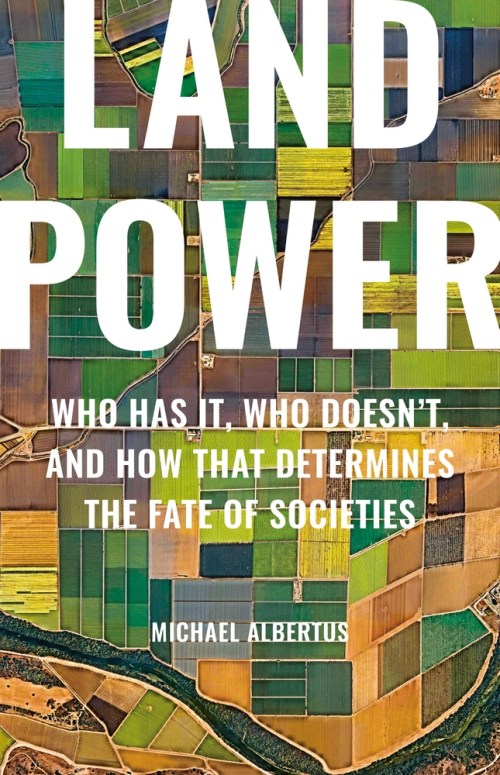
Land Power: Who Has It, Who Doesn’t, and How That Determines the Fate of Societies
By Michael Albertus
Basic Books
Published January 14, 2025


Makes one want to read this book! Thank you!