


In 1980, Haruki Murakami published a short story called “The City, and Its Uncertain Walls.” He was never quite satisfied with it, and never allowed it to be published in book form. But he eventually returned to it and wrote a book called Hard-Boiled Wonderland and the End of the World, a novel made up of two interlocking and connected stories.
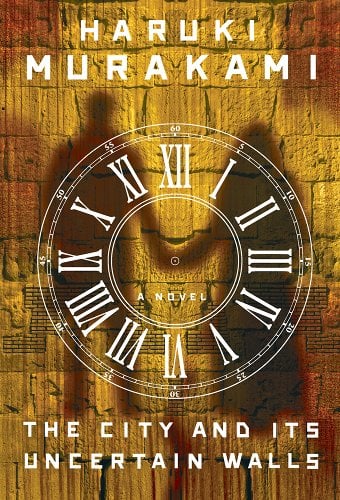
His newest novel, The City and its Uncertain Walls, has been described as a sequel, but that’s not quite correct. Instead it’s a mulligan of sorts, a second attempt at the same idea: a town living in a mysterious subconscious, a town where time doesn’t exist, no one has a shadow, unicorns roam the meadows, and the new guy in town’s only job is to go to the Library and read old dreams.
This new version is compelling. In Part One of the novel, a young teen couple is in love. They write the story of the Town together, sitting on park benches, lounging in the grass. The young woman is haunted by a deep clinical depression that has chased her all her life; the young man doesn’t know how to support her, but wants to try. They write letters back and forth whenever they can.
And then one day, the letters stop, and he decides he has to get to the Town they created — however he can.
This refresh of the Town is fantastic and rich. Murakami has cleaned up around the edges of Wonderland; old readers will be intrigued by the changes, new readers will be able to jump into this novel without having read the old one (frankly, it might help to have never read it). Murakami’s sometimes controversial treatment of women characters is refreshingly mostly absent in this novel, replaced by rich descriptions of changing seasons and unexpected visits by a local ghost. Murakami publishes this new novel with the help of his long-time translator Philip Gabriel, who has a knack for Murakami’s winding prose.
Our protagonist is convincing in his confusion and loss. It’s a romantic story that explores questions of what it means to live in the world, and of what time grants us. Would you live life differently if there was no time? Would you accept a life swept clean of pain or despair if it meant losing joy as well? If it meant watching a part of yourself die?
Unfortunately, Part One ends, leaving 318 pages still to go. What follows is a sometimes intriguing and often lengthy description of the man’s life once back out of the Town, unsure what’s real, seeking the small-town vibes he has lost. Sparks of wonder and emotional side stories illuminate the story around its edges, but it feels like the novel loses its way.
In the afterword, Murakami says he wrote Part One and “felt I’d completed the task I’d set out to accomplish,” left it alone for six months, and then wrote Parts Two and Three. That’s precisely how the novel feels. A delightful ghost librarian and our protagonist’s intriguing meditations on life can’t save the long, drawn-out descriptions of small-town life that never seem to go anywhere substantial.
Worst of all, the ending relies on a stereotype of a young anti-social “savant” with magical abilities who manages to skip over all hurdles with his magical powers of being different from the rest of us. The autistic savant is itself a harmful stereotype, leading to intense misconception and ableism. It’s also extraordinarily lazy writing: Murakami brings the loose threads together and repaves a road to the Town simply by having this young boy do it. At no point are the boy’s powers explained or the magic written out — the only explanation is that his autism, his difference, let him go and do it.

Even if this simplification could be ignored, the young boy’s reason for wanting to find the town brings all the problematic stereotypes to the absolute front of the novel. The young boy declares that he wants, desperately, to go to the Town, because people there feel no emotion—so he’ll belong. “I’m unable to feel sadness…I was born like this,” the boy says to our narrator in the final chapter. “But if I weren’t like this, and were a normal person, I’m sure I would feel sad at saying farewell to you.”
The boy is, the book tells us, not normal. He is emotionless, a stereotype that haunts many autistic people in the real world. Throughout this book, characters insist that life in the Town is not true, is missing something that makes us inherently human. The characters in the Town experience immortality at the cost of joy, despair, and ultimately, perhaps their very souls. Now we’re told this gifted autistic child belongs there. Whether superhuman and savant or emotionless and inhuman, these stereotypes emphasize that autistic people cannot live, dream, and love in our world, because on some fundamental level, they do not belong. And so Murakami’s exciting exploration of what it means to have a soul fizzles on the doorstep of lazy stereotypes.
Hard-Boiled Wonderland is one of Murakami’s strangest, most speculative works, and The City and Its Uncertain Walls does not carry on that legacy. Its new interpretations are interesting and romantic, but the novel as a whole would have been stronger if there were no Parts Two or Three. For this Murakami fan, it was at first an exciting rewrite, only to turn into a disappointing effort that has some beautiful writing mixed in with the confusion.
FICTION
The City and Its Uncertain Walls
By Haruki Murakami, Translated by Philip Gabriel
Knopf Publishing Group
Published November 19, 2024


thanks good review. btw it’s Philip Gabriel