


“You can only be the Revolution. It is in your spirit, or it is nowhere.”
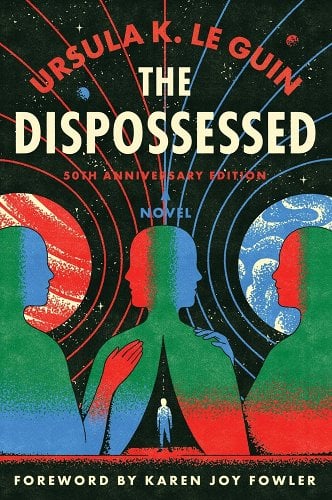
Ursula K. LeGuin’s The Dispossessed launched itself into the canon of literary science fiction immediately upon its publication in 1974. An early recipient of the coveted “Triple Crown” of science fiction, The Dispossessed won the Hugo, Nebula, and Locus awards for best novel. In honor of this classic’s fiftieth anniversary, a new edition is available from Harper Perennial with a new foreword by Karen Joy Fowler.
The Dispossessed is one of the tentpole novels in LeGuin’s Hainish Cycle, a series of seven loosely connected novels set in the same spacefaring universe a few thousand years into the future. Despite being the sixth book of the cycle released, it is set as the earliest in the series’ chronology. The novel focuses on the humanoid Cetians who, hundreds of years earlier, endured a great philosophical schism that sent a large number of settlers from their planet, Urras, to their moon, Anarres. Urras is a capitalist society where splendor and squalor exist side-by-side. Anarres, on the other hand, is a barren moon that struggles to support life; the people who settled there are anarchists determined to create a world built on social responsibility and mutual aid. The novel’s protagonist, a physicist named Shevek, who studies temporal mechanics, is the first Anarresti to travel to Urras since the schism. Invited by a wealthy university to study faster-than-light communication, Shevek’s culture shock is just what he needs to recontextualize his home and his place in the Universe. The novel flashes back and forth in time, weaving together Shevek’s past and present to build to a masterful climax.
The social and cultural reality of the 1960s and 1970s are all over this novel if you know what to look for, but it could just as easily have been written today. Issues of wealth inequality, censorship, climate change, misogyny, police brutality, and xenophobia are just as prescient in 2024 as they were in 1974. As Fowler notes in the introduction, “Many things have gotten better over the last fifty years and many things have not.” The subtitle in the original edition, “An Ambiguous Utopia,” reveals the central question pervasive to much of LeGuin’s work: “Can we change the goals of human domination and unlimited growth to those of human adaptability and long-term survival?” This question of Utopia would puzzle LeGuin’s work for the rest of her life, though The Dispossessed may be her greatest treatise on the topic. Simultaneously deeply philosophical and emotionally fraught, The Dispossessed can serve as a kind of cultural gospel from which to take refuge and hope in dark times.
The purpose of this novel is to challenge readers to reflect on our society. LeGuin’s work is, in this way, necessarily participatory. The prose is largely unadorned, but the narrative itself is, at times, dense and didactic. The non-linear structure of the story is an invitation for readers to grapple with the questions presented by the text. Ambiguity makes its way through this novel with persistence—ending on something of a cliffhanger that does not get resolved in some next book. I personally enjoy this narrative gesture, a nod to the subtitle and the complexity of the themes in the book, but I understand that such techniques are not equally effective for all readers.
I suspect I will be returning to The Dispossessed several times over the next few years, searching for some of the wisdom and insight LeGuin laid down for us fifty years ago. LeGuin’s prose is both elegant and straightforward, and the world she’s built feels as real as it does uncanny. This book is a must-read—not just for fans of the speculative genre—it is the gold standard of literary science fiction.
FICTION
The Dispossessed [50th Anniversary Edition]

By Ursula K Le Guin
Harper Perennial
Published November 19, 2024


