In his essay “Emily Brontë and Wuthering Heights,” Lord David Cecil asserts that “Emily Brontë’s imagination is the most extraordinary that ever applied itself to English fiction.” What, then, of Kathe Koja’s? With her Catherine the Ghost, Koja has taken our primary artifact of Brontë’s brilliance, the great gothic novel Wuthering Heights, and imagined, at last, a unique yet fitting voice for the novel’s tragic heroine, Catherine. Koja has matched the wild and frigid impact of Brontë’s novel with a knife-stroke straight through the middle; Catherine, long hidden, emerges fully formed here, and her ghost takes the novel’s famously mysterious haunted house and asserts herself as its mistress.
Koja, a living legend whose punk sensibilities and refusal to choose a lane have perhaps kept her outside the literary mainstream, fully commits herself to Brontë’s world here. Catherine the Ghost is indeed a companion to Brontë’s novel and not the sibling of Koja’s most well-known works. Where work like Koja’s The Cipher offers nightmare-inducing hints at what might lie beyond our mortal coil, Catherine the Ghost finds the titular, dead Catherine vividly sculpted into being. She is empowered and in love even in death.
“No one is safe from love,” Catherine tells us.
What a gift it is to gain Catherine’s perspective. For those of us who have waited to hear her side of the story, Koja’s version of it is both satisfying and surprising. The publisher has billed Catherine the Ghost as a “modern gothic punk remix” as well as a “feminist retelling.” While anything Kathe Koja does is punk and the book is certainly feminist, I couldn’t help but think of it as a companion to Wuthering Heights rather than a different “take” on the original story. In discussing one of his follow-ups to the His Dark Materials trilogy, Philip Pullman described his new book as “not a sequel or a prequel, but an ’equel.’” Cute language aside, Catherine the Ghost does have that “equel” energy. We are shown events from Wuthering Heights from Catherine’s perspective, and their tenor often changes or, in some cases, completely reverses.
Wuthering Heights is told primarily from Nelly Dean’s perspective, which keeps Catherine and particularly Heathcliff at a distance. This POV, of course, proves to be one of the vital components of the original, as the outsider view allows the reader to be enchanted and bewildered by the mercurial Heathcliff and to be unsure of Catherine’s sanity and feelings and, later, her presence as a ghost. Catherine the Ghost confidently places the POV with Catherine, however, and it is this shift that gives her an agency she lacks in the original.
The perspective is trickier than that, though, as the chapters are told in alternating first and third person. The first-person accounts are from the elder Catherine, the ghost, while the others follow Catherine’s daughter (also Catherine) in a close third person. These third-person sections use only pronouns for the younger Catherine, which is quite helpful when it comes to not confusing the two Catherines. More importantly, these close third sections are told with a familiarity that made me wonder if it was the elder Catherine narrating her daughter’s life. This overlap connects the two women in a way that was impossible in the original novel, and as such, it strikes a poignant chord—about the parent-child relationship’s ability to transcend death and time and even the rules of literature—and this chord is new and fresh to this telling.

In Wuthering Heights, both Catherines are caught in the hurricane of Heathcliff. In Catherine the Ghost, the elder Catherine comes into her power and pulls Heathcliff’s strings from the beyond, giving her agency. Catherine’s determined presence also lends the central love story an immensely satisfying depth and completeness that doesn’t dull the tragedy of the original telling.
“By God! she’s relentless,” Heathcliff proclaims in both Wuthering Heights and Catherine the Ghost. He is, of course, talking about Catherine’s ghost, but he could just as well be speaking of Kathe Koja, whose relentless imagination and mastery over her craft allow this dark and beautiful book to sit proudly beside its vaunted ancestor.
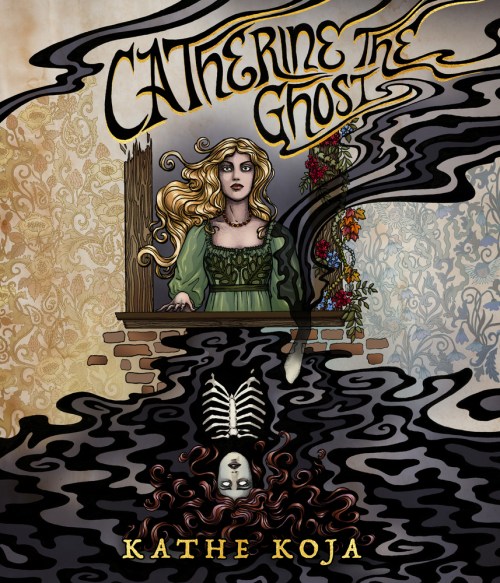
FICTION
Catherine the Ghost
By Kathe Koja
CLASH Books
Published October 15, 2024