


The Europe that emerged from World War II was beyond recognition. Over the course of the war, entire borders were redrawn, and the multiethnic lands of central and eastern Europe, where innumerable languages and faiths once overlapped, ceased to exist. But this shattered world was less the result of armed conflict than deliberate policy. In his masterful book, Postwar: A History of Europe Since 1945, Tony Judt wrote that Stalin and Hitler “uprooted, transplanted, expelled, deported and dispersed some 30 million people” between 1939-43. In the lands occupied by the Soviet Union, Stalin oversaw the deportation of entire peoples deemed untrustworthy, including Volga Germans, Chechens, Crimean Tatars, Koreans, and many others.
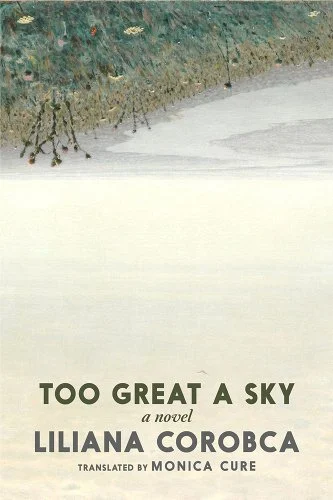
A testament to one such life, Liliana Corobca’s new novel Too Great a Sky, translated from Romanian by Monica Cure, is narrated by Ana, an ethnic Romanian girl deported from northern Bukovina (present-day Ukraine). Unable to share her story for decades, Ana is freed by the fall of the Soviet Union to finally turn to her past. “The times have changed, people can talk now, other things aren’t possible anymore, but people can talk,” she explains. With much of her family now gone, Ana shares her story with one of her great-granddaughters, whose own world seems unrecognizable. But as in her earlier novel, A Censor’s Notebook, which chronicles the paranoid inner life of a censor in Nicolae Ceaușescu’s Romania, Too Great a Sky exposes the utterly alien nature of a past that is not nearly as distant as it seems.
Corobca is masterful at revealing the horrors of a dictatorship that remains out of sight while infiltrating every part of its subjects’ lives. Ana describes her fellow deportees: “as reeds blown by the wind we are shaken by the storm of misfortunes and tomorrow’s uncertainties.” The novel opens with the Soviet Union’s occupation of northern Bukovina—a prize from the underhanded dealings of the Molotov-Ribbentrop Pact. Ana’s family, suddenly divided between Romanian- and Soviet-controlled territories, are landowning farmers slated for “dekulakization.”
Caught under Soviet control, Ana is only eleven when she and her mother are deported to the unforgiving steppe of Kazakhstan. Deprived of food, light, and air, they suffer on a weeks-long train journey, which is only a harbinger of what awaits them. The bodies of those who do not survive the crossing are simply tossed out alongside the tracks. But their arrival at “the end of the world” offers little respite. Subject to forced labor in kolkhozes and work brigades, the deportees must fight for survival. “Everyone was very poor and people would work their fingers to the bone for a handful of grain or a couple potatoes.”
What allows Ana to persevere is her faith, and her prayers and songs extend throughout the novel. After World War II ends, the lives of the deportees improve marginally: “They’d still take us out for heavy labor, but they’d pay us a few rubles for that.” Ana attends school to become a seamstress, which opens opportunities for more skilled work. In 1946, the deportees from Bukovina are allowed to return home, provided they can pay for their journey, but the death of her mother and an extended sojourn in Siberia to find a lost friend add years to Ana’s exile. Ten years after being deported, Ana begins a new life in Moldova, where she finds work, gets married, and hunts down traces of her scattered family. As a survivor, Ana becomes the keeper of her family’s history, passing stories down to her children, grandchildren, and great-grandchildren.
A historian herself from Moldova, Corobca showcases her thorough research in the rich details of Too Great a Sky. But despite Ana’s epic journey, the novel is not so much driven by plot. Rather, Corobca’s unembellished prose suggests a well-kept journal recounting one event after another as if to preserve a historical record. As such, the narrative sometimes wanders or drags. And even while Ana’s disjointed account intimates the fallibility of memory, the imbalance can feel untrue to life. The passing of her beloved mother gets the same amount of space as her hunt for a squirrel. And while much time is dedicated to her early years of exile, Ana’s husband is sketchily rendered, and her children, grandchildren, and great-grandchildren go unnamed. This disparity could be accounted for by age, but Ana’s memory seems unfailingly sharp.
Admittedly, Ana’s present day—after the fall of the Soviet Union—bears little in common with her youth, shaped more by consumerism and technology than deprivation. As Moldovan society finally turns to redress the past, Ana and other former deportees receive a “rehabilitation certificate” and a derisory compensation of forty-one rubles. What Ana actually wants is for her story to be passed on and remembered as part of history. But as shown by Russia’s ongoing deportation of Ukrainian children, Ana’s story is far from a distant memory. Instead, Too Great a Sky serves as a testament to geography as destiny, the seepage of the past into the present, and the resilience of human lives shattered by the machinations of distant centers of power—then as now.
FICTION

By Liliana Corobca
Seven Stories Press
Published October 29, 2024


