


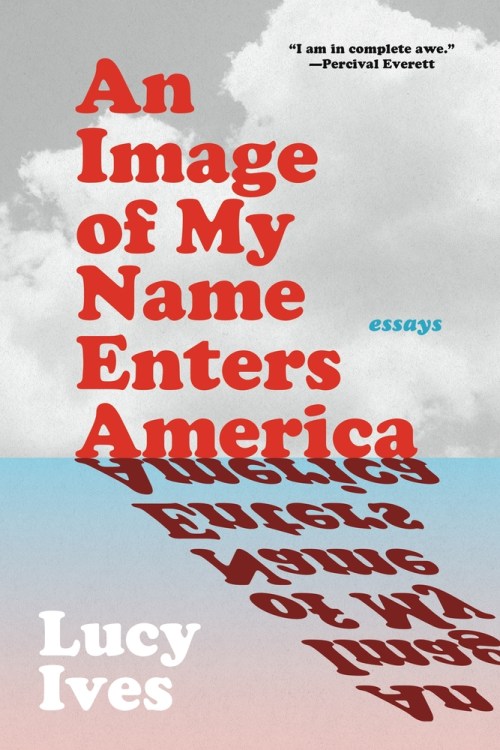
It is difficult to decide where to start when writing about a book as richly textured and expansive as Lucy Ives’s essay collection An Image of My Name Enters America, so I find myself defining by exclusion: there are some books that are easily digested, synopsized, analyzed, categorized, and put neatly back on the shelf. As my underlined, sticky-noted, dog-eared and re-dog-eared copy of Ives’s latest can attest, this is no such book.
Nor is it interested in being such a book, or passing itself off as one. As its title mysteriously (yet aptly) suggests, Ives’s vibrant and encyclopedic collection of linked essays tackles, among many other things, images, names, and family; it is as much an exploration of personal and cultural history as it is a mediation on the limits of language and the ontological questions of what it is like to exist (or, as Ives so nicely puts it, to be a “body in time”).
Framed by her experiences during pregnancy and childbirth, Ives borrows from the traditions of autotheory, memoir, cultural commentary, archival research, and even fiction in her prose. In these five well-footnoted essays, she explores subject matter as varied as astrophysics and lost tapestries, high school friends and Seven Brides for Seven Brothers, immigration history and road trips, exowombs and eschatology, My Little Pony and midwifery and television. And despite the wide scope of these essays, they are of a piece – they are complex, resistant to oversentimentality or too-neat conclusions, and slippery in meaning.
To Ives’s credit, these essays are more concerned with posing questions and following the resulting threads than providing answers; of course, we can no more expect clean, reductive solutions to some of the most fundamental problems of being to appear on the page than we can in life, and Ives is far too wise to offer convenient truisms.
One of the biggest achievements of this collection is the extraordinary energy and associative power behind Ives’s narration. Compositionally, Ives makes sweeping moves across time and space, never allowing room for stagnation. In “The End,” a list-like, philosophical abecedarian lives alongside scenes from Ives’s time as an undergraduate, rendered in present-tense habitual action that collapses temporal distances. In “The Three-Body Problem,” Ives recounts the physical and psychological experience of her labor, pausing at times to bring in niche but resonant details from science fiction or her research into the history of obstetrics. Ives’s deft command of narration is on display in this patchwork of modes – she recreates, reports, revisits, and rebuilds. She writes. And then she writes more, circles back, reimagines. When she reaches the limits of one manner of writing, she moves onto the next, often orbiting the same ideas but approaching from different directions. This fragmentation also complements the sheer complexity of topics Ives tackles – in an instructive passage from the titular essay, Ives writes, “You tell a story about a name not in order to remember everything anyone has ever known about it but in order not to entirely forget. For memory is partial. This is its form.” The collection is, in this compositional sense, a coordinated attack on the passage of time, an orchestration of language and a delineation of its constraints, more concerned with the act of telling than the destination.
Ives’s unmistakable voice unifies these sometimes disparate threads of story, within each of the essays as well as across the collection as a whole. Readers of her novels will note some definingly-Ivesian characteristics in her nonfiction prose – it is insightful, witty, and in on the joke; it is poignant, biting, and vibrant. It is sometimes elliptical but nearly always concrete. It delights in sound and image. On Freud’s “spectral phallus,” she writes “everyone wants it and no one has it!” Of the incompleteness of memory and the inaccessibility of the past, Ives draws on French philosopher Henri Bergson, stating it is “like looking for darkness within or underneath a beam of light.” Of a tumultuous period of depersonalization, she describes being “possessed of a nagging suspicion that [she] may actually be dead.” Though lofty, her prose is not didactic in tone; if anything, it teaches us how to notice the things we already see and how to think about things we already know, or at least think we do.
Ives also writes of language that its “most basic operation is… to cause us to believe that something invented is a given.” It is in these moments particularly, in which Ives confronts language directly on the page, that the work hits its most compelling stride. What can be said? What can be written about? What does language contain, and what is lost beyond it?
“Speaking of boundaries,” she writes almost offhandedly while describing a postnatal period of intrusive thinking, “this is actually the limit of what can be written down. I can’t describe the things I thought to you. I can’t describe them because I would have to choose – and the ways in which life has been extinguished from flesh before witnessing eyes and in private are too numerous to name in language.”

There is a sense throughout An Image of My Name Enters America that all writing is ultimately about choice — about deciding which words to use at the cost of not using others, about recording and documenting only fragments of infinite experience — because language is an ultimately limited and imprecise medium. If there is a central motivating idea of this work, it is that we simply cannot capture everything in words: something unnamable is always lost in the translation from life to language.
Thankfully for the rest of us, that doesn’t stop Ives from trying, bringing this remarkable achievement of a collection into existence along her way.
NONFICTION
An Image of My Name Enters America: Essays
by Lucy Ives
Graywolf Press
Published October 15, 2024


