


There’s that certain romantic essence of youth, when you first learn of nostalgia. You start to miss something before it’s even gone, whether a love or place. You begin to yearn for things you thought you hated. You discover contradictions. Romanticized adolescence is perhaps more intense when you’ve gotten used to drifting, trying to make a home only to see it disassembled and rebuilt somewhere else.
These are concepts André Aciman contended with frequently as a teenager. His Jewish family was expelled from their home in Alexandria, Egypt after the government under Gamal Abdel Nasser seized his father’s factory and the family’s assets. In his new memoir, Roman Year, the lauded author of Call Me by Your Name writes of his pivotal time living as a refugee in Italy with vulnerable hindsight.
“We were not once-and-for-all people… We were elsewhere people,” he writes. He struggled to tie the idea of home to a specific place, as places became unreliable. Even his family unit wasn’t completely reassembled in Rome once they arrived. His parents never got along, and his father, who had many affairs, decided to head to Paris instead of Rome to find work. Aciman, his younger brother, and his deaf mother suddenly found themselves living on crowded Via Clelia in Rome, in a cramped apartment that was formerly a brothel.
He felt displaced and desolate. He writes, “My mother was not a home, my brother was not a home, and Via Clelia certainly wasn’t home. They were all stand-ins, but I didn’t know for what.”
And there was a lot to sift through. Young Aciman had to translate everything for his mother, who had a bad temper, a “violent squall that could break through every bulwark thrown its way.” The family was verbally bullied by their relative, Uncle Claude, immediately upon landing in Naples from Egypt. He helped them avoid the refugee camp by picking them up from their ship, and yet berated and insulted each of them on the ride to Rome. “Never in my life, before or after, had I known such abuse,” Aciman reflects.
“The trouble with abuse when it is dealt so implacably is that it leaves a mark, and you end up believing it… I always had the feeling that he had seen through me and assayed every shortcoming, every failure, real, imagined, or yet to come, and from these there was no hiding.”
Passages such as these move Aciman’s reflections beyond mere teenage dreaming. They speak to any age. It’s always a fear that others will see our flaws, as is feeling alone and adrift.
Aciman discovered and explored his sexuality during his Roman year, learning that his attraction was not limited to one sex. At the same time, it is clear he was enmeshed in a sexist culture in the 1960s (which, unfortunately, is not much examined here). He and his family attended his cousin Toto’s wedding, and Toto told him he’d slept with some of the younger women present. Aciman thought, “I didn’t believe him, but it was refreshing to hear him belittle his own wedding.” Why was this so refreshing, exactly? Did this thought come from Aciman’s impression of his parents’ unhappy marriage?
Another older male cousin, Jules, took Aciman to a brothel in Paris. He retells his encounters with sex workers as key moments that shaped his desire, and yet lacking is the accompanying acknowledgment of the girls in any consequential way. It would have been meaningful for Aciman to empathize more with the people on the other end of his early sexual experiences. And yet, maybe that’s adolescence.
Aciman writes that he wasn’t just one way or wanting just one thing. “I wanted to attend university courses, but preferred learning things on my own, promised to make a fortune for my parents but was incurably reclusive and bookish, was Jewish but celebrated Christmas, had a mother tongue I loved but had acquired another I grew to love more but knew far less.”

These tendencies to live in gray areas may have driven him to live in literature and even become a writer. As with the shame he felt in scaling down a few social classes in Rome, his feelings and circumstances weren’t black and white. He says his family “loved in-between points,” those gray areas. So much was uncertain and yet his memory is so sharp. He paid attention to everything so that, maybe, when things made more sense, he could finally see how his Roman year altered him forever.
Aciman visited his father in Paris in a memorable section of the book, when he began to fiercely love Europe’s intrigue. Like his father, he is sentimental. He says, “Like him, it is in echoes, not in things themselves, or in places, much less in people, that I find my true alignment to life itself.”
Aciman’s elegant narrative is an echo of the in-between, the blurred passage into adulthood. He began to uncover an identity in the romanticism of European cities. He says that “Rome never asked to be loved,” and yet he learned to love it—for its flaws and for its holding of his family in their pain and displacement.
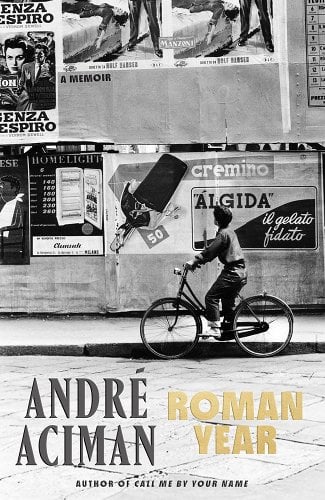
NONFICTION
Roman Year
by André Aciman
Farrar, Straus and Giroux
Published October 22, 2024


