


Rebecca Little and I met in 1996 as Freshmen at Albion College in Michigan. The campus was small; we lived in the same dorm and were both English majors—being friends seemed a given. But I was drawn to her for reasons beyond proximity. She was smart and funny, and her wit could bite. When I learned that she had co-authored the book I’m Sorry for My Loss: An Urgent Examination of Reproductive Care in America with her lifelong friend Colleen Long, I knew the book would provide a sharp perspective on a topic that has dominated the news cycle since the reversal of Roe v. Wade. What I didn’t expect was for it to be funny.
Rebecca and Colleen met in fourth grade at Catholic school in Chicago. They became journalists and the parallel track of their lives continued when both lost babies past 20 weeks of pregnancy. I’m Sorry for My Loss is equal parts memoir, history book, and satire.
We spoke via Google Meet to discuss cowriting, establishing a strong narrative voice, and what it was like to write the book in the aftershocks of Roe’s fall.
The conversation has been edited for clarity and length.

Sara Maurer
There is a distinct and consistent narrative voice throughout the book. It’s wry, a little sarcastic, and always funny. What effect are you hoping that has on the reader? And how did you achieve that consistency between two writers?
Rebecca Little
It’s our authentic voice. This is how we talk to each other. The conversation around grief is very gentle, and it needs to be when you’re in the fog, but then the euphemisms just become phony. But we were very careful—and we discuss this in the authors’ notes—there were no shots directed toward the people we talked to. We take shots at each other and historic figures, but at no point were we dunking on anyone who was telling us their most tender tales.
Colleen Long
I felt like this project could succeed because Rebecca and I have a very similar sense of humor and a very similar writing tone, which is unusual. What we did with the proposal was to really refine the tone more than anything else, so that when we were selling the proposal to agents, we were giving them a personality instead of a topic. The topic is very, very challenging and so what we were trying to do was tell it in a way that was super compelling and really easy to digest. So, the tone was the first thing to come and then once we figured out how we were going to write about it, everything else became really simple. When I was working on chapters, I would ask myself, “How would I say this to Rebecca if I were telling this to her?”
Sara Maurer
This is a big book. Not just in number of pages, but scope—you cover colonialism and even reference ancient Egypt and Greece. Why was it important to look at the wider historical context of pregnancy loss in America, rather than focusing on your personal experiences?
Colleen Long
When we were looking into writing about this topic, we ran the field to see what resources for grieving families were out there. What’s available are memoirs, self-help grief books, and a historical subset on miscarriages. What we didn’t see was a book linking all these things together. The “why” was missing. We wanted to link these disparate pieces together in order to really understand women’s healthcare. Because what we see now is how the lack of understanding about women’s healthcare has led to worse healthcare for women.
We have removed everything that isn’t a perfect pregnancy or a very specific abortion—ending an unwanted pregnancy at a very specific time for a very specific set of reasons. Everything else just doesn’t exist, but this gray area is so large it’s the bulk of pregnancies. I’d like more people to understand the gray area.
Sara Maurer
How did the reversal of Roe v. Wade affect the scope of the project? Was anything derailed or amplified? How flexible did you have to be and how did you make decisions along the way?
Colleen Long
The way we altered the proposal was to create a throughline on how the fall of Roe would affect pregnancy loss and why we think it affects pregnancy loss in a very outsized way, especially because the effect of Roe’s fall on pregnancy loss was not even part of the initial discussion.
Rebecca Little
The scope of the project got bigger after Roe fell, and as we did interviews. We added the section “Loss in the Workplace” because in every interview, people were talking about what a pain it was at work after a pregnancy loss: like how to get time off, how to get insurance coverage, how to get leave. The “Sick and Dying” section got bigger pretty much anytime a news story dropped during 2022. It was like, “Okay, we’ve got to talk about this, we’ve got to add this.” It just kept ballooning because it was happening in real-time.
Colleen Long
And I think we needed to explain the stakes. The reason we included information about “When Pregnancy Loss is a Crime” is because we wanted people to understand why this matters, why it isn’t just about feeling sad about the pregnancy loss. There are big stakes that go far beyond someone’s personal feelings about loss.
Sara Maurer
Chapter 1 begins: “Nobody throws a fetus shower,” highlighting the chasm between the clinical word fetus and the emotional word baby. In your research, what did you learn about how language relates to power and reproductive care?
Rebecca Little
Language was one of the first things we knew we were going to talk about in the book. We don’t talk about other types of healthcare the same way we talk about reproductive health. People aren’t talking about kidneys in the same judgmental way. We already have this culture that sees miscarriage as a failure, then you’re told your cervix is incompetent or your ovaries are lazy. It makes people feel really bad about things they have no control over.
Sara Maurer
The book is about a very difficult subject. How did you sustain the research and writing practice, especially given your own personal experiences with loss?
Rebecca Little
I do think this is where the partnership really came in handy because I didn’t have to explain anything to Colleen. I could say, “I just talked to a TFMR [termination for medical reasons] mom,” and Colleen was like, “Got it.” I didn’t have to explain it. So, I think the partnership made a big difference in being able to process that stuff.
Colleen Long
As a reporter, I have covered a lot of really bad stuff. You just sort of go into reporter mode. You think about how you’re doing your work for the greater good. Like, I’m going to listen to this and it’s going to be bad and I’m going to feel really bad about this and I’m going to feel outraged, but I’m going to put it all together and maybe it’s going to do some good.
At the same time, it was so fulfilling. It was such a great way to do journalism. It was research we both found really fascinating, even though it was hard. It was really interesting and we knew we were on to something. I really value this whole process. It was the most rewarding professional experience I’ve ever had.
Sara Maurer
Ever since Roe v. Wade was reversed, the utterly intimate has entered the public square. How do you think sharing stories changes public perceptions of reproductive care?
Rebecca Little
Women constantly have to audition for humanity. They have to lay their traumas out there to say, “I’m a person who matters.” It’s terrible, but the flip side of that is you can’t have empathy for people whose stories you never hear. So, two things we took into account when collecting stories for the book is, one: the volunteer bias. People didn’t come to us with their stories unless they were ready to tell them. The people who were ready to tell it were so articulate and had given this some thought. Two: some people never want to tell their stories because they didn’t want people to view them as their trauma. So, I do think that there is a tension in those two things. Both are true and important, and so as with anything, it’s about choice. Are you the person who wants to tell your story? Then you should. No one should compel you to tell your story. It’s just as valid to get through it and survive and live your life.

Sara Maurer
Who do you hope reads I’m Sorry for My Loss?
Colleen Long
I think the people in power need to read the book. It isn’t a political book. We don’t actually talk much about politics except how it has come to affect how we view pregnancy loss. But I think it would be really useful for the people in power to read it to give them understanding of what is going on. Not just what is going on, but why this is the way this is.
I would also really like it if men read this book. We figure this book will resonate with people who have given birth, with people who are trying to get pregnant, but for non-birthing partners and especially for men, I just really hope that they would read it too.
Rebecca Little
I have a couple of wishes. I hope anyone who said Roe wasn’t argued on a good legal basis and who thought that was a good enough reason to overturn it, reads the book. There are actual stakes behind this—human stakes.
And I think it would be good if this book was read by people in medicine. If we can bring miscarriages more into the conversation, then when it happens, people will feel like they can talk about it without someone saying something invalidating back to them. Miscarriage is never mentioned until you have one. Not that I’d want every positive pregnancy test to come with someone warning you, “It may not work out!” But it can be a conversation like, “This is going great, everything looks great, but if you feel this, this, or this, let’s have a phone call.”
Sara Maurer
I’m curious how you approached writing together. How did you decide who wrote what, who interviewed whom? How did you work through differences of opinion? Most importantly, how did you remain friends through it all?
Rebecca Little
We knew we wanted to talk to loss parents, we knew we wanted to talk about how abortion had sort of been cleaved from the spectrum of women’s healthcare, we knew we wanted language in the mix. From there, we asked each other what is connecting with you the most, what do you want to look into? And we split up the research. Once we wrote half the chapters, we would send them to the other person. It was actually kind of great because when you were like, “I cannot look at this for one more second,” the other person came at it with fresh eyes.
Colleen Long
I wouldn’t have written this book with any other person. For us, a bunch of different pieces existed in place: we both had this experience, we are both journalists, we both have a similar way of thinking and talking about this stuff, and we both have a very strong work ethic. All of those things had to be in place in order to do this. We really benefited from coincidence in a lot of ways. It all kind of fit together, you know?
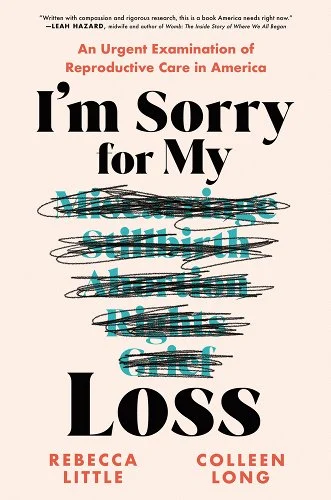
NONFICTION
I’m Sorry for My Loss: An Urgent Examination of Reproductive Care in America
by Rebecca Little and Colleen Long
Sourcebooks
Published on September 24, 2024


