


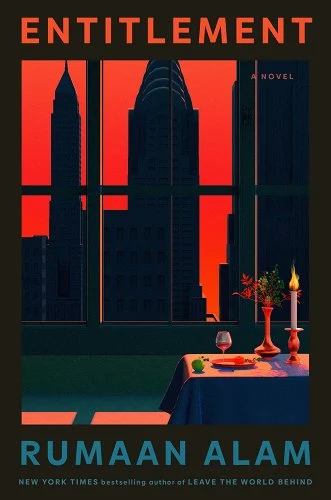
Rich people are beholden to nothing but their own whims. It’s one of the many privileges of wealth, like owning great works of art or not bothering to know the names of your staff. The quirks of the rich have been a central theme in the novels of Rumaan Alam. In his latest novel, Entitlement, Alam pits the wealth of billionaire Asher Jaffee up against the yearnings of Brooke Orr, an upper middle-class black girl raised in Manhattan.
Wealth, class, and race have been favorite topics across Alam’s previous novels. His debut, Rich and Pretty, followed the friendship of a middle-class girl from New Jersey and her wealthy friend from Manhattan. In That Kind of Mother, an upper class woman adopts her nanny’s child alongside her own biological one, in a narrative twisting race and wealth. And in Leave The World Behind, his breakout literary thriller bestseller, the privilege of wealth is interwoven in the critique of race and class.
Entitlement looks at an even greater level of wealth. Asher is worth several billions of dollars, far more than the previous characters Alam has created. He’s doing more than raising the stakes. Asher Jaffee is reminiscent of many of the billionaires in existence today—older, white, and clinging to the mythology of being self-made men. Asher, having inherited a business supply store from his uncle, grows the enterprise through vertical and horizontal integration, and now in his twilight years has created a foundation to burnish his legacy.
The book opens on Brooke Orr traveling by subway to a meeting at the Jaffee Foundation. The subway, delayed, makes her late. A police investigation has held up the train—an all too common occurrence these days, and not out of the ordinary. But stalking the subway riders in Alam’s New York City is a serial jabber, someone pricking young women with a syringe. With this, Alam has unlocked a new fear for all New Yorkers. Brooke slowly becomes obsessed with the ongoing threat.
Brooke is the new girl at the foundation, but Asher takes a liking to her, and leads her to believe he’ll fund a project if she identifies a worthy cause and writes a proposal. She does: an arts program in Brooklyn, which she hopes to fund with millions, though they are reluctant to receive the blessing.
At the heart of this novel, as with all of Alam’s work, is the core relationship between two people, in this case the tension built around Asher and Brooke. Asher lost his only daughter on 9/11. She worked at Cantor Fitzgerald, a financial firm at the top of the World Trade Center, and the attack cut short her life, and tragically, the career where she would earn millions. Asher’s wealth allows him anything he wants, except to bring his daughter back.
Brooke is positioned to fill the void as the daughter he no longer has. Having grown up in Manhattan, she has her own status, privilege, and while significantly less wealth, is far from impoverished. There is, afterall, a certain level of privilege required to take a nonprofit job and pay New York City rent (although she has a very good deal, her mother notes).
This relationship between Asher, employer, and Brooke, employee, is not so cut and dry. He’s given her an assignment with a lot of power, and favors her, but it’s unclear what his expectations are, or hers. Is Brooke seducing him? Is their mutual attraction sexual? Is Asher merely trying to be a mentor in business or trying to replace his daughter who died? There is ambiguity in the way Alam builds their relationship, and Brooke sees it too.
Alam’s critique of the billionaire class is heavy handed. Asher’s foundation is aimless, continually seeking a cause to back on his whim. He’s reluctant to turn over money to the Ford Foundation, his pledge to give away his wealth is rescinded, and he’s really trying to buy a Medal of Freedom. He explores the idea of changing the world, making meaningful improvements to people, yet gives more money to funding oysters than the black children in Brooklyn who Brooke wants to fund.
The novel is timeless in a sense. It’s set vaguely in the recent past, before the Trump presidency that accelerated the country’s wealth disparity, before the pandemic. A reference to former New York mayor Bloomberg and Asher’s reluctance to receive the Medal of Freedom from the next presumed president, a hint at Hillary Clinton’s campaign, intimates without defining a certain time and place. The choice weakens the novel’s critique of wealth by removing it from the present.The billionaires of today seem so much worse, so much less redeemable than their counterparts even a decade ago. People who were merely oligarchs have since warped into supervillains.
Entitlement is not a thriller. It does not jolt or shock or awe in the way Leave The World Behind ignited every chapter. Instead, the narrative slowly burns with cultural criticism. Wealth is on trial. Brooke’s proximity to Asher’s wealth is like Frodo’s possession of the one ring; the mere presence corrupts her soul. Her entitlement grows the more she is surrounded by wealth, and ultimately she concludes, “Money was everywhere, and it was a failure of Brooke’s imagination not to understand this.”
Brooke understands the best way to separate Asher from his money is to provide him with the story he wants to hear, and concludes he wants “the story of Black kids with Black problems.” If she can play to his guilt, his sympathy, she believes she can obtain the money for the Brooklyn arts program, and even for herself.
But black women are invisible, Brooke realizes. Asher hosts a party inviting employees and the recipients of his foundation’s largesse. Lost in the mansion, Brooke comes across Asher’s wife, who confuses her with the hired waitstaff. Brooke blends in with the servants hired to serve Asher’s guests, and she literally becomes a waitress herself, cleaning up spilled drinks and serving crab cakes.
Nobody seems to notice her transition from guest to service employee. But in the end, isn’t that all she was at the foundation? Asher, on a whim, un-gives a billion dollars allocated to the foundation so his wife can have an inheritance. He gives money to the Ford Foundation so he can stop worrying about disbursing it. To Brooke’s cause, he tosses a measly $10,000 to the Brooklyn arts program, a rounding error. Brooke might wear nicer clothing, might aspire to comfort and ownership of an apartment, but she is in the end, to Asher at least, no different than the wait staff cleaning up dishes.

There is more to Entitlement, of course. Alam has packed plenty into this book. When Brooke’s close friend Kim pays cash for a Manhattan apartment, she triggers Brooke’s belief in her own entitlement. Kim has also kept the extent of her wealth private, a secret even from her two friends. Alam also explores the idea of family, and chosen families, through Brooke’s mother and her aunties. There are layers upon layers stacked on each other, and to Alam’s credit, it never feels that way.
Entitlement simmers slowly, boiling over in the final chapters, unraveling the carefully crafted relationships established over the course of the novel. It’s a novel to ponder, to think about, and there is plenty to consider about wealth and the privilege that comes with it. There is less mystery and less suspense than Alam’s previous novel, but that is not the point, since we already know all the great things we would accomplish ourselves if only we had a billion dollars lying around. The pleasure is in watching that wealth unravel someone else.
FICTION
by Rumaan Alam
Riverhead Books
Published on September 17, 2024


awesome blog
I fell for a scam broker, and lost a lot of money. I searched for a way to retrieve my lost money back and I got a recommendation of Expert Bernie Doran. Their expertise and professionalism in navigating the complex process were truly commendable. I have been able to recover all my lost crypto/funds and made $10,000 – $20,000 profits not just by buying the dip but implementing trades with signals supplied by Expert Mr Bernie Doran, I am glad I was able to recover my lost funds successfully . He can be reached on TELEGRAM – IEBINARYFX or Gmail Berniedoransignals @ gmail. com