


In her highly anticipated new book The Body Farm, award-winning author Abby Geni provides a gripping collection of stories that take an empathetic and unflinching look at the horrors and joys of inhabiting our bodies, in various states of illness and rapture. As with The Wildlands and The Lightkeepers (which won the Chicago Review of Books’ inaugural fiction award and the Barnes & Noble Discover Award), Geni shows once again that she is unafraid of exploring the darker sides of humanity, and our sometimes fraught relationship with animals (and each other). But even at their most disturbing, her stories help us relate with her characters, our own bodies, and the natural world that surrounds us outside her lyrical pages.
I happened to be reading one such story, “Petrichor,” while recovering from my first case of COVID-19 this spring. It was perhaps not the best time to read about a fictional woman who loses more than her sense of smell after contracting a familiar-sounding pandemic virus, yet I found myself appreciating my own sensory experience, the simple pleasures of the environment around me, all the more after reading it. My own body felt more alive. That is the gift Geni gives us again and again in The Body Farm.
A Chicago book launch is forthcoming on Wednesday, May 8 at 7 p.m. CT at feminist bookstore Women and Children First, where Geni will discuss The Body Farm with author Frances de Pontes Peebles. Registration for this free event is available online HERE.
I spoke with Geni recently about her new book and the inspirations behind these stories.
This conversation has been edited for length and clarity.

Elizabeth Niarchos Neukirch
In The Body Farm, similar to your other books, there’s an exploration of humans’ wonder at the natural world and animals, and how our interactions with nature can help us process the complexities of being alive—whether that is painstakingly recreating a willow tree in stained glass while caring for a partner with dementia (“Childish”) or obsessively learning about porcupines and their ability to overcome the dangers of their own bodies, in the aftermath of a suicide attempt (“Porcupines in Trees”). Can you speak a bit about how nature has inspired your writing, and specifically these new stories?
Abby Geni
We don’t get to choose our passions, they choose us—and a passion of mine has always been the natural world. I’m fascinated by biology, by the science of how plants grow, how animals evolve. I think we forget that we are animals. We act like we’re not part of the natural world and that’s a source of a lot of the pain and emptiness that many people feel, that we are placeless or we don’t have an identity as part of something greater. And so I’m fascinated by the questions: How do humans interact with the natural world? How are we the same and different from animals? How can the natural world offer us gifts and give us a place in a way that nothing else can?
Elizabeth Niarchos Neukirch
Were there any stories in this collection that started with your own interest in the topic, going down a rabbit hole about a particular animal or natural phenomena?
Abby Geni
I’ve become one of those people that other people give books about animals to, and [they] also send me videos. I’m always getting videos of octopi, and I’ve always seen the videos before. But my brother gave me The Private Life of Sharks for my birthday a long time ago, and I thought, “Sharks! Sharks are cool.” I wrote about sharks a bit in The Lightkeepers, but I knew a lot more about them [than what I included]. The first story in this new collection is “The Rapture of the Deep,” which is about a woman who is a shark tagger, and I wrote a version of that when I was still at the Iowa Writers’ Workshop many years ago—but I didn’t really know the character, I just knew that her interest was sharks. Once I found the character, the story came together.
Elizabeth Niarchos Neukirch
Another thing I love is that there’s a real physicality throughout the book, in terms of how the stories look at the body, what it can carry and withstand, the transformations that it can undergo both for the better and for the worse—from experiences of pleasure to illnesses and substance abuse. Was this always an intended through-line for The Body Farm or did some of the focus on the physical self emerge as you worked on the individual stories?
Abby Geni
I always knew that I wanted to write about different incarnations of our physical selves. I think we forget that we are our bodies. I was interested in that and exploring our relationship, our separateness, and our inextricability with our physical selves. And also we go through such incredible transformations. I have a child who is 11 now, and I remember a friend of mine saying that women should talk about childbirth the way people talk about surviving whitewater rafting or climbing a mountain or deep sea diving even, it’s this phenomenal thing that our bodies do that we’re just like, “It’s a miracle!” Any woman who has been through it knows that it is this harrowing ordeal that takes everything you have. And so I was thinking about how we talk about the body and how different the body is, in different ages and different kinds of illness and in recovery. We live in these magical creations that we take for granted.
Elizabeth Niarchos Neukirch
Were there any specific inspirations for the ways in which you chose to explore the body in the stories throughout this collection?
Abby Geni
The first story that I wrote for the collection was “Childish,” the story of an elderly man caring for his wife who has dementia or Alzheimer’s. As her health and her mind disintegrate, he’s caring for her while making a stained glass willow tree, this beautiful lampshade. I wrote about that because that was my grandfather. He was this typical war veteran, a tough guy, his wife was supposed to cook his food and raise his children, and he took her for granted and he made all the decisions in their house—and then she got sick and he refused to put her in any kind of home, just cared for her on his own in this tender and delicate way that was so gentle and so loving. It caught all of us by surprise because that’s not who we knew him to be. And he was also a stained glass artist, he made these beautiful stained glass pieces, including this willow tree that I used to love when I was little. It was huge. When I was a small child this lampshade was as big as I was. And so I was thinking about the lampshade, and thinking about him out on the sun porch cutting these pieces of glass, and thinking about him watching my grandmother. And the way that she still knew him. You know, no matter what changed, she knew him and he knew that, and it was this very powerful thing. To process it, I wrote from his point of view.
Elizabeth Niarchos Neukirch
That is something you treat with incredible empathy and care throughout this book, exploring the body’s relationship to the mind, whether that is dementia or neurodivergence (“Selkie”), or the increasingly disturbing neurological symptoms of an illness (“Petrichor”). You mentioned that we are not always consciously aware that we are our bodies, this sense that there is a magical and delicate connection between the mind and the physical self. How did you think about that as you were working through this book?
Abby Geni
Nobody can define what our consciousness is, nobody can explain why we are sentient. It’s part of the body, and it’s also something more rarefied and stranger, the fact that we think and that we feel. I am fascinated by the ways that our minds and our bodies work in sync, and the ways that they separate from each other. And there are several huge transitions that the mind goes through: there’s one in infancy obviously, as you learn language; there’s one in puberty as you become who you’re going to be; and then a friend of mine, who is a neurologist, was saying that there’s another one that happens in your 50s or 60s. They don’t know why, but they suspect that it’s the onset of wisdom.
My grandfather—whose body was failing him—was in his 90s, but his mind was just as sharp as ever—and [in my story] “Porcupines in Trees,” there’s a woman whose body is healthy and her mind is sick. And people who are neurodivergent, you know, there’s nothing wrong with their mind, their mind is just functioning differently than most people are used to. It’s just a different fascinating structure that the mind and the body inhabit together. The sort of push-pull of sentience and physicality is an intriguing tension to me.

Elizabeth Niarchos Neukirch
In “Selkie,” a young girl accepts her neurodivergent sister for exactly who she is, and wants to understand her in this loving way, despite the fact that their parents are troubled by the challenges of caring for her. There’s something really beautiful about that, a child being able to more easily accept someone who adults with their assumptions cannot see as healthy in the same way.
Abby Geni
Thank you. I actually worked as a counselor for a summer camp where all the kids were neurodivergent, many were nonverbal and some were in wheelchairs. There was a girl who was nonverbal and didn’t have full control over her hands, and the way she would draw is she would hold the wrist of another person and they would draw the shape. So that’s something I ended up putting in the “Selkie” story: I was teaching her to draw a star and she was holding my wrist and moving it, and I realized nobody outside of us could see when I was in charge of drawing the star or when she figured out how to do the shape and was the one controlling my hand. It was this completely silent communication, invisible from the outside, which just made me think about the ways we talk to each other.
Elizabeth Niarchos Neukirch
How did you decide on the title for this collection?
Abby Geni
I read Stiff [by Mary Roach], a book about death, and the author wrote a little bit about body farms and I was like, “What is that?!” So I think I always knew that there was going to be a body farm in my book, which is a place where they study death and decay. And I thought, wow, walking among dead people and just experiencing the body without the mind… I was always interested in that. But it’s also the body: what is the body, who are we as bodies, in the farm that is our humanity? The title story of this collection, “The Body Farm,” is one of my favorite things I’ve ever written. I found that character and I found that world so easily, they were just waiting for me. It ended up getting published as a standalone in Epoch, which surprised me because it’s so long for a short story—but it’s one of my favorite stories and it felt like an appropriate title for this particular collection.
Elizabeth Niarchos Neukirch
What do you hope readers take away from The Body Farm?
Abby Geni
A renewed sense of closeness with their own bodies and interest in their own bodies. We should never take ourselves for granted. And always in my writing I want people to remember their connection to the natural world, and to reexamine their connection to the natural world.
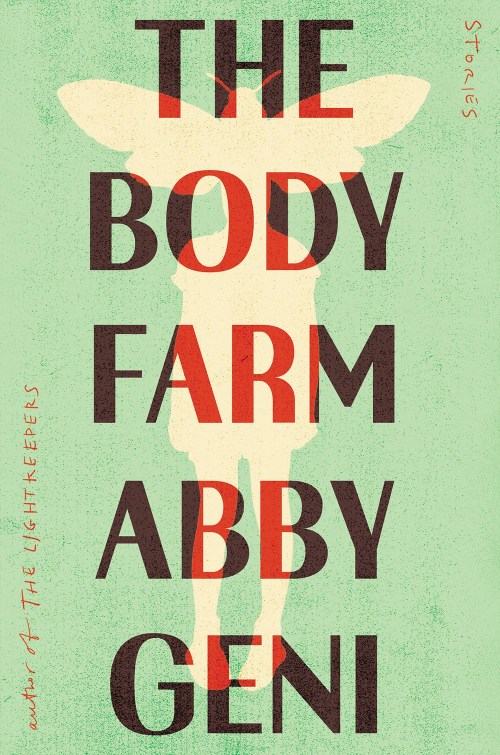
FICTION
The Body Farm
by Abby Geni
Counterpoint
Published May 7th, 2024


