


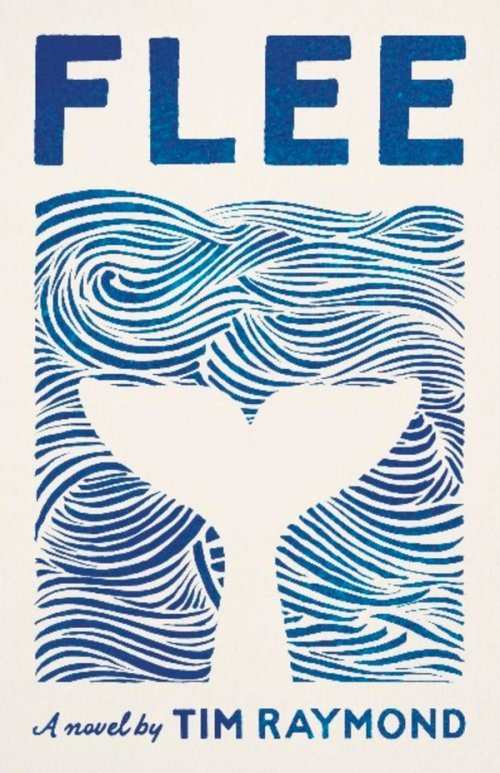
Set in the foggy aftermath of the pandemic, the debut novel Flee by Tim Raymond introduces readers to an alternate world dissolved by the rapid spread of Novel Aquatica, a virus with the capability of transforming infected individuals into beluga whales. The plot follows former ESL instructor Jensen Fisher, a person with autism in his late thirties, as he is forced out of the comfort of his apartment in South Korea and into the responsibility of caring for one of his students, Min-kyoung, after she loses her mother to the virus. Simultaneously urgent, funny, and heartbreakingly reflective in its memories, Flee is about the everchanging landscape of loss and how to rediscover peace within oneself.
The plot strings together elements of autofiction, climate fiction, and something akin to a post-apocalyptic survival journal, all while maintaining a feeling of reminiscence, love, and mourning. Raymond identifies as an autistic, nonbinary writer based in South Korea, and they sincerely reflect aspects of their identity into our narrator, such as the concept of social masking, stims, and thought patterns associated with what a person with autism can experience. The story opens with a hark to Herman Melville as Jensen states his name and the intent for why he sets out to tell his journey. As Jensen and Min-kyoung quickly realize they cannot stay in Jensen’s apartment, the two set out with Jensen’s cat Ori on a roaming quest to find a means to keep living.
Memory and forms of coping are peppered throughout the novel. A love for videogames helps both Jensen and Min-kyoung navigate the turmoil of a world plunged into demise. Jensen references characters from games like Zelda: Breath of the Wild and Hades as the two search for food in abandoned malls or consider routes of survival along the mountainside. As the group encounters survivors, Jensen flashes to experiences with family members he has lost connection with or moments with his wife Yoon, who passed away prior to the events of the novel. Interacting with strangers throughout their travel has Jensen recounting how he was sometimes misperceived in his autism with talking to people prior to the spread of the virus. And yet, Raymond excels in showing the beauty and creativity and resourcefulness abundant in people with autism. In one leg of the journey, both Jensen and Min-kyoung talk to and care for a woman who is infected and mutating into a whale. As the woman loses speech and terrestrial mobility, Min-kyoung reassures her and helps her move to a nearby river.
The organic nature by which the memories ebb and flow feels akin to our reality, wherein the thoughts of the past are sometimes used to inform our present or, alternatively, how memory can intrude, harm, or distract us entirely from goals we set out to achieve. Often, chapters begin with a recollection of a time before the pandemic or find themselves slipping in between Jensen and Min-kyoung’s conversations. Mostly effective, the direction was temporarily lost and disoriented a few times until Jensen is pulled back to the present through means of the plot.
Romanticization of Korean culture is touched upon, but could have been fleshed out more in Jensen’s reflections of his time in the country. On rare occasions, Jensen may generalize or discuss elements of the Korean language in a manner that feels glamourized. At one point in which the author Raymond counters this, Min-kyoung cautiously points out to Jensen how a cluster of survivors intentionally chose foreign representatives to lead the two around their encampment. She believes the survivors do this to convince Jensen, the perceived adult and foreigner in the situation, of the encampment’s safety. Less attuned to the nuances within Korean culture, Jensen is brought to this observation by his former student.
Like memory, themes of isolation, familial dynamics, and placelessness shift and come in and out of focus across Flee. What does home mean when someone finds themselves in a lifestyle of constant relocation? How does grief both connect and separate us from one another? As people form relationships or pull away from our lives, how do our siblings and children and lovers move with them? Raymond’s storytelling—whether it be of sailors sharing their travels, people surviving and describing illness, or immortal videogame characters trudging through the afterlife—can help represent alternate or marginalized perspectives and reveal how what appears to be a stable ground of self-understanding may actually be an unfathomable sea of learning and relearning.
FICTION

by Tim Raymond
Button Poetry
Published on November 24, 2026


