


Richard Russo’s new novel, Under the Falls, should strike his longtime readers as both a departure and a return. The book bears many earmarks of a thriller, with its rapidly mounting aura of menace, its deadly car crash, the slowly unraveling mystery of the crash’s cause, and the reasons the local police chief may be covering it up. But in true Russo fashion, it’s not just crime and corruption that stalk this story; it’s the trademark, unerring, deep sense of place Russo evokes like few other writers.
Under the Falls brings Russo back to familiar territory: the left-behind, working-class, post-industrial towns of upstate New York’s Adirondacks region. Russo has spent much of his career revisiting this area in his novels, reimagining his hometown under various aliases, and creating indelible characters strongly tethered to their environment. All the while, Russo has maintained his personal ties to his native Mohawk Valley though he’s lived elsewhere for nearly 60 years.
His new novel’s opening chapter kicks in with the homecoming of an artist who has made a much cleaner break with his hometown and his past than Russo did. Tyler Sinclair, a hugely successful Nashville-based singer-songwriter, returns full of dread for a one-off gig in Stone Mountain, the town he fled 18 years earlier without a word to anyone, and has cut off completely ever since. Yet he’s made it with a band named after the town, and Stone Mountain has featured prominently in his biggest hits.
Though his manager and others expect Stone Mountain to welcome Tyler back as a favorite son, the town he left behind greets him with anger and resentment, and violence cuts short his show. Gripped by guilt and fear and a yearning to get out almost as soon as he arrives, Tyler tells his girlfriend and songwriting partner Beth, “Stone Mountain is the kind of place you might escape from once, if you’re lucky, but not twice.”
In this interview, Russo and I discuss the origins of this novel, what it’s been like to return to New York’s Rust Belt in fiction and memoir and life over the last 40 years, how difficult it is to make clean breaks, the fragility of favorite-son relationships, and how Under the Falls became not quite a thriller. We also explore the selfishness required to build and maintain a career in the arts, and the forbearance it takes to sustain relationships in a writer’s life.

Steve Nathans-Kelly
Under the Falls is a novel about a rock star who returns to his depressed, post-industrial upstate New York hometown for the first time 18 years after leaving it behind, to play a show and sing the songs he wrote about it, and he doesn’t get the warm reception you might expect. This is also the area you came from and it’s the setting for several of your books, but I’ve never thought of you as someone who abandoned your hometown or exploited its ill fortune. Have you ever encountered this sort of stored-up resentment when you’ve returned to the Mohawk Valley, or suspected that it existed?
Richard Russo
Absolutely. And that’s really probably the source of this novel. When I wrote those earlier books—Mohawk and The Risk Pool and then Nobody’s Fool—I was treated very much like a favorite son. When I was growing up, Gloversville, the town where I’m from, was very much a left-behind place. And it seemed even more so the last time I was in Gloversville visiting relatives there.
During the time that I was writing those early books, people seemed to be delighted that I had not forgotten the place that I was from. But that all changed when I wrote my memoir, Elsewhere. Because in that book, for the first time, I didn’t call Gloversville “Mohawk,” or “Thomaston” like I did in Bridge of Sighs, or “North Bath” as I did in Nobody’s Fool. I called it Gloversville. And because of the subject of the memoir, I really had to tell the truth about my experience growing up there and my mother’s experience. She was the one who wanted so desperately for us to get out of Gloversville because she grew up there too. In my memoir, I wrote a warts-and-all description of the town and had to deal with things that were unflattering, but absolutely true, like the carcinogenic dyes that they dumped into that stream that wound right through the town.
Steve Nathans-Kelly
You put that stream in Empire Falls, but you moved it all the way to Maine.
Richard Russo
Right. If you lived in Gloversville, you probably had a pretty good chance of coming down with some exotic form of cancer. The closer you live to that stream, the more likely that was, which is why Gloversville was being studied back then for its very high rate of cancer. My beloved maternal grandfather died of emphysema, part of which was the result of breathing leather dust up where he was cutting gloves.
So, I wrote very honestly and truthfully about how dangerous some of that work was in the tanneries, having done it myself one summer. And boy, was the blowback abrupt. It was pretty much what happened to Tyler Sinclair. Really, what people were saying to me was, “Russo, you have made a pretty nice living with your books based on our town, and you’re writing screenplays now and you’re doing really well for yourself. But guess what? Here in Gloversville, we’re still poor and we’re still struggling, probably even more than when you lived here. And so where’s our cut of this lovely living you’ve made for yourself?”
That’s exactly what they’re asking Tyler when he returns to Stone Mountain. That was the beginning of this novel because I came to the same conclusion. My mother was so determined that we were going to get out of Gloversville that after the memoir came out, I began to channel my mother, at least in my mind, thinking to myself what Tyler was thinking as he’s returning to Stone Mountain: that it’s the kind of place you might escape once if you’re really lucky. But would you want to press your luck and try to escape twice from this place that seems to have your number?
Steve Nathans-Kelly
Tyler’s determination to jettison his hometown reminded me a bit of early Bruce Springsteen songs, which were all about getting out: “It’s a town full of losers and I’m pulling out of here to win.” He’s shown a lot more empathy since then, but Under the Falls made me wonder what it felt like to hear a line like that if you were from that town. How much empathy is enough if you’re one of those losers?
Richard Russo
Tyler left Stone Mountain in a really bad way. He didn’t even say goodbye to any of his best friends. When he got to Nashville, he started immediately returning unread any mail that came to him postmarked “Stone Mountain.” He vowed never to go back there again. And boy, does he have his reasons. I didn’t have anything like that.
For all of these upstate New York towns, I still have a deep empathy and appreciation because they were part of my progress. They were an invaluable part of what has made me a writer. My mother and I fled Gloversville all the way to Tucson, Arizona, where I entered the university, and what she intended, of course, was a clean getaway. She thought of education as very much like the Witness Protection Program. She wanted me to be a scholar and learn this new language. When people heard me talk, they would have no idea where I came from because I wouldn’t sound like Gloversville, New York. I would sound like I came from some finer place.
But out there in Arizona, I ran across a couple of really good writers in the writing program there, one of whom kind of took me on almost as a mentor. Pretty close to the time that I was going to be graduating from the MFA program, I gave him this doorstop of a novel, and when he gave it back to me, he said it was his unfortunate duty to tell me that the book never came to life.
At that time I worshiped thriller writers like James M. Cain, Ross Macdonald, and Raymond Chandler, and I wanted to be like those guys. I had set the book either in Arizona or in California because I had the idea in my mind that in order to succeed, I was going to have to pretend not to be from a place like Gloversville. He told me, “The problem with this is that you’re writing about this place like a tourist would. You don’t really know it.” And then he said, “There are about 40 or 50 pages about this small upstate New York milltown. You really know those people.” And I wanted to kill him because he’d found me out. That’s who I was.
I threw that book away and I began the book that became Mohawk. In some ways my mother could not have been prouder of me, when I finally did become a writer. But I think it broke her heart that I didn’t make the clean getaway that she had hoped. When I found out who I was, it was largely a question of finding out who and what I loved, and it was back there in the place that she wanted so desperately for both of us to escape.
Steve Nathans-Kelly
It’s interesting that early on, you envisioned writing thrillers like Cain, Macdonald, or Chandler. Under the Falls is probably the closest thing to a thriller you’ve ever written.
Richard Russo
I have a wonderful editor, Jordan Pavlin, at Knopf, and she did me an incredible favor with this book. It made Under the Falls a different book than it would have been if I hadn’t shown it to her and asked for her honest opinion. The first draft of the book began with Tyler and the other members of the band getting into the limo and starting the drive to Stone Mountain.
When I gave Jordan the book, she said, “What you’re doing, Rick, is genuflecting before the thriller form because that’s where thrillers begin. You put the plot in motion, get people moving, and see what happens.” And she said, “What I would love for you to do is to go back and read the opening for all three Fool novels, where you have the better part of a chapter about the place, North Bath. And then maybe eight or ten pages in, you get a character.”
What Jordan asked me to do was to begin this book not with the characters heading up the mountain, but rather with telling us where we are, just like I did with the Fool books [Nobody’s Fool (1993), Everybody’s Fool (2016), and Somebody’s Fool (2023)]. And that’s the intro of this book now, where it talks about the Adirondacks in general, and what happens when you go up the Northway towards Lake Placid and Saratoga Springs, and what if you took Route 29 and you went up towards Speculator and you go through a place called Stone Mountain? It begins with that ominous statement that sooner or later, you would stop looking for the good in this place and realize just maybe how dangerous this place was. And you would turn around, and you would find your way back because you would have concluded by now that there are almost no good outcomes that can come from a place like this.
Then it says, “And none have, with one exception.” And that’s Tyler, of course.
That suggestion from Jordan not only gave us the prologue; it changed my entire sense of the book. If I hadn’t made place important first, before the characters started romping around in it, it probably would’ve been more like your standard thriller. Her advice to me was not to bend the knee to the thriller, but make the thriller bend its knee to me. The result of that was not just the prologue, but the ending of the book where Tyler and Curt have that rapprochement back in the same place where it all began. That’s one of the things you probably don’t expect at the end of a thriller. You expect a gasp, a plot twist of some sort where you think, “Oh my God, I never saw that coming.” What you don’t expect from a thriller in most cases is heartbreak. And that was the great gift that Jordan gave me by making that suggestion: that I could write a thriller, but do it on my own terms and end it the way a Richard Russo novel ends, not the way most thrillers end. Don’t get me wrong—I love plot-driven thrillers. I just doubt my ability to write one.

Steve Nathans-Kelly
Under the Falls is the first time you’ve returned to that region in a while with a completely new imagined town and a new set of characters. Are there things that are different about the place or about you now that make you fictionalize it in a different way?
Richard Russo
Stone Mountain is my first entirely new fictional creation in a long time for that part of the world. But it’s just six or seven miles up the road from where I was living in Gloversville. It’s based on a place called Caroga Lake.
I’ll tell a story on myself here that relates to something in the novel. When I was 18, in New York, the drinking age was 18. I would go up to Caroga Lake with my friends. They had a couple of wonderful bars there with live music, which I loved.
We’d go up and hear some live music and close the bars up there and then go roaring down the mountain, which is exactly what Tyler does with his band after their show. We would do that sometimes all summer long. Honestly, it’s amazing to me that we didn’t go flying off. And if we had, I know exactly the turn on that mountain where we would’ve gone through the guardrails and down into the ravine. It’s exactly the one that I described Tyler going into.
If you’re a writer like me, having written about this place now for more than four decades and always returning like a haunting to this place, it’s because I still love it. But it’s also with incredible gratitude and wonder of the fact that I’m still alive and still around to talk to you about it.
Steve Nathans-Kelly
One central relationship in the book involves Tyler and Curt, who were best friends before Tyler’s abrupt departure from Stone Mountain, though they have had no contact since. Curt still clings to the bond they forged in their youth, and he still wants to believe there’s an unselfish reason why Tyler abandoned him, and for all the times Tyler betrayed their friendship. The book almost seems to suggest that what made it possible for Tyler to escape Stone Mountain while Curt stayed put wasn’t just talent or ambition, but character: the cold-blooded ability to betray and forget everyone he left behind.
Richard Russo
Tyler represents the selfishness of art played through a megaphone. Clearly, he has been true to his art. He wouldn’t be making the kind of music that he is making when he returns to Stone Mountain if he weren’t a true artist. I kind of based him and his partner Beth on Jason Isbell and Amanda Shires, who had the same kind of relationship in terms of their songwriting that Tyler and Beth have. Tyler is very much an artist and a poet in the same way that Jason is just such a brilliant lyricist, among other things. Tyler may have been faithful to his art, and he’s certainly been a wonderful collaborator for Beth, but his selfishness is staggering. And it only seems to get worse the more he justifies it.
If my wife, Barbara, were here, she would validate what I’m about to say. There have been many times in our very, very long marriage where she and I have been talking, and despite the fact that I’m keeping up my end of the conversation, she can tell that I’m working out something from an earlier writing session.
I’ll usually write first in the morning and then again in the afternoon. All of our married lives, she has known that I’m very selfish about my work time. And she’s been very gracious in allowing that to me. But it doesn’t make me less selfish just because she’s willing to accommodate me. Unfortunately, both of my daughters, when they were growing up, learned the same thing about their father: that there were certain times that it’s just best to leave him alone. If there was something that they wanted or needed when they had come home from school and I was still at work, they probably knew not to come down and bother me.
That’s an artist’s selfishness. I don’t think you can be much of an artist without that. It’s more like a calling than a job. But it doesn’t always make you the best possible person, and it doesn’t always make you the best father or the best husband. And whatever that is, Tyler Sinclair has got it in spades.
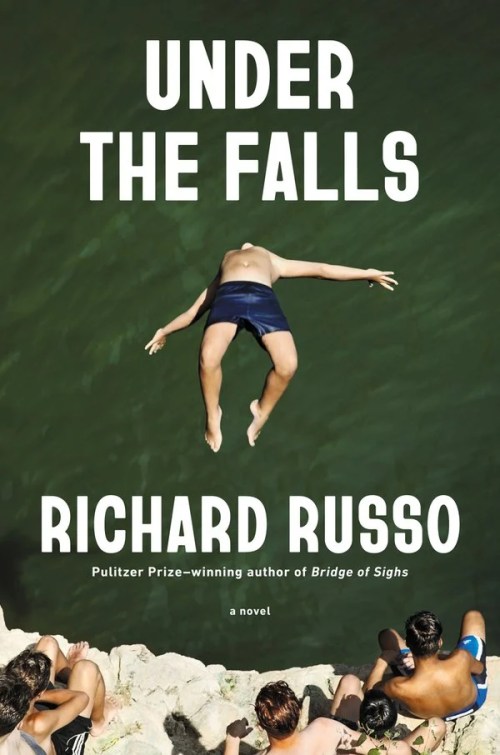
FICTION
Under the Falls
By Richard Russo
Knopf
Published August 11, 2026


