


I have been a Hugh Ryan superfan ever since reading When Brooklyn Was Queer and The Women’s House of Detention. Stories from LGBTQIA+ people’s lives from the 19th and 20th centuries are precious because of their scarcity, but in these collections, Hugh’s vast historical knowledge and thoughtful scholarship further enrich them with meaning and a bright, fierce humanity.
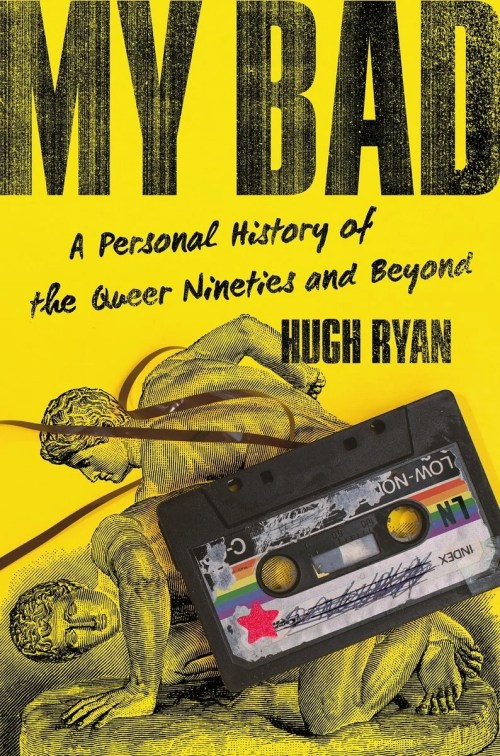
So I hoped Hugh’s new coming-of-age memoir, My Bad: A Personal History of the Queer Nineties and Beyond, would deepen my understanding of queer life during the volatile, transformative 1990s and early 2000s. It did. I expected to be moved by Hugh’s personal stories about living through the AIDS crisis, the emergence of the internet, and the post-9/11 era. I was, deeply. I was also captivated by the memoir’s magnetic voice and unguarded intimacy. Reading My Bad felt like the cool, queer, older kid at school threw his arm around me, told me a joke, and then trusted me with a secret. Talking to Hugh about this triumph of a book felt like that too.

Jen St. Jude
Your memoir mirrors your approach to historical storytelling; you include not just what happened but also why. One of my favorite lines is, “We are all four-dimensional beings—bodies hurtling through time—and everything we are is made up of everything we were and contains the seeds of everything we can become.”
What were you hoping to communicate through your story that might help readers understand their own lives?
Hugh Ryan
When I was younger, there was so little information about queer life and identity that it felt like we were making everything up. What was gay or trans? What was I? When I think about today, with all its names and labels, it’s like, everything’s so much clearer now! But as I started to dig into my own history, I saw that some of that clearness is inhibiting. So much of what we’re told about sexuality and gender now is that you have an inherent self, and your game over the course of your life is to find it. And if you don’t find it, or if it changes, you’ve failed. And also, when you do find it, it retroactively changes everything about every version of yourself you’ve ever been. It allows us so little room to grow, to be different in different circumstances, and it also means that queer people in the bigger historical timeline of hundreds and thousands of years have to be exactly what we are here and now, because our ideas are right. I lived my life mistake to mistake, trying to piece things together. This is how I got to understand myself, and that understanding is still in flux, and that’s not a bad thing.
Jen St. Jude
Did you also write from mistake to mistake? Or how did you edit your life and decide what belonged in these pages?
Hugh Ryan
There are moments in our lives that have meaning to us that we return to and it’s easy to assume that we know what that meaning is. I often don’t. Why do I think so much about the day in 7th grade Spanish class where my teacher taught us the word faggot? I had to understand it.
I’ve also written much about the revolution of queer identity in the 19th and 20th centuries. Because of urbanization, there was a change in how we lived and what it means to be gay. I knew that the internet emerging in the ‘90s had similarly changed us, so as I dug into my individual experiences, I asked what each one had to say about the change in queer life at the end of the millennium.
Jen St. Jude
So much of queer identity circles around desire and gaze. In the book, you often share who you were by showing what you loved and who you were drawn to. And, alternatively, what you were running from. Were you thinking about different ways to show who you are instead of telling?
Hugh Ryan
Desiring someone else, or being drawn to a certain way of being, creates an internal compass. It’s that thing inside us that asks, is this making me feel better or worse? It doesn’t always lead us to the right places. Still, when you live in a world where you are not represented, you have to find that thing inside you that tells you what way to go. Many of our queer ancestors said they found the way to themselves by following desire.
You could also call that pull cruising. Dense and crowded cities in the 19th century made cruising possible in a way it wasn’t before. Today, people do it mostly online, so we have to do it through words. There’s now a lot of self-definition in that process of finding your community and differentiating yourself.
Jen St. Jude
There’s new access to queer community, but hypervisibility can be dangerous too. What’s been lost, despite how much we’ve gained?
Hugh Ryan
The process of assimilation has spread us out, and now you can participate online, but you only get part of it. You don’t always have to go to the gayborhood or queer bar. We’re not in rooms together where anything can happen. I’ve found people on the internet who I think I’ll match with perfectly, but in person it’s all wrong. And the opposite of that is true, too. If I wrote out all the things I was looking for, I would inevitably exclude people I would have vibed with if we were sharing a space together. In the past, there were surprises and the freedom of boredom. We can now reach anyone at any time, and yet it feels like there is so little community or joy. Of course, that’s because our world’s on fire, fascists are in charge, and they’re trying to destroy us. But also, we have promoted this idea that we can live our life anywhere, separate from our people, and get everything we need. I don’t think that’s true.
Jen St. Jude
I’m feeling a diminishing safety on the internet, especially as a queer person, and I don’t think I’m alone. Do you think we’re going to return to those shadow spaces on some level?
Hugh Ryan
It’s impossible to move backwards. These technological changes will not go away, but I do think we have all been exhausted by the new options. It doesn’t mean they’re bad, it doesn’t mean we’re not going to still participate in them. But I’m starting to see, too, bars and bookstores opening up, people doing more in-person stuff. We’ve experimented with assimilation on a digital level, and now is the moment where we evaluate this technology and decide what we like and don’t like.
To return to the end of the 19th century, the change in urbanization is what promoted this anti-urban movement against immigrants, queer people, and Jews. It eventually led to the Holocaust; a moment of reckoning in which the New World and the Old World fought with each other. We’re on the precipice of that right now, and have not yet hit rock bottom. There’s an epistemological clash coming between people who understand themselves through our new world vs. the old one. But people don’t want to give up the internet, which has allowed us to see that the world is more complicated when it comes to things like bodies, desire, culture. Conservatives think they’re fighting trans people, when really they’re fighting the internet. They are fighting the wrong fight, and they will absolutely lose, and they are stupid people, and I don’t mind being quoted about that. They are wrong, and it’s important to remember they are absolutely wrong. They don’t understand the world, but that doesn’t mean they’re not going to cause a lot of damage on the way out. Still, we’re gonna win.
Jen St. Jude
I’m saying this as someone who didn’t live through the ‘90s in the same way you did, but it seems like we’re starting to process not just what happened then, but what it means to us now. Did writing this change your perception of yourself or your life?

Hugh Ryan
I had to heal a lot first before I could write this, but in a weird way, it did help me understand myself better. The more I looked back at my own history, the more I could see all of my weirdness around sex and protection was because I was in a culture that told me I was gonna die of AIDS. There was no other outcome. And then lots of people my age and older died, and things shifted, and we didn’t know what was real. Did protease inhibitors really work, or were we going to learn they caused kidney damage, and we all had to get off of them? I look back and I’m like, ah, you were responding to the world as it was changing.
I also wanted to write this because I was seeing so many fantastical versions of ‘90s gay life. It’d be like, one gay character who would come out to their friends, and everyone would be nice. There’d be an admittance that there was homophobia out in the world, but not from them. The gay person knew what they wanted and would find it. Maybe one person would be mean to them, but they were a bad person, and by the end of the episode, they’d admit they were wrong. That was not real life. It made me want to start talking about what we did live through.
Jen St. Jude
In literature and art about AIDS, I’ve often seen almost a romanticism of these short, brief, tragic, beautiful lives. Though there’s truth to the beauty, it was also so violent. Even aside from AIDS, so many of our ancestors had such short lives. It’s a part of queer life we don’t talk about much.
Hugh Ryan
That lack of intergenerationally has really hurt us. We have very little view of what it means to be a queer elder, to have queer family, to have queer spaces once you’re out of college. For me, finding the Radical Faeries, the squats in Berlin, and even queer studies, enabled me to see what we gained when we had a conversation amongst ourselves. We lacked it more than ever during the AIDS crisis because many people wanted to assimilate. If your only idea of what it meant to be gay was to die at 28, alone, knowing that no one would bury you, well. I don’t blame anyone who did not want that to be their life, who instead chose to be closeted or distance themselves from other gay people as much as possible. When I was younger, older people were a sign of death and that just makes me so sad for all of us.
I love that younger people don’t have to experience that. You might only be 38, but to an 18-year-old, you’re a provision for the future. They’re like, look at all the things I could be. I could be queer, a writer, non-binary, trans. There’s so much possibility when you have older queer people around.
Jen St. Jude
Your work is always just as much about the present and future as it is about the past. From the epilogue: “José Esteban Muñoz wrote that queerness is always on the horizon, never here, because queerness is constitutionally odd…it is always in the potential of those who do not fit.” I wonder what the next generations will introduce that I will not understand. What will challenge us?
Hugh Ryan
At a certain point in history, a bunch of doctors scribbled a circle around a group of people sleeping with folks of the same sex. And they were like, that is an identity, and it is separate from gender. So you’re not attracted to men because you’re a woman, you’re attracted to men because you’re a homosexual. They took that desire and made it an identity. But what if inside that circle, you have groups of people having different experiences? What if someone has that desire as a teenager but never again? What if they just have sex with men for fun but have no emotional investment? What if for some people it is more about gender than it is about sexuality? Right now, we’re naming certain commonalities and saying, ah, that’s the thing that matters. I imagine there will come a time when a circle will be drawn around things that I don’t think are related to each other, because I did not grow up in a world that showed me that they are. But it did for people who are drawing that circle in that moment. That’s gonna be really interesting.
NONFICTION
My Bad: A Personal History of the Queer Nineties and Beyond
By Hugh Ryan
Bold Type Books
Published May 26, 2026


