Life and especially death are full of uncertainty. In television, movies, and many commercially successful novels and memoirs, there seems to be an unspoken rule that death must fulfill a specific narrative purpose—a turning point that carries with it the twins of closure and growth. But real life is not at all this tidy or convenient. And when the death involves sudden disappearance and likely murder, the emotional magnitude of uncertainty is endless.
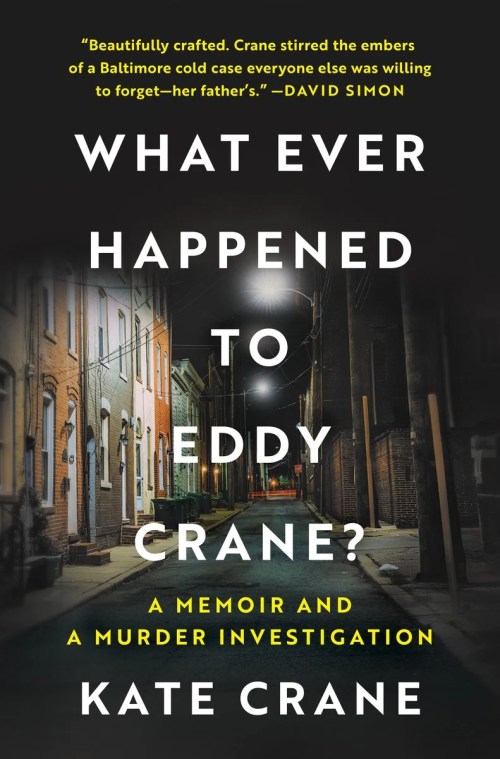
In Kate Crane’s memoir, What Ever Happened to Eddy Crane?, the unanswered questions that haunt the author begin when she was twelve years old, when her father called to say he was on his way home from his trucking parts business in Baltimore but was never seen or heard from again. How the author grapples with the unanswered questions during the aftermath of her father’s disappearance is what fuels the suspense of this multilayered story. Author and television writer David Simon covered Eddy Crane’s unsolved murder when Simon was a reporter at the Baltimore Sun, and the case was later used in his television show, The Wire. Twenty years after Kate Crane’s father’s disappearance, as a journalist in New York City, Crane decides to reopen the cold case investigation by tracking down the detectives who’d worked on the case. Crane not only investigates the old and new discoveries surrounding her father’s disappearance, but also explores how one can find courage and resilience through the search for truth and by writing it down.
This nonfiction page-turner is an unconventional blend of memoir, true crime, and psychological suspense that is skillfully rendered with an analytical self-awareness that critiques each genre. Crane’s gritty and illuminating style of storytelling is both compelling and delightfully rebellious, allowing her to address the limitations of each genre while she writes beyond each one. Some of the most captivating descriptions are of her impressions of the late-’90s DC punk scene, her memories of and revisitations to Baltimore, and key moments of her life as a journalist in New York City. Instead of merely offering a reconstruction of her father’s murder, Crane also delves into the complexities of what was at stake for her to make the decision to investigate her father’s disappearance, revealing fraught family relationships, medical and mental health challenges, and the flawed criminal legal system that failed to bring justice for her father’s murder.
As someone who has known and worked with many people who have been ensnared by the criminal legal system, I appreciate books of all genres that dig into and unearth the broken pieces of the system, books in which the story’s protagonists are not automatically cops or even people without conviction histories. As a reader, I crave complexity and stories that are grounded in and relevant to real life. By showing us the prolonged grief and what it was like to not have a trial or even a timely funeral, What Ever Happened to Eddy Crane? cuts deep, as only the best memoirs can. The missing pieces of the case and aspects of the broken system, which significantly added to this profound loss, underscore what it takes to survive and move forward despite all that is lost.
This book also offers intriguing discoveries about the case that are riveting and suspenseful as we witness Crane’s investigation. She interviews the detectives who worked on the case and other memorable characters, including David Simon himself. He even advises Crane on the direction of her investigation at one point. A key component of what propels the story forward is Crane’s journey of becoming a writer and piecing together what happened.

What Ever Happened to Eddy Crane? is a thrilling and heartbreaking story with psychological depth. While its pages are filled with surprising discoveries that could satisfy even the most ardent fans of true crime, Crane’s book defies the confinement of genres and doesn’t shy away from the complexities of grief, family, justice, and writing. Her book shows how she navigated the unknown—all the unanswered questions that left her and her family frozen in mourning and fear. By bravely confronting the complications and missing pieces, Crane demonstrates how the power of story can be restorative.
NONFICTION
What Ever Happened to Eddy Crane?
By Kate Crane
Hanover Square Press
Published April 7, 2026