


At the end of Miami and the Siege of Chicago, Norman Mailer’s 1968 New Journalism account of that year’s Democratic and Republican National Conventions and the accompanying violence between Yippies and police in the streets of Chicago, Mailer gives a warning to a young woman: “Dear miss… we will be fighting for forty years.” He was wrong. It’s been fifty-eight years and we are still fighting.
That sense of changing times and the doom ahead looms large over Mailer’s account. The book starts easily enough in Miami as the Republican Party nominates Richard Nixon. From there, we pivot to Chicago and the Democratic convention where what started as a simple political account escalates to full blown war coverage with the police and National Guard attacking the protesters making their stand in the heart of Chicago.
A lifelong boxing enthusiast, Mailer is up for this tonal shift, gracefully gliding from style to style like Ali flowing through the ring. In Miami, he is the New Journalist, documenting the events with a focus on the personalities of all involved, delivered with a slightly condescending air. When he is in Grant Park with Allen Ginsberg and William S. Burroughs, he becomes the beat poet employing a stream of consciousness style reminiscent of Kerouac’s The Subterraneans. And when things get violent, he becomes the war reporter, chronicling the events with the same eye that he brought to The Armies of the Night and his landmark novel The Naked and the Dead (a book he is all too ready to remind us he wrote).
There’s no question Mailer is a man of words and insightful observation. Consider his evocative descriptions: Mayor Daley “looked in fact like a vastly robust old peasant woman with a dirty gray silk wig. (At his best, he looked respectable enough to be coach of the Chicago Bears.)”; presidential hopeful Eugene McCarthy “seemed more like the dean of the finest English department in the land.” On politics, he sees the feelings of guilt and obsession with social justice in the populace and sagely predicts that “political power of the most frightening sort was obviously waiting for the first demagogue who would smash the obsession and free the white man of his guilt.” Hard not to think of the MAGA right in that moment.
There’s also no question that Mailer has chronicled a massive moment in American politics—he knows it, but even he is not aware just how big it would be. The 1968 conventions were the last of the old style of conventions: places where delegates came and legitimately decided over late-night drinks and backroom deals who would represent their party. That changed in 1972 to the pageant we see today. And it largely changed because of the state-sponsored violence in Chicago, violence Mailer all too accurately predicts will not end here.
What Mailer has chronicled here is the end of an era and the start of what is politically in many ways a newer, uglier one—more partisan, more fueled by hatred and violence, and ultimately what would lead us to Donald J. Trump. Mailer sees all of this and captures it with style.
And yet…
This is not a book I can recommend. Once upon a time I recommended it to many. As an undergrad English major focusing on twentieth century American literature, this was one of my touchstones: an Important Work For All To Read.
Rereading it for the first time in many years, I braced myself for the casual racism and sexism that is inevitable from a hard-drinking New Journalist white male author of the mid-twentieth century, And make no mistake, those are on full display here as Mailer describes “a sixty-year-old blonde in a bikini with half of a good figure left (breasts and buttocks)”, or when he sees the then-20-year-old Julia Nixon and remarks that “a man who could produce [a] daughter like that could not be all bad.” That observation is quickly followed by the troubling description of the “Eureka Brass Band… ten Negroes… led by their master, a tall disdainfully wizardly old warlock, a big Black… he was an old prince of a witch doctor.” In some ways, this is the price of doing business as a reader looking back at this time, and it’s up to every reader whether or not they want to pay that price. This I was mostly prepared for (though certainly the bandleader description knocked me back).

What I was not prepared for was the out-and-out racism on display. Nowhere is this more prominent than when Mailer is waiting for an appearance by civil rights activist Ralph Abernathy. Abernathy is running late, which prompts Mailer to state: “the reporter became aware after a while of a curious emotion in himself… he was getting tired of Negroes and their rights.” Mailer mulls over this point and ultimately asks himself: “‘How do you know the Black man is not Ham, son of Evil? How do you really know?’… and bitterness toward Negroes flowed forth like the blood of the blown-up dead: over the last ten years if he had had fifty friendships with Negroes sufficiently true to engage a part of his heart, then was it ten or even five of those fifty which had turned out well?”
It is worth noting that this comes the day after he waits at a press event for Pat Nixon. The future First Lady no-shows, which Mailer meets with a shrug, noting how there must have been something sloppy in their planning. It’s hard to read that juxtaposition of responses as anything other than racism, plain and pure.
In the end, Mailer chronicles a key moment—an “out with the old, in with the new” of politics. What he fails to see is that he himself is part of the old, and that his antiquated and ugly views are also on the way out. If there’s a saving grace in reading this in 2026, it’s the knowledge that we’ve shifted to the point where we are no longer willing to brush this under the rug of “genius,” where we call out racism, where we acknowledge there are other voices to be amplified, and where we can grant ourselves permission to put this particular voice back on the shelf to gather dust for eternity.
NONFICTION
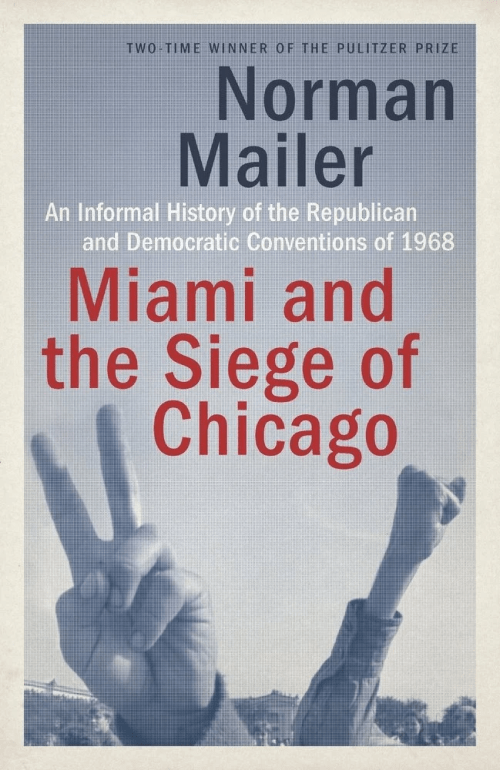
Miami and the Siege of Chicago
By Norman Mailer
Random House Trade
Published July 5, 2016
Originally Published 1968


