


Ireland is a nation of migrants, once shaped by a history of mass-emigration and now emerging as a hub of immigration. The rapid evolution of Irish culture and government since the turn of the century has marked the Republic as a progressive state from an international perspective: same-sex marriage was legalized in 2015, a nationwide referendum legalized abortion by removing a near-total constitutional ban in 2018, and the country elected its third female president late last year. Shifts in foreign policy, increased urbanization, secular attitudes, and a growing economy have encouraged an influx of arrivals. The country is also a popular destination for a widespread diaspora interested in reconnecting with its ancestry, including many Irish-Americans. As anxiety over the economic and political climate of the United States heightens under the current administration, a permanent move to Ireland has become an alluring prospect for some Americans too. Meanwhile, a new wave of emigration among young Irish, faced with a national housing crisis and high costs of living, is a growing concern as some individuals decide to leave the country for better prospects abroad. Still the population of the island continues to grow every year; the increasing numbers include people who relocate for work, asylum seekers and refugees, and Irish migrants returning home. All of this flux requires the continuous development of social policy to address a unique set of challenges migrants might encounter as they integrate and adapt.
The experience of migration is a common subject in acclaimed Irish author Colm Tóibín’s previous publications, including his popular novel Brooklyn and its recent sequel Long Island. Analogous experiences like alienation and queer trauma also feature prominently, as in The Magician or The Blackwater Lightship. His new collection pulls at these connected threads once more. The stories in The News from Dublin span Tóibín’s native Ireland, Spain, and the United States, which have all featured in his other writing, as well as Argentina.
Stories in Tóibín’s previous short story collections, The Empty Family and Mothers and Sons, explore myriad themes ranging from parent-child relationships and strained family dynamics to queer intimacies; escape and exile to belonging; shame to self-possession; and painful histories to quiet hope. The News from Dublin sits well within Tóibín’s wider catalogue, and his masterful style is evident in this new offering with prose that is tidy and deliberate like geometry. In each of the entries, readers are left to do the math. Most of the time the result is a story that has the ability to be sensational without exaggeration.
In “The Journey to Galway” a mother receives news of her pilot son’s death during war and travels from Dublin to the home of her daughter-in-law and grandchildren to deliver the news. The scenario is an apparent fictionalization of Irish dramatist and folklorist Lady August Gregory, whose son Robert died as an airman during World War I. Setting and milieu are expertly crafted through details such as dawn birdsong, maid service, telegrams, and porters on trains. The narration toggles between the now-narrator and her past self, recalling memories which have lost their edge in transit. The story is propelled by what Tóibín withholds through the narrator: betrayals of both family and nation. Without knowing how the characters react to various tragedies, readers must imagine their own verdict.
“A Free Man” tracks a third-person close narration of a former teacher and priest-in-training who has recently been released from prison in Ireland and decides to self-exile in Barcelona. Interspersed with the relocation are callback scenes of the initial interrogations, the trial, and adjustments to imprisonment. The point of view forms a tension between the reality of the character’s convicted crimes and his self-perception, which is at odds with his sentence. The man’s desire for ambiguity in a new city also clashes with the pervasive nature of his crime in both Irish society and notoriety abroad. Here Tóibín indirectly addresses the decline of Catholicism in Ireland due to pedophilia and molestation scandals in the Church. The weight of this story might be lost on readers less familiar with Ireland’s long history of Catholicism in the formation of the free state, but its power lies in “the half-said thing”—the doubtful guilt in the main character and his ultimate freedom.
In “Sleep,” an Irishman in New York shares a bed with his much younger American lover, who becomes startled by alarming noises the narrating character produces in his sleep. The lover insists the Irishman see an Irish shrink—not American and definitely not British—to identify the source of his unrest. As the Irishman is en route to Dublin, the narration shifts away from addressing his American lover directly as “you.” The narrator wanders around his native city prior to an appointment with an Irish psychiatrist, acting as a tourist in his native city. Following a trial of hypnosis and his return to New York, it’s unclear whether the sleeping fits will continue. This lack of clarity extends to the narrating character’s feelings. Part of the equation feels missing because we don’t understand the Irishman’s motivations: how he feels towards New York or Dublin, his relationship, or even the death of a family member. Sleep seems an obvious metaphor for an unconscious “burden,” as it’s put, but it’s on the nose if so. It’s possible the mid-way narrational shift suggests the lover, and the divide that opens between the two characters, is a subtle manifestation for homesickness and how grief travels. Yet, without a clear emotional resolution from the Irishman, this may be a false equivalent.
“The News from Dublin” subverts the notion that knowing the right person allows access to special opportunities, a belief that sometimes holds true for a small country like Ireland. Like many titular stories, this contribution is not necessarily the strongest in the collection but does capture a throughline of estrangement. After a national newspaper reports a cure for tuberculosis, schoolteacher Maurice undertakes a journey from Enniscorthy to Dublin to seek access to treatment for his declining younger brother. The Wexford-based family envision Ireland’s capital city as a nostalgic, idealistic place where a minister in the Dáil Éireann [Irish government], who happens to be an old pal of Maurice’s father, might offer a fast track to a remedy. Former President Éamon de Valeria is further invoked as a near-mythic figure while the motions of the Dáil are described with airbrushed hope. In starting the story with Lent, and later discrediting a Christian God’s interest in small miracles, “The News from Dublin” shifts into a faithless story that questions how and why a government, in this case the Irish state, operates as it does. It signifies a clear divide between rural and urban, religious and secular, and traditional versus modern, wherein the people are disconnected from their governing body.
“A Sum of Money” refers to the cash a gifted young lock pick steals from his classmates’ lockers. Despite money troubles at home, Dan’s parents send him to a Catholic boarding school they deem to be “worth every cent.” Meanwhile, Dan laments that his parents do not visit him or send money for extracurriculars as his classmates’ parents do. He resorts to stealing, albeit through antithetical means, in part because the other boys are careless with their money. Here religion and class present barriers to social connection. Poverty is positioned as not only shameful, but also an inevitable sin.
“Barton Springs” is a subdued reflection on grief as the narrator, traveling with his lover, contemplates returning to Austin, Texas, where he last resided after the death of his brother. He recalls a late-night pool called Barton Springs where he once secretly admired the body of an undressed man with whom he never interacts yet remembers well. Now older, the man contemplates the physicality and proximity of his lover’s body, but this time the fixedness of memory does not harden against life experience. Tóibín writes about queer life as an open and bittersweet thing. The approach, as in his other writings, is gentle and restrained. The brevity of this story does not detract from its potency, but the marked similarities to “Sleep” do create the effect of a refrain.
The “Summer of ‘38” looks back at Marta’s life during the Spanish War when a number of soldiers were stationed in her small town. Later in life, as a widow and mother of three, she receives an offer from an old connection she met in the summer of 1938, and must consider how her past will affect her future. In this case, the character does not move far away, yet the knock-on effects of living through conflict and her subsequent decisions distance her from the home she once knew.

In “Five Bridges,” a plumber named Paul, the self-proclaimed “oldest living illegal immigrant in America,” spends time with his young daughter in the days before he moves back to Ireland. The fallout of the pandemic and the election of an anti-immigrant president in the United States have forced him to leave his home and child to return to his native country, which is no longer familiar. Similar to “Sleep,” the character development is loose. I hoped this story would allow a character to dwell on the insecurity of migration and what it means to feel threatened by a place you desperately want to belong to, but Paul’s psyche is not expanded upon. Instead, there’s a sense that Tóibín is more interested in the larger picture these characters are meant to be communicating: how xenophobia instills fear and displaces families. This feels like the most contemporary contribution to The News from Dublin. The story’s ending is abrupt and open-ended, though perhaps none of us want to consider what follows.
The final piece in the collection, “The Catalan Girls,” is a novella-length story centered around three sisters who move with their mother from a Catalan-speaking region in Spain to Argentina. Over the years and into adulthood they grow apart, but the death of an extended family member draws them back together. Nearing retirement age, the sisters go on holiday to revisit Spain, where youngest sister Montse plans to stay instead of returning to her life in Argentina. The pacing of the story is circuitous, perhaps because the sisters’ personalities remain static. Montse, although the primary focus of the story, is less irresolute than pliant and docile, manipulated by her mother and her sisters. The passage of time is muddled by youth. But fifty years doesn’t lead to much development for the sisters, and the mother remains a wayside character despite being the main catalyst in her youngest daughter’s life decisions. The story comes to an end, in a way, for Montse as she makes an active decision for once, but the dwindling action leading to this resolution makes for a flatter conclusion to the overall book.
Most of Tóibín’s characters in this collection are passive by nature. This has the effect of making the compilation of the stories feel less cohesive or deliberate than previous collections, because a connecting theme in which characters are posited as “out of place” reads as an abstraction, particularly with Tóibín’s restrained interiority. A wide array of settings and conflicts are on offer, and they seem disparate scenarios when in comparison. However, much hinges on the uncertainty each of the characters face. All are caught halfway between a fixed past and what comes next. They make decisions to assimilate or transform. In not recording every mood or guiding sentiment, Tóibín strikes a distinct, delicate balance: the negative space holds the emotional timbre to The News from Dublin.
FICTION
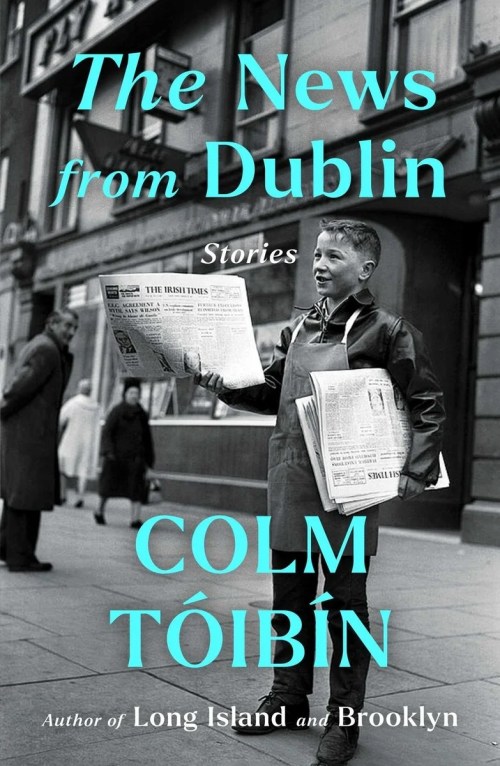
The News from Dublin: Stories
By Colm Tóibín
Scribner
Published March 31, 2026


