


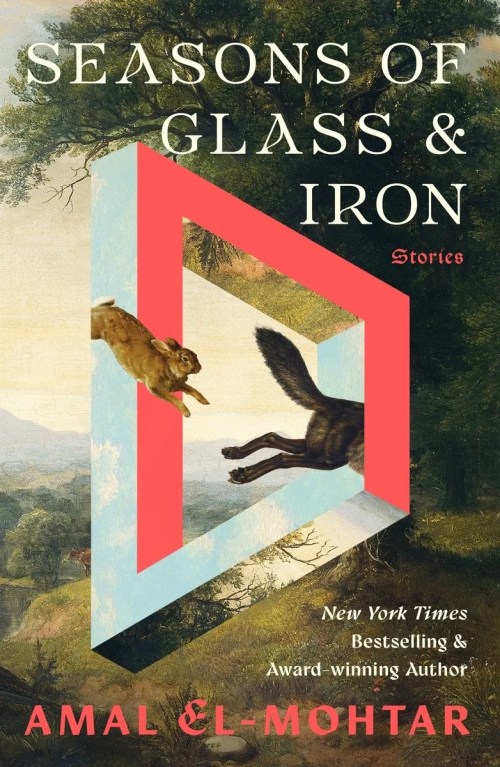
Flowers, when collected, become something greater than themselves. They might form a bouquet—or in some mythologies, a woman. Stories, too, become something greater than themselves when bound together. Year after year, story after story, Amal El-Mohtar has revisited transience, transformation, friendship, grief, love, birds, and flowers. In her new collection, Seasons of Glass and Iron, these stories coalesce into a narrative of their own.
Although it’s a body of work that covers more than a decade of her career, the stories all display El-Mohtar’s inherent interests as a storyteller: women who are friends, women who are in love, women who are kept apart. “I wasn’t sure what argument, coherent or otherwise, would emerge from gathering my favourites,” El-Mohtar writes in her introduction to the collection. “Mostly, what emerged is that I love women.”
In the titular story “Seasons of Glass and Iron”, we’re introduced to two women in the midst of two seemingly disparate fairy tales. Tabitha is cursed to wander in a pair of iron shoes and finds herself atop a glass hill, where Amira must wait for a suitor to claim the golden apple in her hand.
Each woman believes their circumstances are their own fault or choice, because these are the trappings of the fairy tale form—this is just how it is. Tabitha, for instance, no longer knows if she is able to walk without the iron shoes, and Amira admits the glass hill has been useful to her in her hope to avoid any suitors at all.
It’s easy for them to believe that staying trapped keeps them safe, but the compassion each woman receives from her new friend makes her see the world in a new light. “What’s strange,” Tabitha muses to herself, as she reflects on the seven-league boots her brothers got to wear, “is the shoes women are made to wear: shoes of glass; shoes of paper; shoes of iron heated red-hot; shoes to dance to death in.” Both Tabitha and Amira begin to understand they must disregard the rules others have set in order to pursue happy lives.
The women choose to free themselves, and the rest of Seasons of Glass and Iron unspools from there. In “Madeline”, a woman copes with grief through her friendship with a girl who may or may not exist. “The Lonely Sea in the Sky” and “The Green Book” explore women who, although entrapped by sci-fi disease and the haunted pages of a journal, respectively, write letters of love and longing. “John Hollowback and the Witch” is a masterclass of the feminist fairy tale, and “Pockets” seems to reach through the page to place the magic of writing in the reader’s palm.
Poems in the collection like “Song for an Ancient City” double in both English and Arabic, and they illustrate the longing for a homeland, for peace. “Qahr” in particular stands out, utilizing the Arabic word qahr which holds untranslatable sadness to write in conversation with voices from Gaza, “as if a single word in any language / could hold all this wrecking grief.”
Grief and displacement carry through stories like “Florilegia; Or, Some Lies About Flowers”, which retells the Welsh myth of Blodeuwedd, a woman made from flowers to be a wife. Amal El-Mohtar gives Blodeuwedd space to grow, allows her the breadth of her own heart, and permits her to discover how she might transform. Much of this discovery is brought about via Blodeuwedd’s relationship with Adain, a woman at court, who is queer and captivating.
“Tell a different [story,]” Adain urges Blodeuwedd. “You were flowers, and they made you a woman… I too was once other than I am. I had a different name; I threw a mighty spear; I was lord of Penllyn, and did not want to be.”
Inspired by Adain’s open transness, Blodeuwedd finds new possibility within the nature of her own womanhood. “There is wonder in it,” Blodeuwedd thinks. That she “could yet be something else—could be what she desired, instead of what she was before choice was taken from her.” Blodeuwedd, the woman made of flowers, requests of Adain, the woman who made herself: “Teach me how.”
“The Truth About Owls”, written five years before “Florilegia”, also explores the Blodeuwedd myth. This time, it’s approached through the eyes of young Anisa, an immigrant child from Lebanon living in the UK. To cope with feeling misunderstood in her new country, she becomes obsessed with the Owl Center, where she meets an owl named Blodeuwedd and befriends the owl’s caretaker, Izzy.

Anisa resonates with the myth behind the owl’s name as she feels she may never be whole. She tells Izzy, “I feel like I’m just a collection of bits of things that someone brought together at random and called girl, and then Anisa.” In response, Izzy offers that “there’s another word for… what you just described—an aggregation of disparate things. An anthology.”
Seasons of Glass and Iron, in many ways, explores all the angles and parts within something that someone calls “girl.” Imbued with magic and love for women, characters across worlds and time mutually inspire one another in their quests for home. Togetherness and the sum of parts become something more beautiful.
Izzy goes on to say, “There’s another word for anthology, one we don’t really use anymore: florilegium. Do you know what it means?” Young Anisa shakes her head, and Izzy tells her, “A gathering of flowers.”
FICTION
Seasons of Glass & Iron
By Amal El-Mohtar
Tordotcom
Published March 24, 2026


