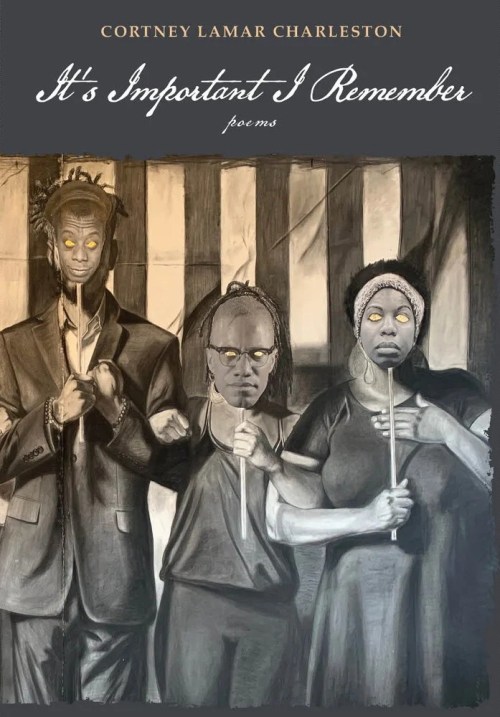
Cortney Lamar Charleston’s soaring new collection, It’s Important I Remember, is substantial both in size and scope, layered, ambitious and arresting, matched by an equally singular physical nature all of which invites a relationship with the reader. Charleston is marvelous at excavating and entwining personal and public history—the myths and the truths—from 1619 to our current times, yet despite his work’s complex engagement with the past, it lives emphatically in the present, and lights a path toward what is yet to be.
This interview has been edited for length and clarity.

Mandana Chaffa
Can we talk about temporality? I’m intrigued that the sections—each tied to a specific historical event, each led by “It’s Important I Remember”—don’t follow sequentially. We start in March 2020 with the acknowledgement that COVID-19 was a pandemic, then move toward Trump’s first inauguration and then the mass demonstrations in June 2020 and then back to the Muslim bans of January 17, and so on. History—or time—is certainly sequential, but the impact of it isn’t, and this bold approach was, for me, a deeply effective one, to cinematically zoom in and out and reframe what memory is, and how it works. Would you talk about this?
Cortney Lamar Charleston
That time, within the confines of this collection, functions more temporally than linearly, I feel, is intrinsic. The emotional and intellectual foundations of this collection began to come together in the first half of the first term of our aspiring autocrat, and the fairly rapid ascent of said man from tabloid fodder to the presidency of the United States had left many astute prognosticators baffled, I think, because they believed in (what they thought was) the American ideal, whereas every turn of that presidential campaign, and then the swift transition into governance, reminded me of the American reality, or at least the African American reality.
2016 and every year since has felt like nothing except a bad case of déjà vu. After all, how different is a man like President Trump from, say, former Alabama Governor George Wallace, whether in ideology or in public persona? What exactly is novel about “Make America Great Again” as a banner in the present day when former President Ronald Reagan said it first and, in many respects, meant it no differently than its contemporary interpretation? When you’re thinking about parallels as a protective instinct, when you’re on the margins and, thus, under perpetual threat by the powerful and their deputies, you are cursed to experience the past and the present simultaneously; it is the recognition of patterns that may be the only thing that can save you, so you stay vigilant, you stay woke, which really means you never let the dead sleep but keep them talking to you, teaching you, telling you how to move forward. This is the positionality I’m writing from: I saw the convergence of troubling forces coming to a head and had to get in touch with the ancestors—for wisdom, for strength, for resolve.
Mandana Chaffa
Let me get really nerdy and talk about the exterior and interior design of this collection. Reading it felt like touring a castle with hidden rooms and parapets, awash in the memories of all who came before, along with empty spaces for all yet to come. There are also specific decisions you made with typography, in the cover art, in the section titles, in the cross-outs, in the number of sections (thirteen, and all the meanings attached to that number: the colonies for one) that very distinctively places the collection historically and, of course, personally. What came first? Content or concept?
Cortney Lamar Charleston
I wish I could take credit for such a wide-reaching genius as you’ve described, but the content most surely came first. My first concern was writing through the text, trying to get a real sense of exactly what this collection wanted to be. It swelled to considerable size, relative to most poetry collections, but I followed impulse and intuition to the points they called me toward. It was only after the body of work had mostly come into a solid form that I began to think about how the work would live in the world.
Because of the expansiveness of the book—thematically, across emotional registers, across the private and the public, across time—I did begin to have a yearning for a physical presentation that embodied this collection’s straddling of past and present and its more temporal, more emotionally and spiritually accurate understanding of our times today; I wanted to have something that felt modern while also feeling archival; I wanted weight that underlined the weight of the language I was carrying in me. So all these little design elements have roots in that, and I communicated these ideas with Northwestern University Press before a contract was even signed just to understand if they were the right partner that could help bring this project to life in the way I was envisioning (spoiler: they were!). The individual elements may not have always been my exact idea, but they definitely flowed from the vision I’d brought to the table, and were all executed with my feedback. We could probably continue talking about all the little details of the book in greater detail, but it’s probably best to be judicious with the space we have!
Mandana Chaffa
Clearly, some of the sections were written outside of the time period they refer to (I know you weren’t around in 1619!). How many of these poems were written in their “era”? What was the timing of writing the collection and then putting it together and how much did your consideration of the collection as a whole change during this process? (And what timing, in this 250th year of the Declaration of Independence.)
Cortney Lamar Charleston
Well, that the book is arriving in the year of the 250th anniversary of the Declaration of Independence’s signing is more of an interesting, if admittedly serendipitous, happenstance due to publication timelines (for reference, I signed my publication agreement on September 11, 2023 … another obviously resonant date). But, to answer your central question here, I’d say it’s probably a 50/50 mix as to poems that were written contemporarily to the inciting or inspiring moment as opposed to being written later on and then slotted into position. I think that’s because I was primarily concerned with letting the individual poems take shape and stack on top of one another before I gave too much attention to structure; I was worried that it could stifle the flow of language to the page if I started ruminating on it too soon. However, once the work truly began to accumulate into something substantial and collectively sound, I shifted to considering how best to organize these seemingly disparate poems (though obviously tethered by the titular refrain of the book) such that a reader could make greater sense of their interconnectedness and interdependencies. Given the essentialness of the archive to the entire project, turning to dates seemed an appropriate choice, and I felt I could signal certain movements in the text by using the date as an establishment of the mood or intellectual focus (aided further by the section titles), even if most or even all of the poems that followed in that section did not depict any images of that exact time; again, it’s one of those nods to the way the past is lived with in the present.
Mandana Chaffa
The older I get, the more I believe we’re often incapable of knowing the true inflection moments in personal or world history as they’re happening (shades of Franz Ferdinand and WWI). Given how enmeshed we are in the present moment, can we possibly have the perspective that, let’s say, your son will have a dozen or more years from now, as he asks his parents about what 2025 was really like for a social studies project? I appreciate how poetically you examine how the nuances of history are fully revealed with the passage of time. All the correlations and frictions and orbits colliding and collapsing into each other.
Cortney Lamar Charleston
The long and short of it is that we can never tease out the true inflection points in history, personal or public, because the future is always the outcome of the fights we’re engaged in right now and there are billions of variables that each have their own weight toward the final outcome. It’s absolutely true that history informs the present and, thus, the future, but it also doesn’t predetermine a damn thing. If it did, there would be no point in studying it at all. But as a tool to understand how webs of decisions led things to unfold in particular directions, it’s invaluable. And I mean that both in terms of knowing why bad things transpired as much as why good or desirable things occurred; our work within the past is all about putting those two understandings together such that we can propel ourselves into better days, days with far more light than darkness. Only once the day has arrived can a story be written about it, and that, ultimately, is what history is even more than facts and figures, dates and times: the story we tell ourselves about ourselves and how we got here. That’s why it’s always a contested ground between those who are sociopolitically dominant and those who are sociopolitically marginalized.
Mandana Chaffa
A key repetition throughout the collection is “It’s Important I Remember,” which is different from “it’s important TO remember.” That small but mighty shift ramps up the intimacy and urgency of each piece. It also shines a light on the difference between memory and fact or, perhaps, memory and what is purported to be fact. I felt that you were often engaging in the sacred act of remembering and, especially, remembering for those who are no longer with us. How do you view the difference between memory and memorializing?
Cortney Lamar Charleston
Thank you for this question! To answer as best I can, I’ll begin by delineating that, at least to me, memorializing is a political practice whereas remembering, or being devoted to memory, is more of a spiritual practice, one that is much more intent on trying to acknowledge and honor the truth. I’ve written about this a bit for my publisher in introducing the book to the world (read here), but some of the catalyzing events (or sequence of events more accurately) for the writing of this collection were the very public battles we were having in this country around the presence of Confederate monuments and the imperative to remove them from public spaces. These physical objects “memorialized” slavers and traitors; by virtue of their form and public position, they venerated men with horrifying beliefs and rewrote their crimes against humanity into something noble, and that is precisely why they came to exist: a kind of political warfare waged through symbols and which established a great lie for future generations to latch onto. It’s a perfect example of why I don’t care much for memorializing, because it ultimately becomes more about what’s useful to the memorializing party in the present than anything else.
Having a practice of memory, on the other hand, actually requires submission of the self. It requires humility. It invites the heart into the hurts and the hallelujahs. It says, “Here I am not because something happened, but because people made things happen, and I owe them gratitude for that labor and sacrifice.” Throughout this collection, I’ve tried to offer thanks to those who have shown me the way, whether they are still among the living or not; it might not take the form of a rah-rah, showy, unambiguous thank-you, but I feel it does the more meaningful work of wrestling with what was done and how daring and precarious the efforts really were (to say the least!). I’ll give another easy example: Rev. Dr. Martin Luther King Jr., who at this point is one of the most memorialized people in the history of this country, a man with his own federal holiday and a memorial in the capital city. I’ve been to that memorial, and it’s most certainly a beautiful articulation in stone, but what weight can it truly hold in comparison to studying the strategies, tactics and results of SCLC campaigns, or sitting with speeches and papers and letters of his mind and imagination, or encountering how media of his day covered and depicted unimpeachably noble efforts, or building awareness of the counter-intelligence and surveillance efforts aimed at damaging him as a prominent leader of a transformative political movement? The granite may look good, but the meaning is always elsewhere, and it’s not meant to be a visitor upon the lazy.
This, in large part, is why the poems in this collection all fall upon the shoulders of the I: it was a way to ensure my own commitment to doing the work that revelation could eventually arise from, revelation being prerequisite to revolutions within our hearts and minds and, thereafter, our politics and material world.
Mandana Chaffa
There’s an unspoken cousin to “it’s important I remember”: it’s important I never forget. Did you come away from this collection thinking about the critical things that you cannot, will not forget? Or alternatively, what memories one needs to release?
Cortney Lamar Charleston
This is a very good question for which I, perhaps, have an unsatisfactory answer. While there are things that I absolutely will never forget, I don’t think writing the collection has necessarily drawn bold lines around these things that bring them to preeminence in my mind. I understand memory to be quite the slippery fish; I’m going to lose some things along the way, small details if nothing else. But there are so many artifacts that carry a charge of memory that can serve to enliven what was before on the verge of being forgotten; if it’s important for me to never forget something, then it’s not necessarily going to be preserved by a lack of fallibility in my very human mind, but more so by an understanding of what to turn to in order to recover what I’m worried about slipping from my consciousness. This book is just another kind reminder I can come back to one day, in all honesty.
Mandana Chaffa
Another memorable line: “See, I can indulge a good myth / made of a mortal man up until the point it makes myth of me as well”; it calls out how we can be dehumanized as objects of others’ narratives, so sharply explored in the section on 1619, as well as the more contemporary pieces about Black women. I was especially taken by how many of your poems pedestal and honor women, both well-known and unnamed.
Cortney Lamar Charleston
I appreciate the compliment! For me, with a mind toward how these revisitations of history throughout the collection were being mined for inspiration and wisdom in navigating current political realities, it was vitally important to speak to how even prevailing narratives of the tradition I come from misplace or minimize credit that should go to women and others even further on the margins within the marginalized (while undermining their specific struggles especially when they are caused or exacerbated by fellow community members). Solidarity starts at home, I guess you could say. I firmly believed this was a crucial element to include if the collection could have any real utility to liberatory practices and practitioners.
Mandana Chaffa
You’re one of my favorite practitioners of the progressive, long-form poem, with space enough and time enough to breathe, that is as much in conversation with the reader as it is with itself. How long do you spend on finishing poems, and how do you decide, it’s done? Are you a cohort in Nina Simone’s school of writing a song in less than an hour, which, to paraphrase the title of said song, “goddam”!
Cortney Lamar Charleston
It’s always so hard to talk about knowing when a poem is done! In my experience, it’s such an intuitive understanding. I suppose the most scientific I can make is that the poem has ended once the questions it leaves me with are devoid of craft concerns; all that’s left is consideration and contemplation and living in the aftermath of something that has stirred a change in you. Craft is all about getting to that point, to the moment the poem “clicks.” That’s the best way I can think to explain at this moment, but even this is a bit of a moving answer. Poems are mysterious things; all artworks are, really.
Take that Nina Simone song, for example: “Mississippi Goddam.” Yes, the legend is that it only took her an hour to write it; in the book, I called it “immaculate conception,” and I, too, have had poems that have more or less come out fully formed in one shot. It’s not something that happens very often, but it does happen. Otherwise, I spend my time, mostly, trying to get language to the page until the point where it starts to run dry on a particular wavelength (and I routinely let network and associative thoughts enter into the fray). I pause, I read, I wrestle with what’s in front of me, trying to understand what I can do to make it “feel” right and whole. It might be cutting language or adding language; it might be experimenting with lineation; it might be scrapping it and trying to approach the subject again through another entry point (I don’t believe all poems have the same potential and I think certain entryways into the writing can generate more powerful poems in their best, refined forms than others). All of this adds up to the poems taking extremely variable lengths of time, but it’s all time well and joyously spent. I love the process.
Mandana Chaffa
I am always enamored of your sharp linguistic armaments, interrogating both word and meaning, which especially suits the often-bloated rhetoric of the moment. When I read “that we’re not bearing witness, we’re watching—” I had to wonder: do I question my own myths enough, slicing away at numbing hypocrisies? More so, what of myself am I truly risking at a time that demands us to act?
Cortney Lamar Charleston
Every single one of us can always stand to risk more than we’re risking. While I want people to ask the question you’re asking (and I ask myself the same things every day and have yet to live up to who I want to be), I also don’t want folks to be debilitated by the feelings it stirs up inside them. Because we live in such a strongly individualistic society, I sometimes worry that this line of thinking can short-circuit people because they feel they must be heroic, when really they need to be in community, because when they are, [the questions] “what am I giving up?” vs. “what are we getting in return for our sacrifices?” fall by the wayside a bit, and you begin noticing and honoring more what is being done and what progress is being made, evidenced by the health of your connections to those you’re in the mud with, so to speak. The world is going to be reimagined and remade in that space before anywhere else.
Mandana Chaffa

There are so many aspects of this collection that feel like love notes: to family, friends, certainly your wife and son. One way of approaching the title of the collection is the individual’s effort to remember—perhaps in order to keep wretched history from repeating itself. And yet, upon a second reading, I was also thinking about inheritance (the past) and bequests (the future) and was more in mind of your son: is he the one for whom it’s important to remember? For you to have hope for?
Cortney Lamar Charleston
Yes, your second reading hit on a really important undercurrent! While I began writing this collection before we found ourselves living through a second term of whatever the hell we want to call this, I was very much aware the wheels were already in motion to this moment. That doesn’t mean that I thought it was predestined we’d be here, but I knew it was a stronger possibility than I’d hoped for. But that didn’t make my poetically delivered warnings moot in the least. Our entire lives will be spent in a struggle of good against evil, justice against injustice, freedom against tyranny, fairness against exploitation; the day we forget this is the day things start backsliding. But, in light of this, I began thinking of this work, also, as a gift to my son (and the generations after me that he symbolically stands in for), such that they have a reference point for how these evergreen struggles manifest in and shape their own lives. It’s an heirloom and example, one among many, many, many, but one nonetheless. I’m glad it exists on the off chance it clarifies something for someone when they desperately need it one day. I don’t know where I’d be if those who came before me hadn’t done the same.
Mandana Chaffa
I was especially moved by the cento “That There’s Always Hope,” which brings to the fore quotes from many beloved poets. I’m still thinking about one of the lines: “It is you that I’m addressing” and that you—standing in for the reader, for yourself, for your child, for many things I may not understand—left me more than a bit breathless. Hope is about that you, whomever we chose to commune with, to remember, and in that sense, this collection,
Cortney Lamar Charleston
Absolutely. I remember distinctly when I italicized that instance of you in my drafting, and it was for the exact reason that you referenced here. I needed that to become an opening, a place within the larger text where any reader or group of readers could inhabit that situates them directly in the struggle and makes real the stakes regardless of their identity and positionality (after all, while I am writing from a Black American perspective and tradition, I’m not concerned solely with Black people … I just recognize Black folks have a particularly valuable perspective toward resistance and liberation that are useful in this moment). Ultimately, I felt we—broadly defined in that American way—needed to converge on a sense of purpose that we could each take with us into our daily lives and start redefining our relationships to one another and the world as constructed.
Mandana Chaffa
In the poem “that the only thing we have to fear is fear itself—” these lines are so striking:
When you look into my eyes you see fear
because you are afraid of me:
Fear is your reflection, reveals you to youby way of my form, and always you turn away, turn away, turn away.
I’m not afraid: I’m full of your fear.
I heard an echo of a contemporary Harlem Renaissance in these lines, specifically Langston Hughes, and both “Dinner Guest: Me” and “Park Bench.” There are so many influences on your work and your delightful “Important Notes” at the end of the collection address many of them. What were you reading, in prose or poetry? What were the soundtracks to this collection?
Cortney Lamar Charleston
I wrote this book in fits and starts over, say, seven years or so. Because I wasn’t drafting (or even trying to draft) at a steady rate that whole time, a lot of my inspiration for this specific project blurs, particularly because I tend to dip in and out of other writing rather than focus solely on one project religiously (my brain just needs the variety!). That said, here are some works of literature and music that definitely influenced me in writing this book as it was happening (a very incomplete list): The Autobiography of Malcolm X (As Told to Alex Haley); Taylor Branch’s Parting the Waters: America in the King Years, 1954-63; Ta-Nehisi Coates’s We Were Eight Years in Power: An American Tragedy; Morgan Parker’s Magical Negro; Patricia Smith’s Incendiary Art; Terrance Hayes’s American Sonnets for My Past and Future Assassin; D’Angelo and the Vanguard’s Black Messiah; Kendrick Lamar’s To Pimp a Butterfly; even Beyonce’s Lemonade a bit. I think all of these were particularly vital in the early years of work on this book, prior to the pandemic, as I looked to find my footing and chart out a trajectory.
I also, importantly, was ingesting an absolute ton of news articles, some contemporary reports and other archival reports—I was just very interested in the language of what I recognize as history when it was being written as news. Part of what I’m here to do is trouble that language.
POETRY
It’s Important I Remember
By Cortney Lamar Charleston
Curbstone Press
Published February 15, 2026