


You know these people. East Coast writers of varying degrees of seriousness. Center-left on both the political spectrum and the Kinsey scale. Like rap in a Pitchfork sort of way. Surprisingly nerdy about basketball. Pretentious about the cultural niches they know and dismissive of the ones they don’t. We used to call them hipsters; I’m not sure what we call them now. But you know these people. And if you’re a fan of Andrew Martin (check out the excellent collection Cool for America, and his aptly titled debut, Early Work), you might even like these people. This is because these people are also the most astute observers of the micro-signifiers of contemporary American life. At least, they are when Martin’s ventriloquizing them.
The first thread in Down Time’s tapestry of neurotic thirty-somethings is Cassandra. In the novel’s opening, she’s on her way to pick up her boyfriend, Aaron, fresh out of his latest stint in rehab. Aaron’s problem is “everything,” but also that he “didn’t have any real problems.” Sound like anyone you know? From the first page, there’s tension, but also a lot of love. Cassandra has copped them seats to the opera, a table at an Italian restaurant from an earlier, simpler era of their relationship, and a room in Manhattan where they send vintage LPs to your suite like complimentary wine. They also, unfortunately, send them some complimentary wine. Aaron disappears his first night back. A bender, a fling (we get his perspective in a later chapter).
The next chapter follows Malcolm, Cassandra’s ex-boyfriend. Malcolm is sort of like Aaron if he applied himself. He drinks, but not as much. He tests his partner, but not as dramatically. He writes fiction that is worse, but more marketable. Unlike the other characters, whose thoughts percolate through Martin’s liberal free-indirect discourse, Malcolm curiously narrates his own story in the first person. Things seem to be going pretty good/not bad until he gets a text out of the blue that Sam, an old flame, has died in a bike accident. “Another brilliant, secretly rich punk gone from the world,” he thinks. He mourns her person, but also what their relationship had settled into, one of social media updates, the occasional text. He commiserates with his old friend Antonia (who’s like Malcolm if he applied himself) over a special-occasion quantity of liquor. It turns out that Antonia slept with Sam as well. Grief, booze, and the synchronicity of it all lead Malcolm to pull up from half-court and kiss her. Another bender, another fling. The next chapter then follows Antonia, who, after a fight on vacation with her boyfriend, gets a little bent at a tourist bar and tries to… Well, you can guess.
The novel is structured around these ill-advised affairs and flirtations. They average out to something like one per chapter, depending on where you draw that line. It’s a plot device that’s potent in the beginning, but weakens as the encounters pile up. The trysts and betrayals are most effective when they braid the main cast together into a knot of ill-fated desire. But when they seek the comforts of the novel’s more thinly-drawn characters (a man whose only salient trait is his love of local IPAs, a woman wearing a dog-collar to a wedding), the tension goes slack. There are enough such detours that the narrative feels a bit rangy for its 280 pages. I was left wanting more. I felt there could have been more had the characters been more closely entwined.
Nonetheless, it is the characters that make this novel worth reading. Martin does construct some satisfying arcs, deftly instantiating the anxieties of a milieu (I won’t say “of a generation”) in the observantly rendered specifics of their lives. His knowing humor permeates the dialogue and narration so effectively as to make it almost compulsively readable. Whether aged eighty or eight, all of the characters are equally capable of engaging in the sharp repartee that is the hallmark of Martin’s writing. At one point, Antonia watches a movie with her grandmother, who observes, “They love to kill off the old ladies.” Wanna guess who won’t make it to the next chapter?

The reality of death looms larger than in Martin’s previous work, in large part due to the novel’s lockdown setting. It’s an era, a mindset, he handles with fidelity. It did a number on our collective psyche (understatement of the decade), and it’s the job of fiction to clarify what the hell happened there. Too few have been up to the task. But in Down Time, we see lovers shoved to opposite sides of a quarantine, couples who stay together because they can’t leave their apartment. It feels neither understated nor overplayed. Deep into lockdown, Malcolm observes “some of our irony had been scoured off by loneliness and terror.” Perhaps they could stand to lose a little irony, but not like this.Though I ultimately wanted more from this story, if you’re a fan of Martin’s snappy, perceptive voice (and you really should be), then Down Time is, if not marriage material, a weekend fling you won’t regret.
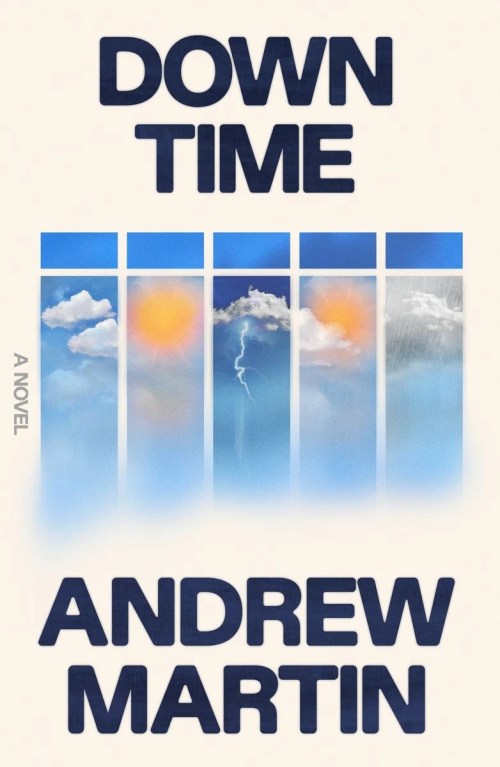
FICTION
Down Time
Andrew Martin
Farrar, Straus and Giroux
Published March 10, 2026


