In Karen Russell’s short story “Bog Girl,” a young man projects all the love his body can muster onto another body, that of a thousands-year-old preserved girl whose form, once exposed to air, becomes increasingly precarious. Similar yearnings can be found in Katya Balen’s Our Numbered Bones, just expanded to novel-length. However, to call Balen’s book a novel, especially when it comes to narrative arcs, feels inaccurate. The book is more long poem, or extended metaphor, and in this lens the reading experience is satisfying.
Our narrator, Anna, escapes her prolonged writer’s block and the grief surrounding her mother’s Alzheimer’s to work remotely on her sophomore novel. The perils of a writing retreat are familiar to any creative, but Anna’s takes a macabre turn when she stumbles upon a body. At first, as the police show up, we expect procedurals and crime tropes, but as Anna meets a band of ragtag archaeologists, she learns the body is bog-preserved and dates back thousands of years. Even more intriguing is Anna’s visceral connection to the body, understanding its (or, rather, her) hopes, history, and fears.
Balen brings an economy of words to Anna’s narration, rich with small details. Simple sentences such as “I lay out biscuits on a plate and they are devoured…we settle into a low hum of conversation that wraps around us” take on a soothing rhythm as Anna dips in and out of the past, recalling details about her husband, her mother, and her own life while trying to find community with the archaeologists. Yet, despite Anna’s growing obsession with the body and her own obvious traumas, we are kept at a relative distance from her feelings. Her caring husband frustrates her. There is an emotional chasm between her and her mother despite their frequent contact. There is constant reference to “the box,” which is not resolved until the tail end of the novel, though the mantra repeats over and over.
It is this sticking point, the nature of information withheld, that distracts from Our Numbered Bones’ many good qualities. When a major plot point is revealed, connecting “the box” to events laid out in the story, what follows is backstory and explanation, key aspects to the character we have not been privy to, despite the novel taking place in first person present tense. While the reveal is unexpected, it at times feels unearned. In terms of character dynamics, we are given small snippets of everyone but Anna, and Anna herself does change, but quietly, subtly, in very expected ways in the context of the story.
Taken another way, outside the context of a typical novel, the book shines as a meditation on grief, the idea of recent loss and loss from thousands of years ago sharing a strong connection. The cyclical nature of womanhood, the female body as commodity and specimen. These themes float to the surface before any sense of narrative does, and therefore brings to mind more poetry than prose. Indeed, the novel relies heavily on verse even though Anna herself is a novelist. In dream states, or when she is deep in reflection, pieces of poetry and verse-like lines are what dominate the page space. Taken slowly, read for language and motif, the book shines.

In her acknowledgements section, Katya Balen remarks on her long history in the children’s literature space, this being her first foray into adult fiction, and while these themes are nowhere near childlike, the brevity feels familiar. Similarly, Karen Russell’s “Bog Girl” is only a few pages long. One wonders if the nature of a preserved body, dead before its time, lends itself to a similarly arrested story, with ways for it to move forward but a conscious choice to stay within its confines.
FICTION
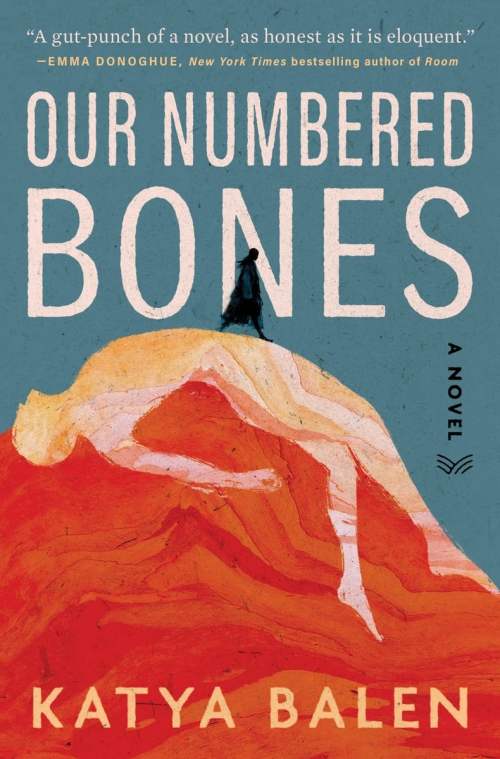
Our Numbered Bones
By Katya Balen
HarperVia
Published February 17, 2026