


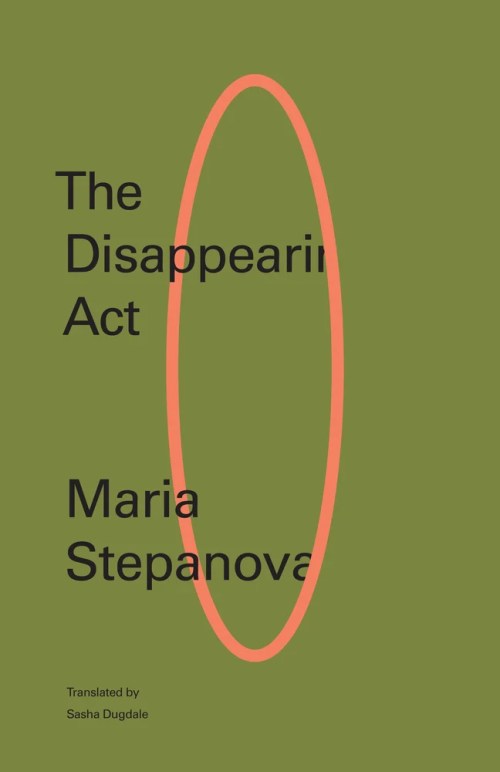
Reading The Disappearing Act by Maria Stepanova was a little bit like looking into a mirror. The story follows a writer (just like me), who is named only as “M” (yes, same thus far) and finds herself wandering an unknown town after a mishap with her train on the way to a reading, feeling a tremendous sense of freedom and intrigue at her newfound situation (well, I’m not lost at present, but I am certainly familiar with the feeling). But whether you are a writer or your name starts with M or you’re acquainted with the beautifully suffocating feeling of possibility when you find yourself somewhere no one knows you, I’m going to tell you why, if you are an American like me, you need to read this book…and you will see yourself there too.
The Disappearing Act is one of those gems of literature that demands context to fully understand its greatness. This book is set, though without ever actually saying so as to evade censorship laws, in Russia, during the time of Russia’s full-scale invasion of Ukraine circa 2022 and the fallout thereafter in 2023. Maria Stepanova fled Russia so as to remain safe as she spoke out against the State through her work, both as a writer and as the founder and former editor-in-chief of OpenSpace.ru, and then later, Colta.ru, an independent cultural platform.
The main character of this new novel is not so far from the situation of Stepanova herself. M is on her way to an author event when she finds her connecting train cancelled and, though she makes some further attempts to arrive at the event, ultimately takes pleasure in remaining in the unknown town of F. M is overwhelmed by the taste of freedom that accompanies lingering in a town that knows nothing of her nor she of it, and finds herself stumbling upon a rogue circus and volunteering to participate.
Despite this deceptively simple plot, this book delves deeply into who we are when we are no one, and who we are when we are far from home. Although Russia is never named, it is talked about extensively under the pseudonym “the beast.” M grapples with her hatred for the actions of her home country while still feeling deeply attached to it, even irremovably a part of it. She muses that “she found it hard to explain that the very nature of the beast made it tricky to hunt down or to fight. You see, she might have reasoned, it’s not as if the beast was there in front of me, or even behind me. No, it was all around me, and to such an extent that it’s taken me years to realize that I was living inside it, that I was perhaps even born inside it.” M experiences that uncanny feeling that, if you are an American, you may feel as well—that feeling that the land in which you reside, even when you try to escape it, is stuck inside you, or perhaps you inside it.
And in trying to escape that feeling, M realizes that it is not just her mind that cannot outrun this feeling, but her body as well. Her home is in the way she approaches situations, the language she speaks, the way she walks. She confesses “sometimes she noticed in the face or in the shoulders of the person she was speaking to something like a spasm, which told her it was the beast they saw in her, the beast first and foremost.”
Knowing this feeling to be true, M cannot help but think extensively on this subject, only to land on the thought: “Why did M’s every thought, every memory, inevitably and rapidly lead her to think about the beast and its workings? When all was said and done it was a discourtesy towards the rest of the world and everything that wasn’t the beast, and yet still fully deserved her attention.” Perhaps we also feel that way when we think of our home country…that it is so undeservedly all-consuming and yet so necessary to us to think about what we are, what we were, what we could be or could have been.
These questions that M considers are essential for us to think about for ourselves in this day and age in the United States. America the beautiful, if it ever was, has morphed into America the beast. Children sporting Marvel are being detained, bystanders who bravely step in are being executed, those who call America home, who lift our economies and our culture and our collective joy, have a war being waged against them. If you call yourself an American and you aren’t thinking about what it means for you to live in this beast, you should be. Yes, these questions are exhausting and in some ways impossible to answer. On the surface these issues may not affect you, but we are all given the duty of responding when our government attacks our neighbors. We owe it to them, at the very least, to think about these things.

Here, in this beautiful olive green little book from New Directions press, is a poignant, powerful story that can help you think on these issues as you wander through a town and to a circus with M. The Disappearing Act is a gift that has appeared in this country, in this language in which I write—accept it.
FICTION
The Disappearing Act
By Maria Stepanova
New Directions
Published February 17, 2026


