


In my previous life as a high school English teacher, Mark Haddon’s The Curious Incident of the Dog in the Nighttime was one of my favorite texts to teach. The narrator’s striking voice is an excellent vehicle for teaching both point of view and the less-quantifiable social-emotional skills of empathy and relating to difference. I’m sorry to say that I’ve been unfamiliar with the rest of Haddon’s oeuvre beyond Curious Incident until now.
Leaving Home: A Memoir in Full Colour is a unique nonlinear, richly illustrated memoir. Told in a collection of eighty-seven vignettes, the organization of the story is stream of consciousness in a way reminiscent of a conversation with an old friend, freely associating from one memory to the next.
The marketing copy for the book describes it as “lavishly illustrated,” which is true even as it fails to capture any specificity. Leaving Home is not a picture book, nor is it a graphic memoir, but each of the vignettes includes one or more images: old photographs, artifacts from Haddon’s childhood like book covers and pamphlets, and/or art created by the author himself. The illustrations give the memoir the illusion of thumbing through a photo album and discussing the contents of each.
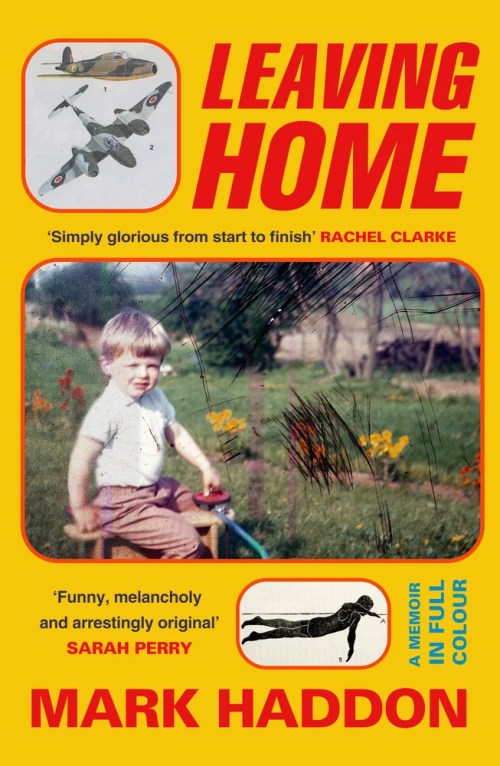
The subtitle as presented on the book’s cover, A Memoir in Full Colour, is not present in the front matter. Lest the brightness of the yellow and the relatively pleasant expression of a toddler Haddon on the cover imply that what lies inside is pleasant, before the copyright, title, and dedication pages is a photograph of a bouquet of flowers and the words “An exorcism.”
While the term “exorcism” may inspire images of a certain violence, Leaving Home is the tenderest autopsy of the ghosts of one’s life. The book is dedicated to Haddon’s sister, Fiona, who features prominently throughout, but it reads at times like a love letter to the anxious, deeply depressed child Haddon once was.
A highly sensitive child to adults ill suited for parenthood, Haddon’s early life is marred by an inability to live up to his parents’ unrealistic expectations of him. Much of the memoir explores the way their strained relationships changed over time. His discomfort with playing rugby, his father’s most beloved pastime, as a child evolved into insults and interrogation about his sexual identity when he got an ear pierced as an adult. Admonished by his parents repeatedly to “get a real job,” Haddon managed to craft a career for himself as a writer and illustrator in spite of it all.
The early alienation from his family of origin set the groundwork for Haddon’s lifelong interest in difference. He was, of course, hyperaware of his own differences: somewhat sadder and more anxious than the average person, sensitive, creative. Haddon has spent much of his life volunteering with individuals with cognitive and developmental disabilities, a fact that comes through so beautifully in his rendering of autistic teen Christopher Boone in Curious Incident. His ability to forge connection through difference is a beautiful throughline, especially as he marries his wife and builds a family of his own, shifting the paradigm from one of duty and obligation to one of love and acceptance.
Leaving Home is not a craft book. You will find no writing exercises, no meditations on the construction of a sentence, no odes to plot devices. But as any memoir written by a writer, it is impossible to fully strip writing about writing from the work.

As a writer predisposed to melancholy and anxiety myself, I found Haddon’s approach to writing and to the world relatable and comforting. He ponders the artifice of narrative when applied to a human life, made manifest in the stubborn lack of chronology through the book’s many vignettes. Capturing difference of perspective is perhaps Haddon’s literary superpower, and I was moved to tears reading his insights on the impact a balcony can have on the perspective of either a human being or a fictional character. With a memory colored by a painful childhood, Haddon describes struggling to remember the details of the books he’s read and envy he has at readers who live with a library of stories in their minds–something many writers yearn for. He describes his own memory, especially for the stories he’s consumed, as a compost heap; he cannot retrieve anything from it, but all of the stories therein act as fertilizer for his own work.
Ultimately, Leaving Home is heartbreaking, hilarious, and richly hopeful, especially for other oddball creatives. The life he paints is one of quiet steadiness, creative expansiveness, and a love for all that is different and interesting. The inclusion of visuals into the text adds richness and intimacy. It’s a book I expect to return to for quiet triumphs to buoy my creative spirit through all sorts of dark times.
Memoir
Leaving Home: A Memoir in Full Colour
By Mark Haddon
Doubleday
Published February 17, 2026


