


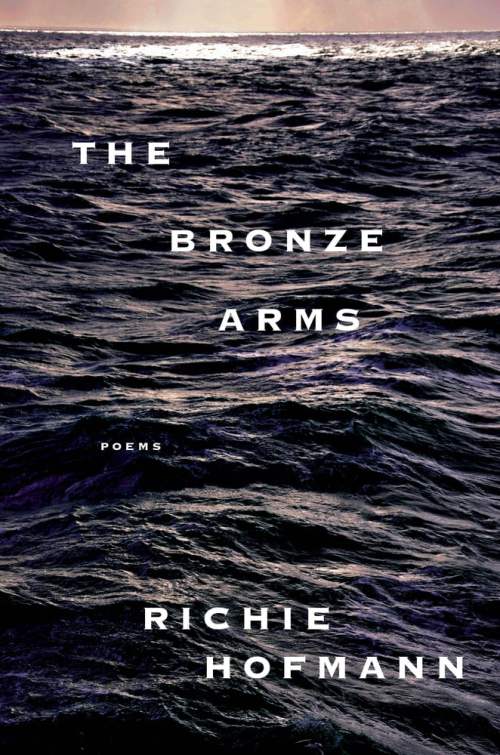
Buoyed by the richness and complexity of his two previous collections of poetry, Richie Hofmann’s The Bronze Arms is one of the most highly anticipated poetry books of 2026. My 2025 goal for reading was to pick up more books outside of my comfort zone–to a transformational effect–-and it looks like I’ve carried that goal into 2026, as I dig into The Bronze Arms with its themes of water and danger, men touching each other and its danger, men caring for each other and its splendor, and the archaic and modern in communion.
Like any good poet-turned-rhetorician confronted with an unfamiliar textual landscape where “other men tried to put death into the mouth” of an “Angelic Richie,” a world where the speaker’s lovers “chewed my hair softly / while I slept on their chest / any fragment of him unhinges me / masters me,” and men “shoved crumpled dollar bills” into the speaker’s mouth, I searched with eyes wide open and both arms extended for a doorway in. The doorway was our shared language and a mutual mindset hardwired for noticing the beauty in contradiction, pain, pleasure, and uncertainty.
Borrowing from rhetoric—perhaps a not unsurprising move given the book’s Greek motifs, classic allusion, and the setting of the collection’s harrowing heart-center “Drowning in Crete,” a poem about the speaker (and poet’s) near drowning at the age of five—I called upon rhetoric scholars Sonja K. Foss and Cindy L. Griffin’s concept of “invitational rhetoric” to see how Hofmann’s poetics of invitation successfully drew me into his world.
Hofmann’s extremely vulnerable poetic is invitational, not confrontational, disrupting a top-down power dynamic that can be a condition of the relationship between readers and texts. While reading The Bronze Arms, I do not feel like a voyeur, though I am certainly an outsider to the world Hofmann describes, in many respects: I have never been out of the country; intimacies between men are foreign to me; I am not all that familiar with classical allusion. While a book is, at the end of the day, an object we hold in our hands, and one on the heady material of eroticism and embodiment and classic themes can run the risk of impenetrability, it is Hofmann’s ambivalence that invites a reader like me into a sort of no-man’s-land of feeling that ultimately activates and engages me.
We see this when the speaker offers several mini conflicts in the space of the poem “Breed Me,” a title that invokes a not-very-sexy if still highly erotic bid between lovers: “I deplore clutter but I do like flowers”; “I like hard and classical”; “The ceiling fan / Pushed heat around / Even though it was snowing outside.” Some little conflicts arise again in “Lust Archive,” if in a bit more straightforward language: “Serenity and violence, / Pleasure and loneliness.” In “Armed Cavalier” “The summer I wished you loved me / Enough to kill me, / But not really,” offers perhaps the most aggressive form of pathetic whiplash: love me, murder me, or something in between.
If The Bronze Arms offers contradiction without confusion, it also offers space without lack. The collection is airy and uncluttered (he “deplore[s] clutter,” remember), with lots of room to contemplate Hofmann’s undulations. Early poems like “Minotaur” include a line of white space between lines, allowing the reader to take a beat between “My longing for you followed me like a shadow, / Getting longer in the day, disappearing at night, the maze.” Here, “longing” is both the feeling the speaker has for the ‘you’ in his “camera lens” and a characteristic of the reading process brought about by the white space between lines, the “shadows” that follow the speaker and every line of the poem.
In “Breed Me,” another poem with white space between lines of text, the description of the speaker’s environment partners with the poem’s form: “Through the blinds, obscure gods shined, / Making the outlines of my body / A kind of emptiness.” What might appear when we part the blinds of the poem? What resides in the appearance of the poem’s emptiness?
The readerly practice of min(d)ing the gaps for meaning is reminiscent of another poet writing in a classical queer tradition of her own invention: Sappho. The Bronze Arms contains fragments—a practice of Sapphic recovery—sometimes rhymed and other times unrhymed, sometimes in couplets and other times in four lines. The poems are even listed in the Table of Contents by their first lines, rather than by discrete titles, another nod to Sappho. These glimpses—not really asides but certainly relegated to a different positionality than the more central poems of the collection—command attention in their own right:

the night entering the day from behind
I took off my clothes
my body a series of entrances and exits
desire desire without any meaning
In the above passage, I noticed an opening right away. There, between two desires, is my entrance into the text, where dominance is never offered without the attendant naked vulnerability of the body without clothes, not unlike the natural process of night coming into day.
Richie Hofmann’s The Bronze Arms is an entire collection of poems each good enough to be the anchor poem of the collection, that is, the poem intended to leave the reader with the most positive last impression. This is exactly how I would want a cherished poet friend to invite me into their world and its beautiful entanglements.
POETRY
The Bronze Arms
By Richie Hofmann
Knopf
Published February 10, 2026


