


We have to assume that as artists and writers, we all face moments—likely many—where we ask ourselves: What’s the point? Most of us will never grow wealthy from our craft. As for those who do, we often find ourselves questioning their artistic sincerity. Have they simply mastered the art of reducing their soul to a manageable, marketable asset, distorting their identity for the sake of self-promotion?
Most artists still rely on a day job—as educators, insurance salesmen, doctors, clerks at the Museum of Modern Art, or copywriters—to subsidize their practice. The question then becomes: At what cost? How wide is the gap between the work-a-day mundanity and our essential, artistic selves?
In Daniel Poppick’s debut novel, The Copywriter, the narrator, D__, is a poet writing copy for a retail startup. He is a “permalancer,” or as he puts it, “someone who is less of a mirthless tool might put, a permanent freelancer.” D__ exists in a professional liminal state, attempting to build a firewall between his art and his work. But that separation is an illusion. The veil is punctured when his new CEO—a man possessing a comic lack of experience—offhandedly remarks, “You’re the writer—you tell me,” before asking, “What kind of poetry do you write?”
If we attempt to find meaning in labor, what concessions do we make for the sake of a paycheck? How does this friction reshape the self?
Everyone D__ associates with outside of work is a poet. Will finished his PhD with a dissertation on the poetics of bureaucracy and ekphrasis, “but [his] real passion is delivering office furniture.” Ruth, after a prestigious writing fellowship, is off to pursue a PhD in L.A. And Lucy, D__’s long-term (soon-to-be ex) partner wrote her dissertation “on the use of live animals in post-Elizabethan theater—mostly sheep, but occasionally dogs and pigs—which she later abandoned for a job at a magazine.”
John Keats defined negative capability as the ability to exist in “uncertainties, mysteries, doubts, without any irritable reaching after fact and reason.” D— invokes this concept when he learns his company is likely folding. “I understand the dynamics of this moment in my professional life well, which isn’t to say I don’t hate it,” he reflects. “Understanding the unsaid, decoding silence, reaching beyond reason for what Keats called negative capability. It isn’t poetry, but poetry has trained me for it.”
In Gramscian terms, this friction represents a struggle for ideological survival. The workplace functions as a micro-state where the CEO maintains power not through coercion, but through cultural hegemony—the process of making corporate values like meritocracy and optimization seem like undeniable common sense. The Copywriter is written as a series of notebook entries, and D__’s notebook, a chaotic repository of parables, dreams, and emails, serves as his primary site of counter-hegemony. By meticulously documenting the “uncanny, comically meaningless” nature of his tasks, D__ performs an act of de-naturalization; he refuses to see the office’s absurdity as normal.
While the system demands his “spontaneous consent” to its goals, the notebook allows him to cultivate what Gramsci called good sense—a critical, if fragmented, awareness that resists the dominant narrative. In this light, D__ is not merely a “Traditional Intellectual” (the poet) hiding from the world; he is a nascent “Organic Intellectual” of the precariat, using the very language of his exploitation to map the sturdy structures that seek to commodify his soul. The novel’s humor stems from this realization: the more D__ tries to find meaning in his labor, the more he realizes the labor is designed to parody the very concept of meaning.
How wide is the spiritual gap between art and work? D__ defines poetry as “the art of turning away from labor while performing it.”
This tension was present in Poppick’s earlier work. In a review of his 2017 poetry collection, The Police, Emily Barton Altman noted that Poppick’s ultimate question is “whether or not language can do anything to bridge the gaps that our own policing increasingly widens.” The Copywriter extends this inquiry into the corporate sphere.
While flying back from a visit with Ruth in Los Angeles, D__ experiences an “anti-epiphany.” His firm has asked him to write an event description for a lecture by a prominent former U.S. statesman—a man despised globally for the bloodshed caused by his policies. For D__, using his linguistic gifts to polish the image of such a figure is a bridge too far.
“[W]hat does poetry do?” D__ turns to ask Lucy. “It doesn’t bother you that the country is about two seconds away from becoming a full-blown fascist death cult and we’ve organized our lives around writing poems for one another that almost no one else will ever read?”
When D__ responds to the assignment with a clipped, “I’d prefer not to,” he evokes Melville’s Bartleby, staging a quiet insurrection against the established hegemony of the workplace. He is wresting back control of his language from its corporate contamination.

The Copywriter suggests that while the modern artist may be forced to lease their hours to the marketplace, the lease does not include the soul. D__’s journey reveals that the most radical act an artist-worker can perform is the withdrawal of spontaneous consent. By maintaining his notebook—that secret, uncommodified archive of the “uncanny”—he preserves a pocket of resistance within the corporate machine. By reclaiming language from its day job and returning it to the realm of poetry, D__ does more than just survive; he stages a quiet, persistent revolution.
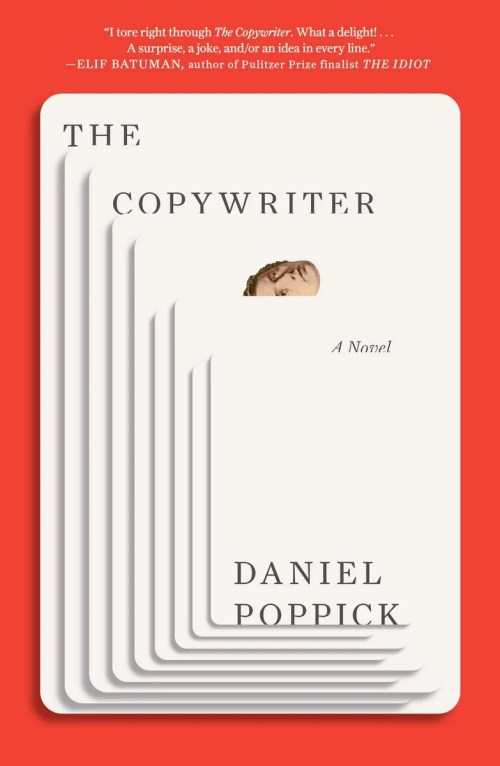
FICTION
By Daniel Poppick
Scribner
Published February 03, 2026


