


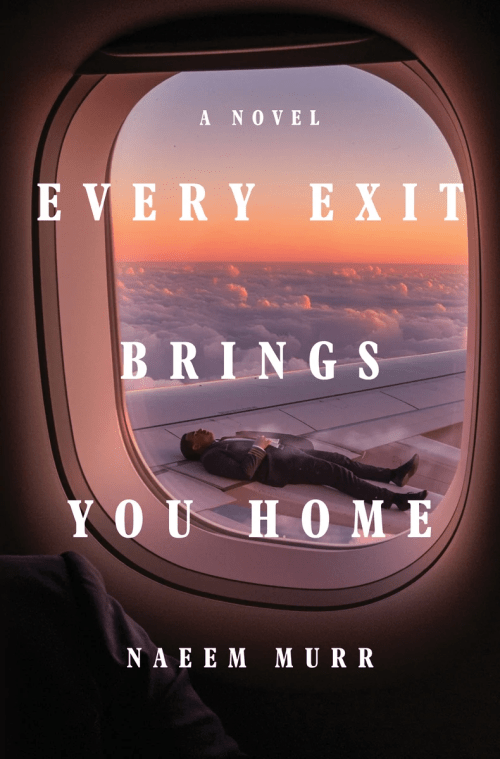
In Every Exit Brings You Home by Naeem Murr, flight attendant Jack (formerly Jamal) and wife Dimra are originally from Beach Camp in Palestine; now they live in a falling-apart Chicago condo building trying to get pregnant as the housing crisis accelerates around them. When a new woman moves into the basement, Jack finds himself growing increasingly attached to her, to his own dismay. As he pushes back against his instincts, he thinks about two former loves: one that he was violently punished for back in Palestine, and one in the skies who never truly knew him.
Surprisingly, Jack’s biggest problem manages to stay internal. He lies near-constantly. His fellow flight attendants think he’s a gay man with a dedicated partner. Few people in his life know of his history in Palestine. In a fit of spite, he tells his estranged father that he and his wife have had a son that hasn’t yet been born. But all his lies go largely undiscovered. There is a plus side and a minus to this: while Jack is never vulnerable, opened up, or judged, he is also alone in his misery, and as the novel proceeds, he increasingly discovers that other people—from their rules-obsessed downstairs neighbor to the two women dating down the hall—are also keeping their stories close to their chests. Alongside Jack, the reader gathers stories of love and heartbreak, watching this constellation of people try and survive.
Perhaps the reason for Jack’s walls lie in his and Dimra’s past. Both are haunted by guilt. A feeling of having escaped the bombings, violence, erasure, and horror that their families are still facing, horrors that Dimra watches on repeat on TV all day. Damage, violence that is “endless, endless, endless.” Readers too may feel the damage is endless; this isn’t a novel for the weak-hearted, as misery piles onto misery.
In the face of all the violence of Jack’s parents’ pasts, and of Jack’s painful childhood, the everyday feuds and disasters of the rich, fascinating characters all around him in the condo building often feel frivolous. Jack is called on to fix clogged pipes and noisy floors; as a neighbor gripes to him about her love life, his memories cycle back to his displaced uncle being forced to rip up his own garden for Israeli settlers. At one point a cheery new flight attendant has no idea what Auschwitz is; she smiles at Jack with “an innocence so appallingly absolute it seemed sinister.”
The women of their camp make fun of his mother, until she is arrested and comes back hardened. The suffering is part of Palestinian identity: endurance, the feeling of waiting in a never-ending cycle of pain and hope. Jack and Dimra suffer in their own way, but they are no longer part of “that shibboleth of ultimate Palestinian victory; samood, the capacity simply to endure.” Their survivors’ guilt places them in a state of being at home neither in their past nor their present. They can only think of home, but it is no longer their home.

The pain feels endless. And yet when the noise stops, suddenly, in Jack and Dimra’s apartment, their crabby downstairs neighbor admits that she misses it. Every Exit Brings You Home encapsulates the pain of longing, and the struggle of letting life in when your heart feels like it’s turned to stone. Theft, displacement, shame renew themselves in Chicago, but Jack and Dimra struggle to truly occupy the spaces they inhabit. Both cast out of home, their reentry at one point denied, their letters rejected, they hover in a state of waiting until it is too late to be content in what they’ve found.
FICTION
Every Exit Brings You Home
By Naeem Murr
W.W. Norton & Company
Published February 3, 2026


