


How many times did the algorithm get you today? Calculate your TOD (Time on Devices): texts with friends and colleagues, social scrolls, work emails on the computer, and your after dinner HBO show all count. Not to say these things are bad. This is the digital age after all, and we must keep in touch with our loved ones, we must relax when the day allows us to, and we must be employed to survive. But that daily measure of our finite time is still daunting when put into perspective, and I mean really put into perspective. Where did your attention go today?
The algorithm knows something that we do not. Our devices are engineered to be the first light of a brand new day and the last light of the night before. It finds us on the morning commute, in-between tasks at work or arm curl reps at the gym, during class, during meals, mid-Zoom meeting, mid-conversation, when winding down, when just waking up, while reading, while watching a movie, and most of the time—just because it’s there. As a collective human race we effortlessly give billions of minutes of our time to this subconscious version of ourselves, a glossy eyed trance where the minutes pass differently. In this alternate reality, our time and our attention do not belong to us, and it is becoming increasingly difficult to reclaim them. The Friends of Attention want you to understand that this is not your fault.
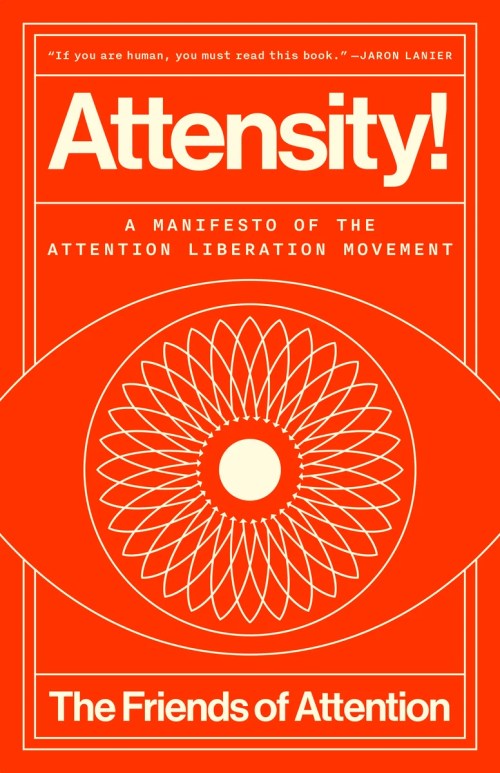
In their own words, The Friends of Attention are a nonprofit coalition of creative collaborators and colleagues who all share a passion and a need to act against the attention crisis. They write, gather, organize, discuss, study, and pursue to reclaim what unfathomably large corporate powers have mined from our psyches for various commodities, namely our profit, power, and political gain. Their first publication, Attensity!: A Manifesto of the Attention Liberation Movement, is an accessibly written manifesto with a motivational tone that seeks recruits for their movement. Not with a signature, or an email for a newsletter, but for you, the reader, to just start paying attention. Pay attention to YOUR attention and pay attention to the attention of those around you. Is a society of bent necks towards a backlit screen really the best we can do?
Attensity! targets a literally inconceivably large praxis of society. It is clear we are well across a point of no easy return when it comes to the use of technology in our everyday lives—and the Friends of Attention do not claim this is a bad thing. The book’s many authors have broken down their message into short but intentional essays and bumper-sticker-esque innuendos that simplify this large and layered idea. They understand most people are not thinking about this crisis like they are, or even as a crisis at all.
Firstly, the reader must understand the philosophical broadness of what attention actually is vs. what it is defined as through years of military and government backed research and evolving DSM definitions (the Friends explain this better than I can). Second, the reader must appreciate why their attention is valuable and recognize the simple idea that attention towards a thing gives that thing value. And third, the reader must take themselves out of it. Though many pages are packed with elementary, explanatory language discussing these concepts, the effect on the whole is a voice that is addressing a collective consciousness. Some may find the narrative of Attensity! to be so optimistic and sincere that it feels plain, repetitive, but this is on purpose. This is a crisis that can affect almost everyone, and has, no matter their age, education level, or economic status. The voice of Attensity! is so monotone, so objectively neutral for the greater good, it could hypothetically be digestible to anyone. This is an incredibly difficult feat when your enemy is an already politically polarized, overworked society, supercharged by a well-oiled algorithm that irresistibly and without reserve aggrandizes our sense of self and spits it back into our vacant stares on an hourly basis.
Similarly, The Friends of Attention address the many benefits that technology, even social media, has brought into our world. They understand that our new found levels of connectivity (the kind that doesn’t get artificially manipulated by Big Tech) has led to greater movements and greater understanding, that arguably would not have been possible before without the ability for young people to engage with peers from all over the world. Resorting back to a less connected world just for the sake of the “good old days” is not their prerogative. As they put it: “This is not a conversation about trade-offs, it is a conversation about coercion, theft, and the instrumentalization of human life.”

According to YouGov, 40% of Americans did not read a single book in 2025. The way the Friends of Attention see it, if this book somehow winds up in your hands, that means you have already probably noticed the elephant in the room and therefore you’re already ahead of the curve.This is a crisis set in the middle of a massive juxtaposition, books and reading are not exempt from the attention economy either. Will a book like this ever reach the people it intends to without the algorithm inevitably having to help them out? Probably not, but that isn’t the point. The path to determining the logistics of our physical and digital existences gets muddy rather quickly. When self aware, it is incredibly easy to become burnt out, depressed, and overwhelmed by screen times, frequent communication, and our unlimited access to literally anything. Before you start planning any kind of social media detox or build habits to start reconnecting with nature, the Friends insist you do the human thing first, and feel it. You can sense something is different, something is wrong— how does that make you feel? Maybe it deserves your attention.
NONFICTION
Attensity!: A Manifesto of the Attention Liberation Movement
The Friends of Attention
Crown
Published January 20, 2026


