


Jill Blaine is dead, but not gone. She exists somewhere in between, on a plane of existence that overlaps with our living world, but is very much not it. At the start of Vigil, George Saunders’s anticipated new novel, we don’t know the afterlife’s rules. They’re revealed a little at a time, and—in a strangely satisfying way—not all questions are answered.
We literally plunge in alongside Jill as she plummets toward the earth in the opening scene, knowing only that her remit, for some time now (how long?), has been to assist dying souls—her “charges”—over the threshold, into death, by encouraging them to leave themselves behind and accept their demise. Tie up any loose ends. As the story proceeds, we learn what awaits those who do not find comfort, who do not attain total peace, though we suspect from the get-go that Jill is one of them.
Following up his Booker Prize-winning Lincoln in the Bardo, Saunders returns to the topic of death. A mark of an effective writer is the ability to make a ubiquitous subject feel brand-new, and Saunders continues to illuminate the veil between realms in a tangible and arresting way. Here’s how he describes Jill’s impression as she meets her newest charge, Vigil’s antagonist:
“Before me lay a person who had not willed himself into this world and was now being taken out of it by force, the many subsystems within him that had always given him so much satisfaction shutting down agonizingly. Soon it would come, accompanied by disbelief and panic, and he would find himself on the wrong side of a rapidly closing door, everything he had ever known and loved out of reach, over there, beyond it.”
But when Jill enters “the orb of his thoughts,” she discovers that her charge, the notorious oil company CEO K.J. Boone, possesses a “formidable stubbornness” about what he considers to be his life’s many triumphs. To make matters worse, he is antagonistic to Jill’s presence. As she puts it, “This was—unusual. To say the least. Normally I am received quite warmly.”
We learn, via fellow spectral presences—or, as Jill elegantly calls them, those “of our ilk”—about Boone’s swift rise to the peak of the oil business, about his entry into the halls of power, and about his use of that power to exacerbate what most people on the planet would call the greatest crisis of our time: climate change. Ghostly characters team up to share their experiences of the warming planet with Boone, but they’re quickly at odds on the proper approach.
Most prominent among these is “the Frenchman,” an inventor of an early engine who, having not found his peace, and having made it his mission to atone for the environmental catastrophes his device unintentionally wrought, advises Jill to lead Boone “as quickly as possible to contrition, shame, and self-loathing.” He’s spent his entire afterlife becoming the spirit world’s foremost climate-change expert, whereas Jill seems to have no idea it’s even a thing, so detached has she become.
The contest between Jill and the Frenchman over Boone is the vehicle for the book’s interrogation of determinism. But Boone is Jill’s charge, and she is not deterred, either by Boone’s resistance, or by the Frenchman’s insistence on holding Boone to account.
Jill’s a true believer in her cause. It’s all about “elevation,” you see. Elevation beyond oneself. Having become one with hundreds of people in their final moments, Jill has seen the truth, felt the truth, about Boone, about all of us: “Who else could he have been but exactly who he was?”
A human being is “an inevitable occurrence, upon which, therefore, it would be impossible, even ludicrous, to pass judgment.” We are trapped in ourselves, jailed, unable to be free. So we must be comforted.
Something has been happening to Jill, ever since she entered Boone’s suffocating presence: “familiar symptoms of an affliction that, when upon me, always caused me to become less powerful and effective than was desirable.” That affliction? Recalling her former existence as a living human being. Which she has always, until now, managed to push away.
Jill is aghast that she has become more “herself” than she’s ever been—that is, since she died. She decides, for the first time, to find out what became of her husband, Lloyd. And in the process, she rediscovers the shocking cause of her death, and the source of her convictions about “elevation.” Will Jill recommit to her cause, or will she embrace her burgeoning re-humanity?
I wished for a couple more scenes of K.J. Boone in action as a climate-change denier. Boone uses his immense influence to poke holes in climate science—in a hundred ways large and small, with varying degrees of underhandedness—and to mock and attack those who champion it. We do receive plenty of information, much of it recounted retrospectively by other characters, but sometimes by Boone himself in deathbed-reminiscence mode. One such self-reflection near the end of the book: “Only a handful of people in all of history had ever known that kind of power. Presidents, maybe, depending on the era… He spoke and markets moved; called a king and the king picked up.” I’m reminded of bulldozing media titan Logan Roy, played by Brian Cox on the show Succession.

Perhaps TV makes for an unfair comparison, but I did want to see Boone at the height of his powers, in order to cultivate a thorough regard, a visceral feel, for Boone’s magnitude as “the single worst agent in the monumental and criminal effort to deny” climate change.
On the other hand, painting Boone’s portrait from a distance focuses the reader’s attention on the wreckage he causes for pretty much everyone in his life, and for society at large. Any suggestion of which, of course, he attributes to the jealousy of inferior people. By spending so much of our time with Boone in his current state as a spent, entitled ex-eminence, we understand how his self-conception functions within his own mind: he was a good person, an essential person, who did what needed to be done, a gift to the world. He’d “always been the best among them.” If he was a little harsh? Well, his early life had been hard.
This is a key achievement of Vigil: we’re given a contemporary villain of the first order, the kind of man who we typically discuss, in the fever swamps of social media, in the most extreme terms, and with no nuance whatsoever. We don’t reserve empathy for our enemies. Not that evil doesn’t exist! Not that Boone necessarily deserves any empathy! Here’s a man with an able, dexterous mind, who has caused the world a great and unambiguous harm. Who really should know better. And look: his idea of himself is totally at odds with most of the world’s idea of him. We’re asked here to acknowledge that. Shouldn’t we account for it? If we’re to slow the destruction of the planet, wouldn’t it be helpful to account for it?
We’re plopped right into Boone’s mind and forced to linger there, forced to consider his angle. We see how he got the way he got. Just as Jill does, with her afterlife powers, we, via the power of story, are allowed to become one with K.J. Boone. Dare we judge him?
I felt certain Vigil wouldn’t offer any pat conclusions. Invoking Chekhov in an interview with David Marchese, Saunders states his aim as not to solve a problem, but simply to formulate it correctly. The highest praise I can offer Vigil is to report how many of the novel’s core questions—Is Boone, and are we, “inevitable occurrences?” When the consequences of our actions are un-rectifiable, what does that mean for us? How can we make peace after trauma, and which sacrifices are worth it? Is anything ever worth relinquishing our humanity?—resonate long after the final page turns.
FICTION
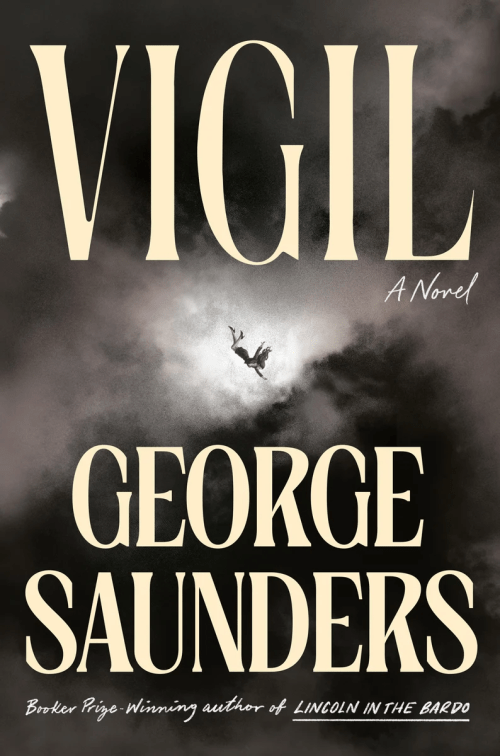
Vigil
By George Saunders
Random House
Published January 27, 2026


