


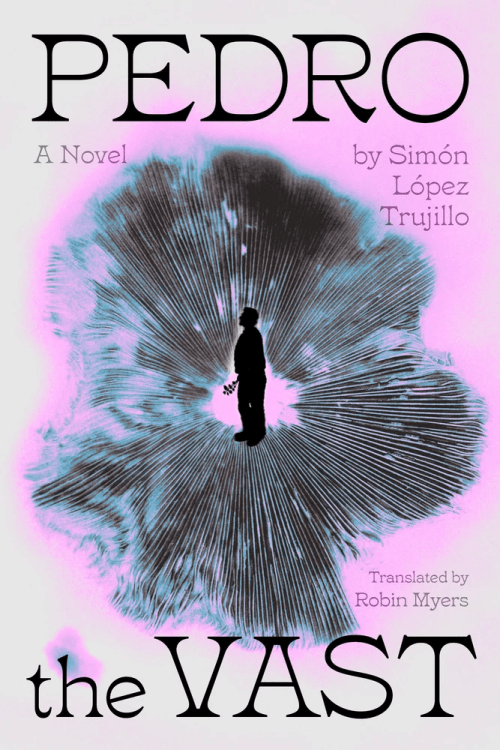
In Simón López Trujillo’s Pedro the Vast, readers are taken on an expansive journey as a deadly fungus forever changes the lives of Pedro and his family in an imaginative and mesmerizing sci-fi novel that ventures into environmental horror territory.
Pedro, a forest worker at a eucalyptus plantation in Chile, whose days are defined by early mornings and late evenings, works hard to provide for his children, Patricio and Catalina. He spends his days pushing his body to its limits on the plantation and ignoring a persistent cough after he inhales mysterious mushroom spores. Meanwhile, Catalina spends her days at school, and Patricio searches for ways to bide his time at home as he suffers the consequences of his school suspension. In parallel with peeking into the day-to-day lives of Pedro and his family, we follow mycologist Giovanna as she returns to provincial Chile to consult on a strange case of lethal blight.
Moving back and forth between the lives of these different characters, Trujillo uses each perspective to tell the bigger story as we slip in and out of the viewpoint of Pedro, his children, and Giovanna. We see each character in the story work like an organism, functioning as part of a larger whole. This technique proves effective, as we are brought along on an adventure in Pedro the Vast, where we go from being swarmed by a church’s fanatical congregation to marching past translucent people on psychedelic hillsides, and accompanying researchers as they arrive at Chilota Bay to begin their expedition searching for mycological specimens.
As the novel progresses, we follow the deterioration of Pedro’s health as his cough intensifies, eventually leading to his sinking into a coma. In this moment, we are on a journey through Pedro’s consciousness, following a sequence of otherworldly trips in which he searches for answers. While in this coma, Pedro is becoming Pedro the Vast, as the fungus that has invaded his body integrates itself with him, and in the second part of the novel, we are reintroduced to Pedro.
Now, if you have an aversion to spoilers, I recommend skipping over this paragraph. When Pedro eventually wakes up from the coma, he is alive, but as a changed man: a hybrid version of himself, somewhere between human and this parasitic fungus. He comes out of his coma, speaking in lyrical, puzzling sentences and spewing out what seems like a secret code that needs to be deciphered by the human race. Speaking in long, hypnotic monologues to anyone who is around. Functioning as though an alien species is controlling his body. Except this species isn’t alien as we know it. It’s fungi that come from the same place we call home, Earth. The invasive fungi aspect is what makes Pedro the Vast stand out as feeling realistic and sends shivers down my spine compared to other sci-fi novels where the invasive species is from elsewhere.
Although Pedro the Vast is a short read, Trujillo manages to pack in a feast of information, imagination, and action, making it an epic tale of survival and hope that leaves a lasting sense of “oneness.” As each character’s experiences and consciousness bleed into one another, amidst the story of this invasive fungus spreading into their lives, the novel begins to read like a stream of consciousness inside a strange organism that has taken over its host.
Despite the use of scientific terms such as the name of the mushroom Cryptococcus gatti, which is suspected to be the cause of Pedro’s predicament, Trujillo manages to avoid making this novel feel overly scientific to the point that readers feel lost or bored. Suppose you’re not well-versed on the ins and outs of the biochemical properties of fungi: fret not. Trujillo’s inclusion of graphs, datasets, and charts doesn’t add confusion to the story. Rather, it adds texture and depth to the novel without distracting from the story itself, allowing the reader to become engrossed in it.

Underneath the sci-fi layers of Pedro the Vast, there is tenderness neatly tucked into the story. There are moments when Pedro’s children deal with their father being hospitalized and reckon with the idea that their father will be forever changed after awakening from his coma. When Patricio realizes that his father is alive but not the same, it is a realistic account of how many people have had to deal with a loved one who has succumbed to an illness and the melancholy and confusion that accompany the new reality. This aspect of the novel hits close to home, especially in an era defined by the COVID pandemic. Pedro the Vast at times reads like a realistic account of what dealing with an unknown illness ravaging a community looks like.
Pedro the Vast is a mesmerizing sci-fi novel reimagining an invasive species infecting humans, with the lingering side effects not brain fog but prophetic insights and collective consciousness. While reading Pedro the Vast, I was reminded of the television show The Last of Us and the fungi that took over the bodies of its hosts, turning them into violent creatures whose sole reason for surviving was to infect others. However, in Pedro the Vast, the fungi seem more like divine intervention, as they try to send cryptic messages to the human race.
FICTION
Pedro the Vast
By Simón López Trujillo
Algonquin Books
Published January 13, 2026


