


A true testament to the interconnectedness of time and space, Song of Ancient Lovers is a portal that takes you within and without mythic reality and historical conflict, ancient icons and modern media, curating a rewarding tale of love in a devastating world.
Laura Restrepo daringly retells the story of the Queen of Sheba through fascinating vignettes, ultimately detailing the epic love story of Sheba and King Solomon, both as the ancient story and as a modern romance. Building from this premise, the novel is mainly concerned with individual struggles like belonging, independence, family, destiny, and ethics, as well as depicting global horrors such as war, abuse, disease, and poverty. Sheba and her legacy act as both thread and fabric, cultivating a multifaceted textile of a text that continually references itself. Song of Ancient Lovers, at its core, is an unexpected romance, fraught with violence, deceit, and sacrifice, a reminder of the continuity between our mythic present and our sensationalized past.
Through alternating narratives the reader becomes familiar with Goat Foot, one of Sheba’s many names, her origin as an outcast, and her journey to creating the wealthiest kingdom of the age. Exiled by her mother, Goat Foot endures extreme isolation and even resurrects from the dead, emerging with an unwavering sense of self and a reinvigorated desire to live. From nothing, Sheba maneuvers through extensive deserts, cultivates an impressive incense empire, and witnesses and aims to end the destruction brought by greed, hatred, and envy.
In the modern narrative, we are given an intimate glimpse into the life of Bos Mutas, a writer who has been haunted by iterations of the Queen of Sheba since he was a young boy. He travels from South America to northern Africa, driven by his obsession with the Queen of Sheba and the desire to research and write about her. He arrives in Yemen, joining Doctors Without Borders, with the goal of exploring the area where Goat Foot was once said to roam. However, he is quickly engulfed by the intense conflict surrounding him.
Bos Mutas must prioritize his position within Doctors Without Borders and the heartache at hand, pushing his thesis research aside. In Yemen he is joined by Zahra Bayda, a Somali midwife who rescues, guides, and enthralls Bos Mutas, expanding and yet grounding his perspective of the world. The two are bonded in their constant attempts to mend a shattered world, and Bos Mutas must grapple with the seemingly futile nature of his research on the Queen of Sheba amidst the horrors they witness. In this environment of extreme anguish and pain, he must discover how his identity as a writer fits in, how his stories could heal even if they are not the stitches Zahra carefully gives someone.
The ebbs and flows of these narratives run concurrent even as they detail events centuries apart. Bos Mutas sees and senses Sheba everywhere, her enchanting aura appearing to him across the globe, reinvigorating his exploration for the truth about her. As Bos Mutas learns more, so does the reader. Through the alternating narratives we are along for the ride in his thesis project, we experience Goat Foot’s growth, and we are gradually shown the sticky spiderweb that connects these stories together.
Adding another layer to her novel, Restrepo consistently references, alludes to, and cites various authors and creators, particularly within the modern narrative, providing a more comprehensive view of Bos Mutas. Having a glimpse into the films, music, and books that come to his mind unlocks a new dimension in our understanding of him. This aspect of the novel is refreshing in how it humanizes Bos Mutas and situates him more clearly in a globalized existence. His reactions are informed by his experiences, his thoughts dictated by what he has learned.
Indeed, the entire novel is an impressive feat as it gathers remote references, mythic tales, philosophical teachings, pop culture, and lived tragedy into a cohesive text. If the novel ever feels overwhelming, the sentiment draws you in, rather than shunning you away. You are compelled by its constant ties to the world around you, making the book a vessel within which to understand yourself as a continuation of everything that has happened and everything that will happen.

As a reader, these references are exciting when recognized, intriguing when unknown, but always pushing our understanding of the intertextuality of life, the collage of content that is constantly roaming through our minds. You emerge suddenly hyperaware of the relationality of all things, of our inevitable place in the past and present of existence.
A glorious weaving of storytelling, Song of Ancient Lovers has a dazzling but dizzying effect as it traverses millennia, alluding to everything from Edward Said to Ghostbusters, and all in the same breath. While initially striking, the reader becomes familiar with Restrepo’s cadence, and her continual references make for an immersive novel that spills off the page. The connections she makes are all too relevant in this moment, and the reader can identify how the Queen of Sheba and Bos Mutas’s stories are more intertwined than they are disparate.
Restrepo seems to be saying to us: the past reverberates into the present. Myth returns again and again. Are we listening this time?
FICTION
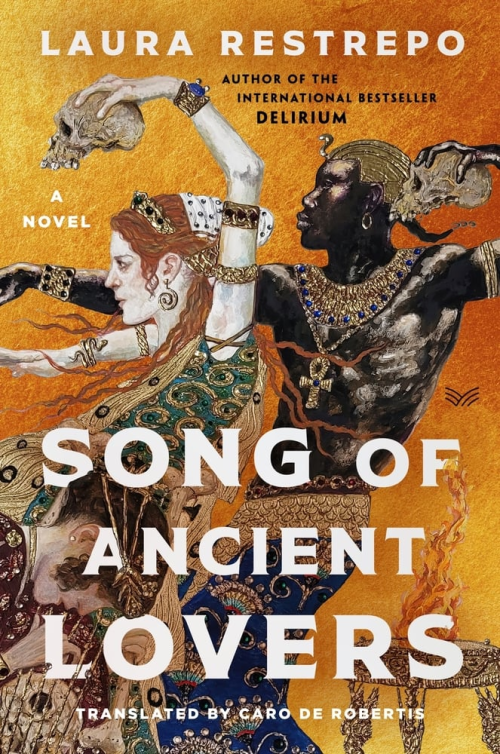
Song of Ancient Lovers
By Laura Restrepo
HarperVia
Published December 30, 2025


