


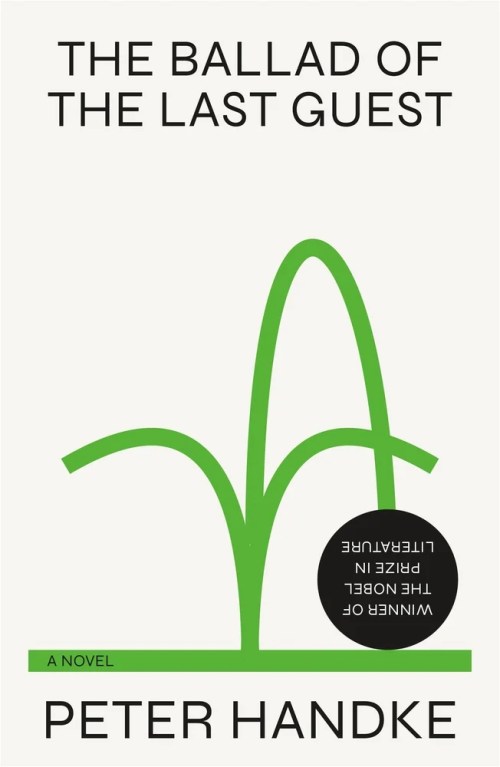
Anyone who has ever returned home for a holiday, school break, or momentous family event knows the feeling of alienation that can accompany such visits. Places and people that are simultaneously changed by time yet still uncannily familiar. Or rather, is it the visitor who has changed? Or both? Peter Handke’s latest novel The Ballad of the Last Guest is both a homecoming and an exploration of a world subject to constant flux.
At 82, the Nobel laureate Handke has written enough plays, prose fiction, and screenplays to have some themes emerge (and repeat) since the publication of his first novel Die Hornissen (The Hornets) in 1966. Alienation, identity formation, and the nature of language as a force that can both entrap and liberate define many of Handke’s more notable works—including A Sorrow Beyond Dreams (Handke’s memoir written after his mother’s suicide) and The Goalie’s Anxiety at the Penalty Kick, in which a goalie murders a woman and goes about his life without knowing if the police are after him. Both stories are driven by intense, even claustrophobic, internal dialogue about how someone should exist in a world that has changed forever. The Ballad of the Last Guest is no different.
In The Ballad of the Last Guest, Gregor Werfer returns to visit his family bearing the secret that his brother, a legionnaire, has died and been buried far from anywhere that could be considered home. His family visits have been infrequent over the years, though his mother and others assume he is safe on his “expeditions” abroad, “As if someone who disappeared, went missing without a trace, sparked particular dreams in those left behind, very different from dreams of the dead; every one of those dreams portrayed him living an exceptional life, never against a background of death.” To Gregor, his family remains familiar, their rituals of polite avoidance still intact, though his sister’s pregnancy is news to him. Where the fruit orchards he remembers from childhood once grew, sprawling suburbs have overtaken the land to form what Gregor calls an “agglomeration” and others might call a city.
First published in Germany in 2023 as Die Ballade des letzten Gastes, Krishna Winston’s English translation of The Ballad of the Last Guest is as full of witty family observations as more contemplative introspection on the effects of time and distance on selfhood. The novel’s three sections delineate a transformative process for Gregor that relies on establishing reality, describing experience, and then synthesizing that experience into relatable narrative. By the end of Gregor’s physical and psychic wanderings about town, he comes to embrace an identity he has formed for himself around the concept of the titular Last Guest, an outsider who demands to be taken more seriously than other “trending types” by acknowledging a kind of circuitous change logic for what he has witnessed happening to his family and his hometown: “But what did “out there” suggest to the last guest? And how about “inside”? For him there was no more outside or inside. Or maybe thus: outside was inside and inside was outside. And as he sat there, he was traveling at the same time, or rather being transported.”
Shifting fluidly between the intimacy of first person narrations into more critical third person perspectives allows Handke to observe his subjects at a distance. At times, Gregor’s perspectives are pitted in direct conversation with the comments of a more detached omniscient observer: “But how does a person like that, a person on watch, walk–walk and keep watch at the same time? Yes, how?” The chronology of events matters less than the commentary about artifacts, social structures, and memories Gregor rummages through in rapid though disorderly succession, since “No taverns, cafés, seedy bars, and the like had never appealed to him, Expedition Man, unless there was something to celebrate; see the description above of the bayside restaurant on the next-to-last continent from his birthplace. But what was there to celebrate on an evening like this, and with whom? Tell me, with whom?” It’s all part of the process of building the kind of anxiety-riddled interior landscapes that Handke has built his career on.
When Handke was born in 1942, his Austrian place of birth was still part of the German Reich. His father and step-father both fought for the Wermacht. Like his narrator Gregor, Handke has found his own way of describing a chaotic world made up of people and places that were changed forever, yet still recognizable by the moments of beauty and horror that make it worth living in.

FICTION
The Ballad of the Last Guest
By Peter Handke
Translated by Krishna Winston
Farrar, Straus and Giroux
Published December 2, 2025


