


The true crime genre has been a pop culture staple since at least the 1980s, when the practice of criminal profiling rose to prominence. Americans can’t seem to get enough of their monsters, whether it’s a new angle on serial killer Ted Bundy or a Ryan Murphy limited series sensationalizing killers from the recent past.
In The Monsters We Make: Murder, Obsession, and the Rise of Criminal Profiling, Rachel Corbett shifts focus away from killers and onto the profilers themselves. Who are the people claiming to have insight into the minds of murderers, whether it be Jack the Ripper or Adolf Hitler? What if those responsible for some of the best-known criminal profiles are artful at best and sadistic at worst? Corbett sat down with the Chicago Review of Books to discuss criminal profiling as she has come to see it.
This interview was edited for clarity and length.

Lori Hall-Araujo
You open your book with a description of a violent episode from your childhood. Your mother’s ex-boyfriend, [Scott], who had been an important part of your family for four years, committed suicide. It wasn’t until later, as a young journalist, that you looked into that case and discovered that, in fact, he had killed his new romantic partner and his dog before turning the gun on himself. You explain that as you were investigating the circumstances of that murder-suicide, you wanted to understand who he was, not just what he had done. I wonder if you could explain for readers a bit more about [your] decision to broaden the scope from criminal profiles to a consideration of profilers themselves.
Rachel Corbett
When I learned about Scott [and] what had actually happened, I became pretty obsessed with the crime, and I really wanted to understand what was going on in his head. I researched the murder-suicide as a phenomenon and the profile of people who commit that crime. It didn’t make me feel like I really understood him any better. It was just data. I then became interested in myself in a way. What was I hoping to accomplish? I felt like what I was doing was trying to rationalize the irrational in a way that can’t be done.
This was personal to me, but it is, of course, a very universal feeling: the desire to know the people who terrify us the most. The people who are often defining them for us are profilers, and I construe profiling pretty broadly in my book. We think of the FBI Behavioral Science Unit as profilers when it first comes to mind, but it can also be other aspects of law enforcement, and it can be the portrayals we write in the media or in pop culture that tell us who’s a bad guy and who isn’t. They reflect the fears around us.
Lori Hall-Araujo
Going with this idea of criminal profiling as being broadly encompassing, I was thinking about the federal government’s recent deployment of ICE and the National Guard to US cities with large immigrant populations, including Chicago. Is that a correlation you see as well, preemptive [immigration control] actions rooted in criminal profiling?
Rachel Corbett
When you think about ICE, they’re portraying immigrants as criminals. Palantir is building profiles of these people for ICE to use. In the beginning of the book, I talk about phrenology and how you could look at the bumps on the skull or facial features to determine who was a criminal. And, unsurprisingly, perhaps the facial features that were considered criminal tended to be those of immigrants, Asian features, and African features. We’ve come full circle in a way. It’s the same people [immigrants] being targeted. The prediction element of it is what’s so disturbing. Prediction might be fine, but when you actually use law enforcement to target these individuals based on categories they’ve been lumped into, we have problems. It’s [a practice of] fitting the person to the crime rather than the crime to the person.
Lori Hall-Araujo
You say in the book that, throughout history, crime has been exploited to demonize entire categories of people and to justify social control. I’m wondering if you could talk about this concept of social control in relationship to contemporary pop culture, true crime, and the tendency to focus on attractive young white cisgendered women as victims, when the reality, at least in the United States, is that trans women, women of color—especially American Indian women—are much more likely to experience violence in their lifetimes. What can you say about social control and this erasure or absence in the true crime genre [as it pertains to victims]?
Rachel Corbett
I think about them as two different things. With the media focus, I think of it as a distraction and a little bit of a dumbing down of the realities of violence. If you have a bunch of women watching true crime because they feel they’re represented in it—and, yes, it’s certain kinds of women—then they feel this is a reflection of their lives, and maybe they can learn something from it. But of course, the odds of being killed by a serial killer are next to nothing. What are the actual dangers? Why are we being pointed in this direction? It’s making us feel pacified in a way. It’s making us feel we’re in control of these fears of serial killers in our lives. I think it’s maybe distracting us from real threats, whether it’s in our lives, in our communities, the government, and the people who are pointing the finger.
Lori Hall-Araujo
I know it’s not the focus of the book, but I’m curious if you think there could be some sort of a connection [between profiling and the showcasing of attractive white women as victims in pop culture]?
Rachel Corbett
I think it has to do with ratings for one thing. I talked to an FBI profiler about this. He consults on TV shows. He said he was frustrated by it. He would talk about cases he actually worked, but when he would encourage television producers and directors to [look] at other types of victims that weren’t just pretty, white women, they refused. It’s the type of victim and the formula. People have come to expect such a particular thing from these shows.
Lori Hall-Araujo
What was most surprising or concerning to you during the course of doing research for this book?
Rachel Corbett
One thing I wasn’t aware of was the degree to which the FBI very consciously used their profilers as a public relations strategy. We’ve come to realize that that type of criminal profiling is pretty ineffective. It has a lot more to do with the mythology of profilers that you see on TV than it does with any kind of reality.
The FBI was really instrumental in doing this. It was the era of Ted Bundy in the seventies into the early eighties. J. Edgar Hoover [FBI Director from 1924 until his death in 1972] had left the FBI in disgrace. After he died, his whole surveillance operation was revealed [as problematic for its invasion of privacy and targeting of Civil Rights activists as domestic threats]. So, to recover, the FBI needed to rehab its image, and it needed funding. They really glommed onto this idea of the serial killer and made Ted Bundy the poster boy for a whole epidemic that really wasn’t an epidemic at all.
There were nowhere near the 4,000 to 5,000 victims they said serial killers were claiming every year. It was really more like 400 to 500. They went out in the press and openly exaggerated these figures. Then they said we have a solution, which is these mind hunters, supernatural criminal profilers who can see into the minds of murderers in a way that nobody else can. These guys started getting a lot of attention: John Douglas and Robert Ressler. Robert Ressler even admitted that they did this later on. He said, Yeah, it was an old strategy in Washington to create a crisis and then present yourself as the solution.
And it worked, and they got a lot of funding. People pressured their Congress members to give the FBI more funding because they were scared. Before this, the FBI almost never dealt with serial murder. It was not even on their radar. The FBI’s role in the mystique that still is with us today around the serial killer was really interesting and surprising.
Lori Hall-Araujo

One of the profilers you talk about in a couple of chapters is Henry Murray, the Harvard psychologist who wrote a profile of Hitler and who conducted experiments in humiliating undergraduates, among them the future “Unabomber” Ted Kaczynski.
Rachel Corbett
The files from Henry Murray’s humiliation experiments at Harvard were sealed by Harvard. They exist. The university just won’t let anybody see them. I could’ve written a whole book about Henry Murray. He was my way into this [topic]. I was looking at early profiles, and I came across his profile of Hitler. When I looked into his [Murray’s] life, it was incredible. He had such an enormous impact on psychology, even today. He was really influential in his time with his Thematic Apperception Test (TAT), which is still used sometimes.
He took this idea of profiling to such an extreme. It wasn’t just about profiling someone; it was about changing their personality. He actually tried to enact this breaking down of people, undergraduates, specifically. He became so emblematic to me of this duality I look at throughout the book: who is the criminal? Is it the criminal or the profiler? Who’s the sadist in this situation? Was it the sixteen-year-old Kaczynski or was it the man who was humiliating him for three years?
Lori Hall-Araujo
In your last book, You Must Change Your Life, you looked at the relationship between the poet Rainer Maria Rilke and the artist Auguste Rodin. Some would say your latest book is a significant departure in terms of genre. What would you say to readers who might hesitate to read The Monsters We Make?
Rachel Corbett
That’s a great question. For me, it’s looking at two-person relationships and how we shape each other. I conceived of this book with each chapter looking at the profiler and the criminal. The way they try to define each other ends up creating a reality in this constant narrativization of true crime. That’s the thing I’m interested in that has persisted across the books: how someone becomes who they are. It was Rilke in the first book. How did he go from being a young man to one of the world’s most famous poets, and what were the influential factors? Rodin was one of the big ones. And how does a person go from being Ted Kaczynski to the Unabomber? Well, I think Henry Murray is one of those big factors. I like to look at those two-person dynamics, dyad, as Henry Murray would call it.
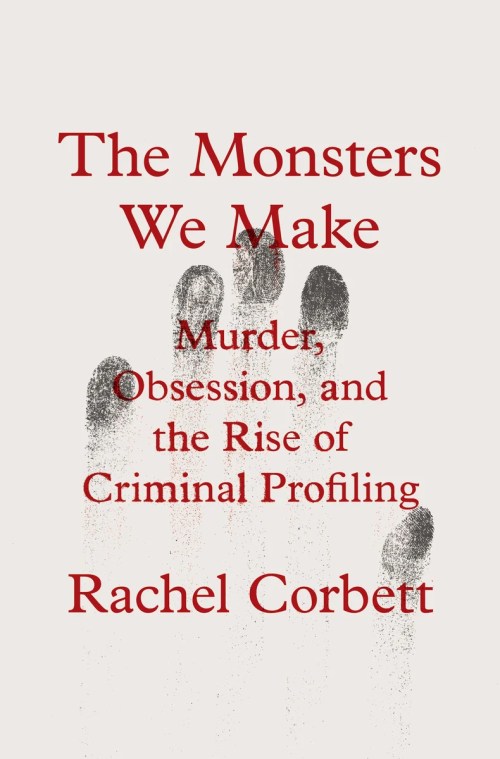
NONFICTION
The Monsters We Make
By Rachel Corbett
W. W. Norton & Company
Published October 14, 2025


