


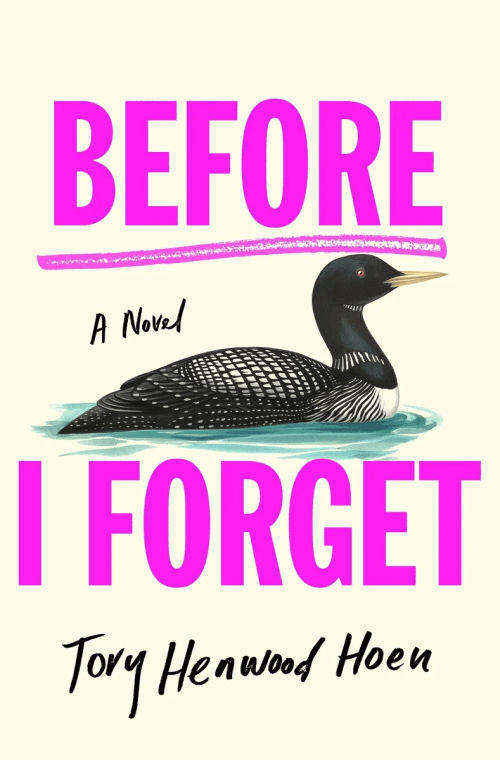
The impulse to find a silver lining during and after a tragedy can be pernicious in its cloying efforts to repress negative feelings. Yet there is no denying that it is through the wringer that one discovers what they are able to handle and who sticks around and peels them off the floor when they are no longer able to handle it. Balancing these two facts with grace in Before I Forget, author Tory Henwood Hoen offers a lovely, entertaining bildungsroman about family, forgiveness, grief, and memory.
Protagonist Cricket Campbell is spinning her wheels in New York City as the assistant to the CEO of a Goop-esque wellness brand, her life feeling like a series of false starts and unresolved plotlines. For nine years, she hasn’t been back to Catwood Pond in the Adirondacks, where she spent her summers growing up and where her aging father, Arthur, now resides full-time. Her older sister, Nina, has been living with their father in recent years as his Alzheimer’s has advanced. When Nina announces that she is moving to Stockholm for a job opportunity, Cricket steps into the role of primary caregiver. Though heading back to Catwood Pond seems like moving backwards, it evolves into a healing experience as Cricket grows to appreciate her father’s dementia-driven naivete and recognizes that he might even be gaining clairvoyant insight as he loses his memory.
In Cricket, the reader finds a charming, self-doubting 26-year-old constantly singling herself out as the one person who has no idea what she’s doing, who ruins everything, who can’t find her purpose. She has pigeonholed herself for so long as the reckless, immature younger sibling that she preemptively presumes disappointment from everyone around her. Taking over as her father’s caregiver is a big leap, a portal to a different, complicated level of adulthood, a lonelier and more morbid milestone, despite the reality that one in four American adults is a caregiver. Becoming her father’s caregiver is the first decision Cricket makes that comes off as abrupt—not due to undeliberated impulse, but because she is trusting her intuition.
Hoen is artful in her critique of peoples’ incapability when it comes to engaging with elder care and their discomfort with talking to someone suffering from memory loss. Cricket’s boyfriend Dylan brushes off her wish that he had met her father in person by pointing out that Arthur wouldn’t remember him anyways. In response, Cricket wonders, “Does he really think the only reason to interact with someone is to have them acknowledge and validate you?” As Arthur’s memory goes, the present becomes all he has. That can make the circular nature of conversation frustrating and even heartbreaking as he forgets his own children, but gradually Cricket finds pleasure in identifying the glimmers of her father’s personality that persevere. The cast of characters around Arthur and Cricket are pleasant and supportive, a reminder of close proximity and acts of service as key pillars to a solid community.
There is also no shying away from the financial strain that caregiving presents: the lost income due to the caregiver’s constrained working hours, phone calls to bicker with health insurance, the ambiguous estimates of the cost of hospice care. Dying is a longer process than we tend to imagine, and it is too often exorbitantly, offensively expensive. One can see how Cricket’s ex-boss’s offer to acquire the intellectual property of Arthur’s oracle persona and scale and productize his wisdom feels akin to a siren song. The satirical portrayal of a wellness startup is spot-on, from selling luxury buckets inspired by a fantastical idealization of pioneer life to the deleterious impulse to “convert every glimmer of authenticity into a product; to scale small joys until they are so bloated that they wither and droop.”
The return to Catwood Pond is also freighted for another reason: a tragic accident that killed Cricket’s ex-boyfriend and first love, Seth, when they were in high school. Dogged by what-ifs and if-onlys, her roundabout early twenties have been self-inflicted punishment. When Arthur, who has lost track of the names of both his daughters and his beloved cat, is able to recall and maybe even perceive Seth, it seems like the magical realism of Arthur’s prophesizing will dredge up old wounds. Instead, Hoen takes a different tack, examining the ways that Cricket’s emotionally charged memories have pinned her down for the past decade. As Carl, Arthur’s affable neighbor, points out, “[Guilt] befriends your ego and tries to convince you that everything’s about you—the past, the future.”

Cricket’s personal growth and epiphanies occasionally verge on corny, but mostly in the circuitous, accurate way that maturation demands—waking up one day and realizing that your parents were just people fumbling through their twenties and thirties, but they also made some good points all those years ago. Before I Forget is a novel brimming with both pragmatism and heart, clear-eyed about the sadness, joy, regret, and grace that accompany the kinds of hard decisions many of us have faced or will face one day.
FICTION
Before I Forget
By Tory Henwood Hoen
St. Martin’s Press
Published December 2, 2025


