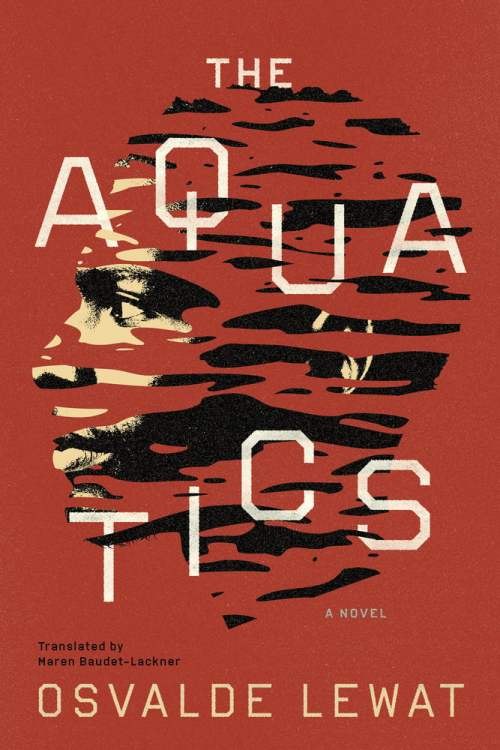
Katmè Abbia was raised by a tough aunt, and has eked out a life for herself married to a prefect, Tashun, in the fictional African country of Zambuena. The Aquatics by Cameroon author Osvalde Lewat, translated from the French by Maren Baudet-Lackner, is a story about privilege and facades. Every day, Katmè puts on a number of veils: the veil of pretending she’s OK with quitting her job to run Tashun’s household, for example, or the veil of propriety at luncheons with the other wives and mothers in politics.
Even the veil, perhaps, of being comfortable in her own privilege. Her good childhood friend Samy calls her out on this early. Katmè throws money to everyone, from beggars to vendors to the servants who cater to her, with a belief that money can fix anything in a world packed with corruption. While Katmè believes it will help restore balance, Samy sees it more clearly: he labels it “desperate” and scoffs at the idea that it could make real change.
She labels Samy’s new art exhibition “too raw” and “too much.” It’s deeply political, and she’s skeptical, sure he “couldn’t actually believe that a bold and powerful piece of art forged from nothing could force society to deviate from its fixed trajectory.” And when he is arrested, ostensibly for his homosexuality, Katmè is shocked, and certain that money and her influence on her husband can free him.
But the veils persist. When she visits Samy in prison, she does so wearing a disguise, so that she won’t hurt her husband’s political prospects. Tashun promises to help, as do the very progressive diplomats at the luncheons, but those veils of well-spun false promises keep Katmè from seeing the real direness of the situation at hand. She can’t see the depth of Samy’s fear, of the threat to him, of the government, of the violence hidden within the people around her.
The novel is framed by the second burial of her mother Madelaine. In Zambuena, funerals are about celebrating the dead through lavish displays of wealth, the care and love for your dead demonstrated through performative grief and expense. At the first funeral for her mother, only a few people gathered, and the coffin didn’t even fit in the grave. Katmè never even visited the grave, a deep sin. But neither did her aunt, the woman who sobs ostentatiously at both funerals.
The second funeral is only lavish because Tashun sees it as a way to get ahead. Campaign posters plaster the party, and his influential uncle forgets to mention the deceased in his speech.

Katmè is seen as cold-blooded, but she can’t help it: these ceremonies are empty for her. But by buying into this world of falsity and facade, she ultimately gives up her ability to genuinely feel herself. “A series of compromises doesn’t add up to a life,” Samy tells Katmè with a quote that comes back to haunt her when her veils finally fall.
The Aquatics shows how the insistence on obscured comments, the maelstrom of corruption and reducing humanity to cash, and forced propriety can allow for, foster, and encourage real violence. Some readers may wonder why our protagonist is Katmè and not Samy, whose trials and tribulations serve primarily to further Katmè’s character development and story. But this is not meant to be a tragic tale of homosexuality; instead, it’s a story that centers the people who are so determined to hold up the pillars of propriety and avoid confronting their own raw fear and emotions that they will allow violence to happen, disaster to occur, before they let it go. The Aquatics is ultimately about the lies we are willing to tell ourselves, the cowardice too many people perpetuate every day, and what it would look like to finally confront complicity within ourselves.
FICTION
The Aquatics
By Osvalde Lewat
Translated from the French by Maren Baudet-Lackner
Coffee House Press
Published December 2, 2025