


Emigration and exile are common themes of life for Cubans living around the world. Since Fidel Castro’s death in 2016, nearly two million Cubans have left the island, the majority leaving after anti-government protests in 2021. People have been leaving Cuba since Castro took power in 1959, with subsequent emigration waves in the decades since then involving several hundred people at a time. For generations of this diaspora and their descendents, questions about collective identity can be informed more by family stories and individual memory than the publicly aired class struggles of Cold War competition between nations. Carlos Manuel Álvarez frames his latest novel, False War, as a modern search for meaning, but also an escape from the oppressive logic of power.
Álvarez’s notable early journalism (The Tribe) and fiction (the story collection La Tarde de los Sucesos Definitivos) earned him a place on the 2017 Bogota39 list of the best 39 Latin American writers under 40 in 2017. Since then, his nonfiction (The Intruders) and fiction (The Fallen) has continued to explore family life and individual portraits of post-revolutionary Cuba. False War, his first novel to be translated into English by Natasha Wimmer, reads as a kind of synthesis of the many voices he has encountered over the years. Wimmer, who translated Roberto Bolaño’s 2666 and The Savage Detectives nearly two decades ago, has worked more recently to bring living writers like Álvaro Enrigue, Nona Fernández, and Pedro Juan Gutiérrez (who is from the same part of Cuba as Álvarez), to a wider readership in English.
The title, part of a quote often attributed to Cuban writer José Lezama Lima that prefaces the novel, invokes the long history of repression that many Cubans cite at least in part as reason to leave the island. Lezama, whose 1966 novel, Paradiso, was outlawed by the Cuban government despite praise from literary circles abroad, has become a kind of folk hero to many Spanish language writers. Like Lezama’s novel, False War is less concerned with the particular geopolitics of the era in which it was written than with the personal stories of people trying to find their way in spite of it.
Like other Wimmer translations, the voices that intersect throughout False War’s plots are many and distinct, varying from petty criminals to musicians to middle class tech workers who own a boat. The central narrator comes to Miami from Mexico City after his girlfriend dies in an earthquake, triggering a series of braided first person anecdotes that move between formative past events (returning to Cuba after his sister’s death, caring for his sick father) and living in Miami while writing a novel he tells his friend he’s calling False War, at one point saying, “And right now, reader, neither you nor I can know what it is I’m thinking about this book you’re holding (your right now is not the same as my right now; the right now is always tragically different from the right now of writing).”
The self-referential trick is anything but gimmicky though. It’s a reminder of the immediacy of the narrative being formed in real time and the lives shaped by small moments. He posits, “And all I wanted in the middle of the earthquake, all my girlfriend wanted, was to keep thinking. Was there anything more permanent than not being able to think?”
Sandwiched between the novel’s first and final parts (Modern Lives I and II, respectively) is an interlude comprised of sections titled “Berlin” and “Rural Village.” Just as Álvarez assigns and omits the names of places with intention, some characters get monikers like Barber and Client, Dissident and Exile, Father and Adolescent, and Gringo while others get actual names like Freddy Olmos. Though difficult to follow at times, the aliases become vessels for imagining what the rest of these fully realized lives might look like within the kind of labeling that often gets used to describe different generations of Cubans throughout history.

As if to compensate for some of the abstraction, Álvarez’s characters mention specific street names throughout Cuba and Mexico City along with real Miami bars like On the Rocks in North Beach and Lagniappe in gentrified Wynwood where everything, including philosophizing, feels more immediate accompanied by a drink and a cigarette in hand. Even different styles of salsa dancing are a metaphor for the generations of Cubans whose moves range from the timba beat of the nineties that “is fast and requires a modicum of athletic ability,” to the school of the seventies embodied by “ladies and gentlemen who dance casino-style, slow and elegant, a hint of severity in their movements.” When a Barber who left during the first exodus asks his younger Client about his time at Guantánamo, Client admits that even while detained there was still music, “Salsa, I think, but it was political salsa. Not good for dancing.”
The jokes play on discordant attitudes between Cubans of different generations, but also a shared sense of futility. When False War debuted in Spanish in 2021, Cuba was awash in action aimed at disarming those in control of a regime that refuses to relinquish the myths of its past. But the characters in False War hope they can do better by living one small moment at time.
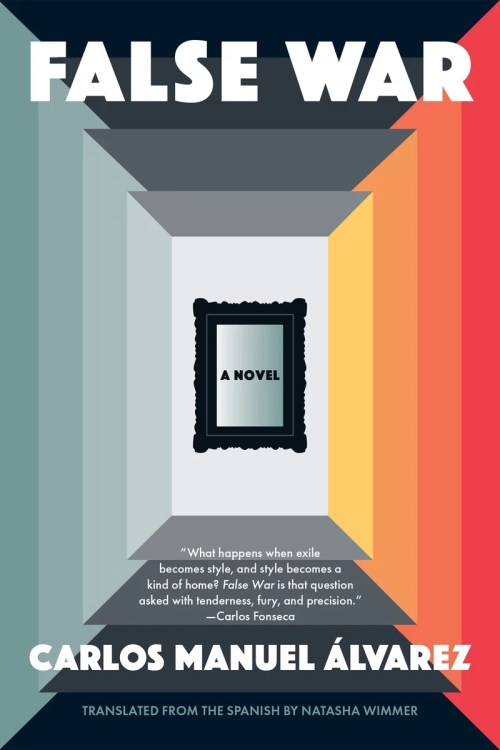
FICTION
False War
By Carlos Manuel Álvarez
Translated from the Spanish by Natasha Wimmer
Graywolf Press
Published November 4, 2025


