


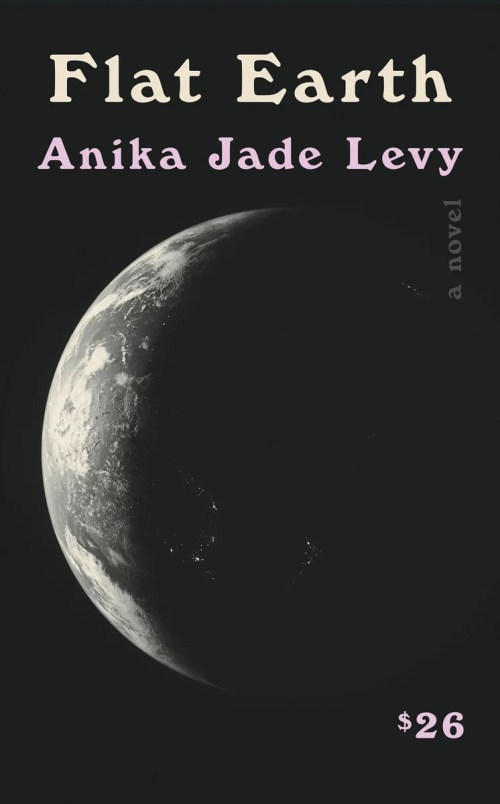
I sometimes find myself frustrated and bored by the narrow, grating approach of novels about twenty-somethings lost in New York spending too much time on their phones, but Anika Jade Levy transcends any and all preconceived notions of the subgenre and delivers an enthralling depiction of the persistent and absurd dissonance of contemporary life.
Flat Earth follows Avery, a media studies graduate student in New York who spends the time she should be writing her series of cultural reports dating men who don’t seem to like her very much, scrambling for money, listening to the advice of an online Australian life coach, and grappling with her jealousy over the success of her wealthier, prettier best friend Frances. Every character has been meticulously, lovingly rendered offputting, every detail deliberately handpicked to maximize the sense of disarray that characterizes modern life.
This debut novel is brimming with strange and cynical insights into conspiracy, belief, art, class tensions, the Internet, and cool girls.
I had the honor of interviewing Anika Jade Levy ahead of the release of Flat Earth to find out what she’s been thinking about when it comes to belief, girlhood, satirizing a real world that feels more and more unreal, and prescription stimulants.

Anson Tong
In Flat Earth, everything feels like it’s unraveling at breakneck pace—society, politics, Avery’s life and view of herself, the friendship between Avery and Frances. This can all be really bleak, but you manage to make it both compelling and funny. What challenges did you experience trying to balance these different levels of story that you’re trying to tell?
Anika Jade Levy
Unhappiness is funny. Or at least it should be. The challenge wasn’t balancing tones so much as refusing to choose between them. The book is about living inside collapse—social, romantic, spiritual—and realizing that irony and sincerity have to coexist if you want to survive. Avery and Frances both perform composure while falling apart, which is how a lot of people live.
Anson Tong
I enjoyed the interstitials/”cultural reports” between chapters that you include. They balance absurdity (“Half of us have eating disorders. The other half have salmonella poisoning.”) and realism well (“There is a sense of indifference toward the past, amnesia about recent history, bodies shipped in state refrigerators, the proposition that lethal injection might be a prescription for poverty, a consensus that poor people might be somehow self-erasing.”). How did you go about writing these and deciding where in the book they belonged?
Anika Jade Levy
My hope with the reports is that by the end of the book the reader won’t be sure whether the culture is reflecting Avery’s breakdown or producing it. The reports are about consensus, which is why they are written in the first person plural—a collective “we.” I also wanted them to be a relief, little commercial breaks. I was trying to mimic the way real life interrupts itself. Like when you’re crying in your car and then Instagram serves you an ad for ketamine therapy.
Anson Tong
Whether it’s the flat earthers that Frances documents or the “gallerinas” and other irritating art scene characters, there seems to be this element of looking for something or someone to believe in. Are you comforted or concerned by the idea that in this vacuum that the decline of organized religion has left, people are grasping for all sorts of semi-niche belief systems?
Anika Jade Levy
I’m not comforted or concerned. The decline of organized religion didn’t leave a vacuum so much as it decentralized belief. Flat earthers, incels, the art world, the patriarchy—they’re not symptoms of faith’s disappearance; they’re its latest denominations. They have myth, hierarchy, ritual, persecution, salvation. Everything is increasingly catered to hyper-niche consumer demographics, and belief is no exception. Faith sort of runs on a subscription model now: misogyny for men, astrology for women, wellness for the rich, conspiracies for the alienated. Every belief system we mock for being delusional is really just a failed re-enchantment project.
Anson Tong
You mentioned to CULTURED that you believe that there “are ways of seeing that are contingent upon a degree of ignorance or naïveté only available to young women.” Can you expand on that idea and talk about how Avery and Frances, in their differing perceptions and enactments of girlhood, are seeing the world?
Anika Jade Levy
Avery and Frances are both making order out of chaos in different ways. They’re both negotiating the threshold between insight and delusion. Their perception outpaces their experience, so they brush up against forces like patriarchy, charisma, and power before they have the vocabulary for them. The “belief systems” in Flat Earth—the conspiracies, the microcultures—aren’t so different from girlhood itself. They’re ways of seeing built on incomplete information.
The genius of Frances’s project is that it occurs to her to step outside of the front-facing camera and make a film about America. Avery can’t get herself out of the frame. She’s caught in the stage of girlhood where seeing and being seen feel identical.
When I say that certain ways of seeing are contingent on a degree of ignorance or naïveté, I mean that young women are often granted a kind of epistemological innocence—it’s assumed that they don’t understand what they’re seeing. That misreading is its own vantage point. That’s why the idea of girlhood is so ubiquitous now. Because it’s not a developmental phase; it’s an optical technology—a lens the culture uses to process its confusion.
Anson Tong
Towards the end of the novel, when Avery is recounting Frances’s achievements, she includes, “her marriage, her movie, her eating disorder, her suicide attempt, her pregnancy.” This made me want to ask you for your thoughts about narrativization and womanhood and the idea of hardship making someone more interesting or capable of creating art.
Anika Jade Levy

Early on in the book, there’s a throwaway line about how Frances casually goes on dates with men for money, not out of financial necessity, but because she “hopes she might get herself sex-murdered by one of these men, so that the girls in our department will mythologize her forever and she’ll finally get her sixteen millimeter films screened.” I think a lot of people, especially artists, treat hardship as an accomplishment, something to be indicated on a CV. In this book, Avery and Frances compete with one another in a lot of different ways, but there’s a very real sense of competition over whose life is harder.
Anson Tong
The Adderall shortage gets mentioned a few times, and Kirkus Reviews described your writing as “stimulant-driven.” How would you characterize your fascination with stimulants? What do you think Kirkus is picking up on?
Anika Jade Levy
I think I was responding to how ubiquitous stimulants have become in professional and academic life. There’s a lot of reasons for this, but a major one is that no one has enough time. Everyone’s overextended, everyone’s optimizing, and stimulants offer this fantasy of temporal elasticity, a way of dilating time. Or a way of manufacturing an illusion of control over your time, outrunning entropy for a few hours. It makes sense that Adderall is increasingly popular in an economy that necessitates hyperproductivity for survival. Focus has become its own moral virtue.
There’s also a political dimension. I’m interested in the way that speed has exacerbated social movements and extremism. A lot of the twentieth century’s most radical shifts, both fascist and avant-garde, were chemically accelerated. The Nazis used amphetamines as performance enhancers, but also the more utopian avant-gardes. The Cybernetic Culture Research Unit, for instance, began as a radical art collective and disintegrated into techno-occult chaos once amphetamines entered the chat. Nick Land didn’t just burn out—he sped himself into reactionary philosophy. I think that’s what Kirkus was picking up on: the way the book mimics the sped up tempo of cultural production, where the line between inspiration and psychosis is just a dosage issue.
Anson Tong
Satire keeps turning out to be prescient. The Patriarchy dating app that Avery goes to work for doesn’t feel that far from some peoples’ proposed solutions to the male loneliness crisis. Is there anything else you included in Flat Earth that you think (or fear) is becoming truer by the day?
Anika Jade Levy
The book opens with the Adderall shortage—which I wrote months before it happened—so maybe the clairvoyance is chemical. But I think what’s really predictive isn’t the specific events, it’s the mood: the collapse of belief into irony, the way absurd ideas become policy once they find a venture capitalist. The “Patriarchy” app was supposed to be a joke, but now it feels like something a TED Talk would defend as “innovative gender realism.”
It’s also hard not to feel that early-2020s New York was a kind of cultural incubator for the mess we’re in now. I was trying to capture the feeling that irony and sincerity had collapsed into each other and everyone was trying to build belief systems out of lifestyle. That scene ended up being a kind of cultural R&D lab for the rest of the country—a beta test for the new American moodboard of moral panic, attention scarcity, and lifestyle ideology. What felt fringe then has gone mainstream.
Fiction
Flat Earth
By Anika Jade Levy
Catapult
Published November 04, 2025


