


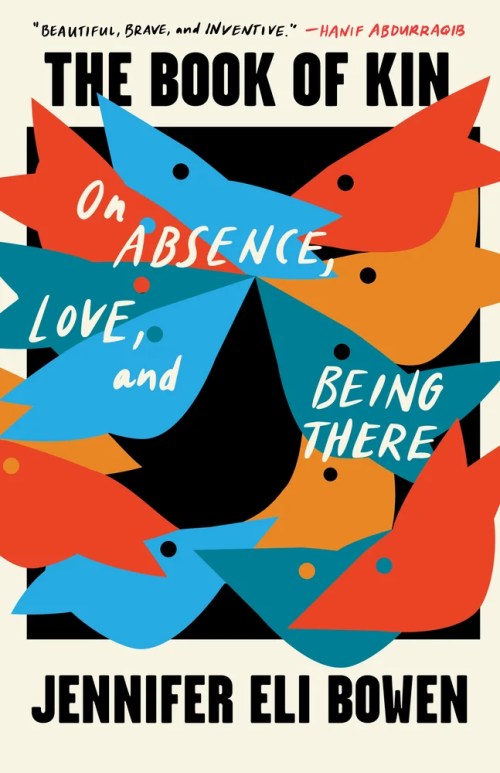
With the current state of our world, it feels a bit like divine timing to be writing about Jennifer Eli Bowen’s debut, The Book of Kin: On Absence, Love, and Being There. Maybe, though, the chaos around us is exactly why I chose to review this book; maybe some sort of subconscious call for community was begging to be attended to. After reading, I’d suggest that everyone listen to that subconscious urge and pick up The Book of Kin as well.
According to Bowen, The Book of Kin took decades to complete, and it’s very understandable why. The book is 238 pages of essays: intimate memories as a creative writing instructor teaching in Minnesota prisons, as a wife within a deteriorating marriage, as a mother, a daughter, a neighbor, a friend, and a stranger. The book begs the question: why and how do we care for others physically, emotionally, and ideologically?
As it is a collection of essays, Bowen is able to move seamlessly between varying aspects of connection and community. In one essay (though her father plays a role in other pieces as well), Bowen reflects on her relationship with her absent father in order to examine how presence plays a role in the development of familial safety. In others, she emphasizes the profundity of incarcerated individuals in order to humanize those who have been stripped of their most basic emotional needs. As a whole, the Bowen reminds readers that it’s human to be scared, to retreat, look like a fool, even criticize others when we should lead with empathy instead; however, she also asserts “it’s the lifetime of hourly, humble, unsexy, hard-fought interactions with those closest to us… that usher change.” 238 pages in and of itself isn’t particularly long, but Bowen’s fervent dedication to her craft and to those who inspired this piece within these pages is glaringly evident.
The founder of the Minnesota Prison Writing Workshop, Bowen’s criticism of the American carceral system is emotional and enlightening. From the airy and gentle, seemingly ideal quarters of Norway’s maximum security prisons to the dark, dehumanizing isolation of America’s excessive prison system, Bowen illuminates the profound narratives of incarcerated individuals and what our treatment of said individuals says about the state of our society. America is hyper-focused on the punishment of lawbreakers that they won’t even entertain the chance of rehabilitation. Vengeance and penance reign over restoration and connection, so it’s no surprise then that the prison complex exacerbates a vicious cycle. Oftentimes, those against prison reform—those who shudder at the phrase “abolition”—would say that the legal punishments of places like Norway (which does not have life sentences but rather a maximum of 21 years in a rehabilitation facility) do not work. However, as Bowen emphasizes, brokenness does not always signify condemnation. A healthy society requires purpose and community, listening and empathy, not retribution and cyclical violence.
The Book of Kin is a testament to intentional storytelling. Each essay is perfectly placed within the narrative, pulled together with bouts of humor and reflection. Personally, my two favorite essays are “The Library” and “School.” Light-hearted and intensely relatable, “The Library” chronicles the deep, complicated human desire for companionship, both intimate and at a distance, all throughout the contents of her yard’s little library. The latter essay, “School,” comes a bit later on in the piece. What begins as a reflection of the author’s academic and mirrored personal struggles as an adolescent soon becomes a breathtaking declaration of the transformative powers of writing and storytelling. Bowen revels in the construction of communities that heal each other and reminds readers that home and safety are not reliant on places, but rather, people.
A hopeful exploration of what it means to care for one another, The Book of Kin is honest, entertaining, heart-wrenching, and dripping with empathy. That is something, as I’m sure Bowen would agree, we could all benefit from sharing a bit more of.

NONFICTION
The Book of Kin: On Absence, Love, and Being There
By Jennifer Eli Bowen
Milkweed Editions
Published October 21, 2025


