


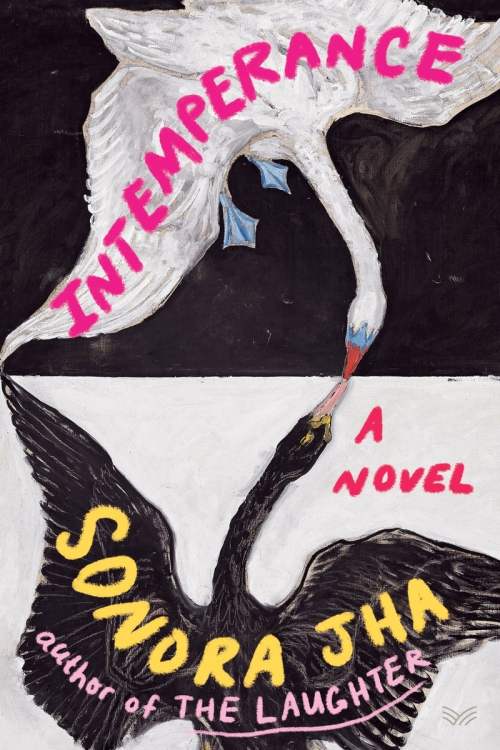
In the past several months, literary novels about middle age have enamored readers and critics alike. Ben Markovits’s The Rest of Our Lives centers a law professor coming to terms with his post-infidelity life. Miranda July’s All Fours reckons with love and sexuality through an unconventional journey. These novels achieved places on the Booker and National Book Award shortlists, respectively, bringing into focus a life stage that often goes unnoticed in broader society. Meanwhile, Sonora Jha’s Intemperance is both of these and something much more, an incisive portrait of romance, womanhood, and friendship through the South Asian lens. It stands tall as one of the best novels of 2025.
The unnamed narrator is a fifty-five year old sociology professor on sabbatical. She lives alone on a houseboat, accustomed to the single life after two failed marriages. Seemingly on a whim she announces her intent to host a swayamvara, a spouse-choosing ceremony straight out of Indian folklore. Suitors will compete in predetermined feats, and the winner will be garlanded and chosen as her next husband, her hopeful partner for life. This decision is immediately controversial. The narrator is not only middle aged and twice divorced, but she is also disabled from childhood polio and wracked with long-held trauma. She is used to her creature comforts and independence. She has no delusions about her desirability, and yet, she delights in men physically and emotionally. She proclaims “but see, only now, when I have overcome the fear of being seen by the world as the ‘unloved woman’ do I truly desire to be a woman in love.”
Outside influences begin to trickle in. Internet trolls and ‘well-meaning’ Indian relations express disapproval, while friends and wedding planners offer their services in earnest. Most perplexing is a distant relative who tells the story of a family curse, which our narrator experiences firsthand through the use of homemade kohl. These speculative elements feel jarring at first, but soon blend seamlessly into the narrative and underline the narrator’s decisions with historical precedence. She is not just acting on her own behalf, or on behalf of middle aged South Asian women, but for generations of wayward lovers and those who choose their own path.
Jha’s writing is lush, detailed, and sensual. When pondering her type in men, the narrator cooks fragrant prawn curries and delights in the spices and process. When she looks for wedding clothes she runs her hands along the silk. These small matters do not go overlooked, if anything they add richness and immersiveness to the reading experience. Former brides can walk through these event milestones and remember with clarity the leadup to their own wedding, maybe even more clearly, as the stress and pressure from your own event is no longer a factor. Six years ago I shoved cake samples in my face and made a quick selection. When reading Intemperance I savored those cakes.
Most importantly, even in the face of obvious tragedy, Jha’s writing embraces joy. And joy, as it turns out, is sorely missing from these other tales of middle aged dissatisfaction. Our narrator is not seeking a partner to complete her life, but to add to it. In this manner she not only cherishes long-held friendships but seeks new platonic connections, often learning from younger women like Demi, her former student turned wedding planner, and Vee, a disabled documentary filmmaker. This, coupled with the fact that the swayamvara itself has very limited page time, shows readers that the purpose is not merely male companionship, but growth, refusing to settle into the placidity of middle age when there is more to learn and experience. Jha’s narrator defies the expectations set by her age and ability by simply wanting more.
Small matters hold the novel back from perfection. As our narrator is largely settled in her life, many conflicts remain firmly in the past, and little goes ‘wrong’ for her in the larger scheme of things. Outside threats feel toothless and ephemeral. Granted, her own sense of shame and her frequent trips into the past serve as internal threats to the operation, but for those seeking larger interpersonal conflicts, Intemperance is not this sort of novel.

Then what type of novel is it? If anything, it embodies its title. An indulgence, at times excessive. It takes its time from ritual to ritual. It lingers in the sensory and in memory. It helps us see the nuance of midlife with a pervasive, infectious optimism. It shows us that internal demons are not quite past, but can still be overcome. It is a balm in an otherwise bleak literary and sociopolitical year, and is of a standard Jha herself already set with her darker 2023 novel The Laughter. In short, it is a book that can and should be read by all.
FICTION
Intemperance
By Sonora Jha
HarperVia
Published October 14, 2025


