


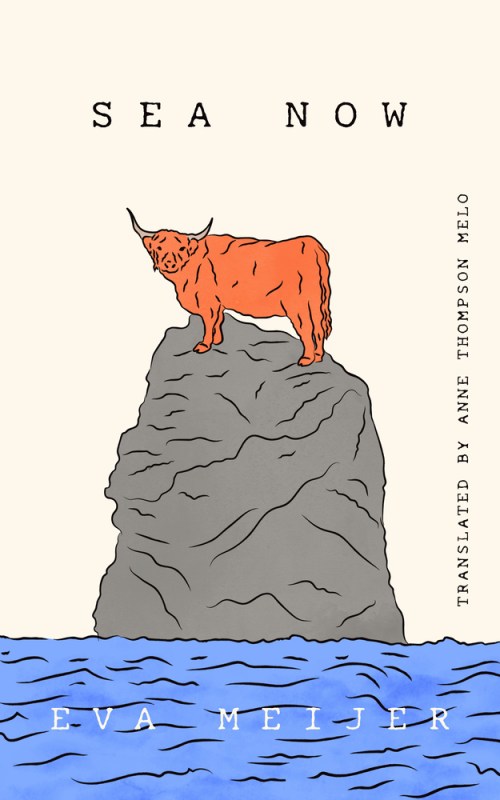
People picture disaster either as a sudden explosion, or as something that might happen elsewhere, or far in the future. But in Sea Now by Eva Meijer, translated from Dutch by Anne Thompson Melo, disaster just comes, crawling forward, wave by wave. One day, the tide simply comes in and stays. It is unprecedented, mystifying. The scientists have few explanations. But their explanations don’t actually matter. The ocean is coming, moving into the Netherlands with a devastating determination, and what humans do about it won’t, ultimately, matter.
Meijer brings a satiric bite to her story. The ministers battle back and forth about whether to evacuate while there’s still time but not wanting to cause panic. People dismiss the news story at first, see it as a curiosity, assume it’s nothing they haven’t seen before. A group of people insist that the ocean simply isn’t actually rising, that the world is not ending, and they refuse to move. A group that fights for climate change is unsettled by this final disaster—what do they do now that the catastrophic is actually happening? What else do they stand for? Little advertisements get increasingly extreme, raising prices as hustlers attempt to sell survival kits and disaster services. The sentiments and press releases are annoyingly familiar, as is the anxious dread of the few people who realize that life might truly be taking a turn.
And Meijer isn’t afraid of taking a cutting approach to the way societies deal with disaster. At one point the Prime Minister thinks to himself that other countries are being so welcoming to the Dutch refugees because they believe they are hard workers, but also because they know the Dutch can pay. Meanwhile, people who were already refugees in the Netherlands must camp out together outside of evacuation centers, or stay behind in the flood zones, knowing or fearing they won’t be accepted into Germany. New climate-displaced migrants are welcomed into other European countries, while migrants who were already fleeing are rejected all over again, thrown into more uncertainty. Meijer reveals the harsh edges of capitalism throughout this book, allowing her detached tone to show the dehumanizing nature of the way we approach human lives and unavoidable disasters.
The constellation of the novel allows Meijer to jump around between formats and places, viewing the disaster as if from far above, watching inaction and action alike flow out from the slow but steady progression of the sea. She also portrays the ineffability of nature, the way it seems to work as an unstoppable, inexplicable force that humans have always tried to control, but have never succeeded in taming.
But ultimately, this studied detachment hurts Meijer: halfway through the novel, she switches to focus on the journey of three protagonists into the flood zone. A constellation novel becomes the novel of three characters trying to grasp at straws to recover something of what is lost. The change leaves some of the storytelling capability behind; even as they encounter survivors and explore a world overtaken by water, we now see the flooded Netherlands through the eyes of the three women. An omniscience disappears in favor of a more uncertain point-of-view.
While the flood zones are compelling, the reader never grows attached enough to most of the characters to fully feel their struggles, after growing used to focusing using Meijer’s ironic, bird’s-eye lens. Yet there is something to the story that will keep readers drawn in until the end, an intriguing view of what climate disaster might look like—not so much a flash flood, but instead a slow creep, taking cities over one by one.

FICTION
Sea Now
By Eva Meijer
Translated from Dutch by Anne Thompson Melo
Two Lines Press
Published October 14, 2025


