


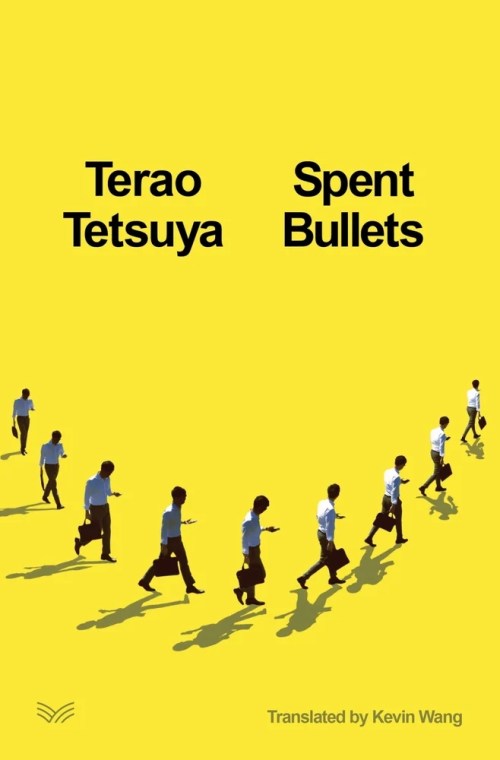
Terao Tetsuya’s Spent Bullets, translated from Chinese by Kevin Wang, is a collection of linked short stories that follow Taiwanese high-achievers in their transitions from top of their classes to high-earners in Silicon Valley, and as they discover that even this isn’t enough to quiet their tortured spirits. These stories are strange without including uncanny elements or fantastical environments. This reality—the one you and I live in—is where these stories take place. The shame-filled, hidden crevices of it. There is no joy to be found here, no matter what you achieve.
Jie-Heng is the first character we meet and the cord that binds this wounded group together. In junior high, he is effortlessly smart, but also friendless and tragically obsessed with his most popular classmate, Wu Yi-Hsiang. After asking why Wu Yi-Hsiang spits into the urinal before using it, Jie-Heng goes from invisible to his classmate’s latest object of persecution, a form of attention that sexually excites him rather than causing anxiety. This relationship’s complexity persists long after Jie-Heng officially becomes one of Wu Yi-Hsiang’s friends. One day, the two play a fighting video game at Wu Yi-Hsiang’s house. No matter what character Jie-Heng chooses, he is always beaten to a bloody pulp. Astutely, Wu Yi-Hsiang asks if Jie-Heng is “getting off” on losing so spectacularly. He then portends that someone like Jie-Heng “can’t survive in this world.” Someone, in other words, who craves this particular type of abuse but cannot dole it out to others.
The stories change time periods and perspectives, shedding light on Jie-Heng, Wu Yi-Hsiang, and other classmates’ experiences at their prestigious university and in adulthood. This collection could just as easily function as a novel with the time jumps in no way impeding the narrative’s cohesion. On the contrary, the leaps through time are a very pleasing aspect of how new information about each character comes to light. It turns out that the academic wins and corporate climbing are merely a backdrop for the emotional dissatisfaction and sexual frustration that takes up much of the space in their lives. In fact, these characters’ achievements feel quite distant from who they are as people, personal identity being a concept that remains elusive throughout the collection. Jie-Heng tries to make friends after moving to the US but finds that, even among other gay Taiwanese men, he is perpetually misunderstood. Wu Yi-Hsiang continues to torment others throughout his life, accepting the role with disconcerting seriousness. It doesn’t matter to either of them who finds them attractive or brilliant or successful. Each only wants to play their part—dominant and submissive—but the world asks more of them, which turns out to be more than they want to give.
At first, these stories simply seem to speak to the formativity of childhood. Jie-Heng cannot live comfortably in a role of intellectual dominance when all that had ever satisfied him was to be submissive to someone else—one person in particular. And that person, Wu Yi-Hsiang, cannot be satisfied unless he is forcing his will upon someone else. But this isn’t the whole truth either since even when these characters get what they think they want, they still aren’t happy. An uncomfortable yet compelling takeaway of this collection is that maybe happiness is beside the point of living.
None of the characters reveal much of their inner world to the reader. Jie-Heng for example does not reflect on why he constantly seeks to be dominated, why it is pleasurable, or how pleasurable it really is to him to be in that role. We don’t learn how much of who he once was as a child truly remains in him as an adult versus how much is merely a reverberation of his former self that he feels obliged to cling to. He does not reply to Wu Yi-Hsiang’s observations about him nor is he introspective about them. He insists that he is being misunderstood by those around him, but presents no firm alternative to these misinterpretations. Is this because he cannot begin to know himself and finds it too difficult to try? In every story, we are shown what happens, but not what characters think or feel about these events. This lack of interiority leads to ideas that feel like they are leading somewhere, only for the reader to arrive at a brick wall. Perhaps this effect is intentional as it echoes what the two principle characters experience throughout their lives.
For instance, in the story “Some Kind of Corporate Retreat” the protagonist, whom we can infer to be Wu Yi-Hsiang, dates a colleague, a woman who is also gay. When their relationship begins, the woman reasons that “maybe [they] needed to find a partner, no matter who they were, to survive this endless blizzard called immigrant life” and he goes along with this. However, when the two go to the airport for a trip back to Taiwan, they run into one of Wu Yi-Hsiang’s old university classmates, another gay man flying back with his husband-to-be. Clearly a different life is possible for Wu Yi-Hsiang and his partner, but neither pursue it. There are career benefits to Wu Yi-Hsiang marrying his colleague, which one can assume is their primary reason for living against their natural inclinations. But even professional advancement does not ultimately contribute anything meaningful to their lives, which Wu Yi-Hsiang seems to warn the generations behind him about as an alumni speaker at his alma mater when he tells them “in Silicon Valley, you must first die in order to live.”
The reputations these characters work towards have no stated purpose. There is no passion behind the accrual of more money, no pride that feels real or tangible when a new achievement is met. Tetsuya doesn’t explicitly name the origin of his characters’ pursuits, excluding perhaps Ming-Heng who, in the story “The Avalanche Joseki” very nearly achieves what his father gave up on and seems driven at least in part by that father-son relationship as he considers his own fate.

In addition to the aforementioned story, the strongest tales center Jie-Heng and Wu Yi-Hsiang’s fraught relationships to one another and themselves, and are closest to revealing valuable truths about these characters. Generally though, readers are welcomed into the same fog the characters exist within, where a hand held up to the face cannot be seen clearly, even if it belongs to you.
FICTION
Spent Bullets
By Terao Tetsuya
Translated from Chinese by Kevin Wang
HarperVia
Published October 14, 2025


