


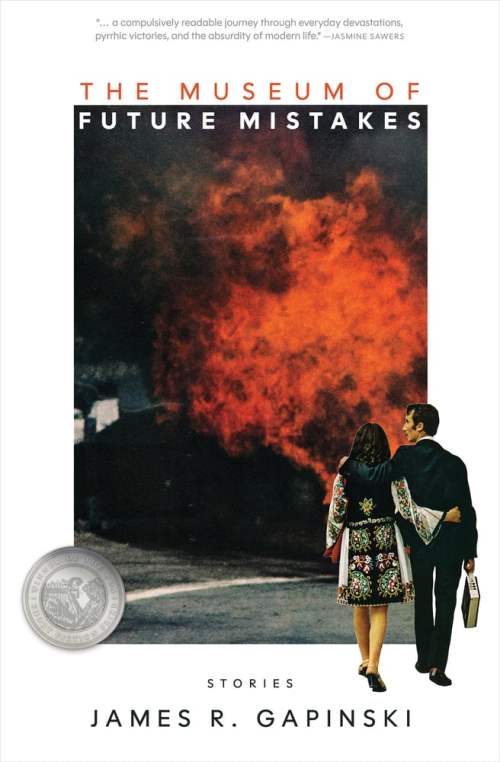
An elevator elf that supplies useful daily gifts (“The Elevator Elf”). Literally stealing and returning an ex’s beating heart (“Three-Month Autopsy”). A ghost living in a woman’s fingernails and exacerbating her hypochondria (“My Fingernails Are Haunted”). James R. Gapinski’s The Museum of Future Mistakes is a collection of our-world-but-distinctly-more-surreal short stories that work hard to amuse and disgust. There’s also the titular museum where everyone has an alcove displaying artwork of their upcoming mistakes and a tree whose fruit is golden before the first bite and tar-like and spews bugs after (“Fruit Rot”). The premise of each story is the kind of bizarre “what would you do” scenario that would be excellent to ask someone at a party to find out whether they’re willing to commit to a bit.
The aptly named “Kitten Egg” starts with, “My cat lays an egg. What the hell, cat?” The author anchors absurd situations with a practical way of writing, bringing the reader along as characters try and often fail to adapt to their newfound fortune, misfortune, or cat egg. Despite how short these stories are, they are immediately engrossing as you wonder what could possibly happen next.
Gapinski is frequently hilarious through minor details: the elevator elf is “considerate enough to drop extremely large, bone-crushing items away from my outstretched limb.” An ad in a magazine triggers the thought, “At the spa, they always talk about opening your pores. In television commercials for expensive creams, they always talk about closing pores—shrinking, minimizing. Contradictions like these beget wars.” The ghost in the woman’s fingernails makes insistent declarations ranging from “Your ass looks flat in those new jeans,” to “There’s nothing but sadness after you die.”
Many of their characters are unprepared to handle newfound power and privilege. The couple who find the magical tree in their yard in “Fruit Rot” rapidly succumb to capitalism’s worst impulses. “Karol’s Cleaners Will Clean Anything” offers a laundromat where the claim is not an exaggeration, but a promise. Astronauts from Florida land in the extraterrestrial Portland and pretend to study “The chemical properties of a small batch craft IPA could lead to breakthroughs in understanding human metabolic functional variance” before ultimately retreating (“When the Astronauts Landed in Our Neighborhood”). Like a conniving genie, Gapinski grants wishes and watches gleefully as unanticipated consequences stack up.
Some stories are vignettes drawn in a way that tempts the reader to fill in their own details and assumptions, like the second person “Hospital Story” about the near-scripted anticipation and expectation of a hospital waiting room and “Evolution of Apartments,” a series of evocative descriptions of apartments—“410 square foot one-bedroom in an old house, long ago quartered into rickety standalone units… Get an outdoor cat. Think about grad school.” Gapinski plays with the familiarity of these scenes, inviting the reader to fill in the gaps.
Gapinski is keenly interested in the lengths people will go when placed in extreme situations as well as how mundane situations can be literalized into extreme ones, especially in romantic contexts. “Sharon’s Lover is Dissipating” asks what lengths one would go to if their lover, a cloud of black vapor, “lost part of himself after each outing—dissolved, evaporated, assimilated into a vast, distant atmosphere.” The story “Three-Month Autopsy” takes seriously the idea of stealing someone’s heart as well as their liver, stomach, and other internal organs. The main character and their partner of three months, Ravi, examine the seriousness of their relationship through which of their exes’ organs they’ve taken and kept. Love really makes you crazy in Gapinski’s Portland.
Magical realism is used to shine a light on emotional truths that may be more easily dismissed or suppressed in normal life. In “Brother and Not-Brother,” everyone begins to resemble the narrator’s deceased brother, including his girlfriend. She even smells just like him, “Smoke with a hint of pine, like a campfire or a burning canoe.” In “The Museum of Future Mistakes,” the narrator is a gold member of the museum and visits his personal exhibit every week hoping to learn from his future mistakes. He is rattled by the new addition of a sculpture of his current girlfriend and scrambles to stop the prophecy, potentially harkening its fulfillment. Both of these are sensationalized versions of real emotional experiences that can tear a relationship apart. They feel more comprehensible in these stories than the more interior versions of grief and self-sabotage that happen every day.

The Museum of Future Mistakes is a speculative fiction grab bag bursting with whimsy and pragmatic cynicism. Gapinski wields anthropomorphic interlopers and bizarre circumstances in order to craft an intensely human set of stories.
FICTION
The Museum of Future Mistakes
By James R. Gapinski
BOA Editions
Published October 7, 2025


