


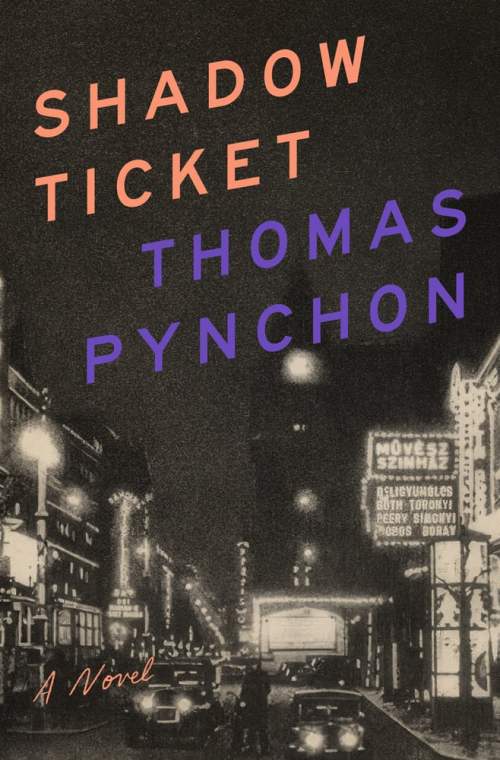
Thomas Pynchon would prefer not to be introduced. Which is fine, because by now, on the occasion of the publication of his ninth novel, Shadow Ticket, the 88-year-old famously reclusive writer needs no introduction anyway.
Pynchon is one of only a few members of the pantheon of writers whose names are also adjectives. Orwellian (dystopian). Kafkaesque (surreal). Dickensian (includes orphans?).
What, you ask, does Pynchonian mean? For one, if you want to cut a corner, “Pynchonian” and “postmodern” are often used synonymously to mean, in the immortal words of Moe Szyslak, The Simpsons’ irascible bartender, “weird for the sake of weird.” (The Simpsons pulled off the coup of the century convincing Pynchon to voice his cameos on the show not once, but twice.)
Weird is part of it, but that sells “Pynchonian” short. In Pynchon, everything does mean something. You may just need several readings and a slew of advanced degrees in linguistics, history, and philosophy to get all of it. Also Pynchonian: Madcap plotting. Eccentric characters oozing sarcasm. Punny, riotously funny dialogue. And so forth.
So, what of Shadow Ticket? The novel, his first since 2013’s Bleeding Edge and his shortest (at just over 300 pages) since 1966’s The Crying of Lot 49, is unmistakably Pynchonian. On the accessibility scale, Shadow Ticket lands closer to Pynchon’s later novels like Bleeding Edge and Inherent Vice (2009), and further from the all-but-impenetrable novels like 2006’s Against The Day or his 1974 National Book Award-winning magnum opus Gravity’s Rainbow. In fact, unlike Gravity’s Rainbow, Shadow Ticket contains exactly zero chapters narrated by a lightbulb who has run afoul of an international lightbulb cartel. (The Phoebus Cartel, believe it or not, was a real thing.)
Shadow Ticket does, however, include an International Cheese Syndicate (Pynchonian: absurd, nefarious organizations) as a minor plot point. That plot? Well, in a word: zany.
Here’s what you need to know: We start in Milwaukee in 1932 with a private investigator named Hicks McTaggart. Hicks, dodging attempts on his own life for rubbing a bootlegger the wrong way by making time with this fella’s dame, is given the assignment of tracking down a missing woman. This woman’s name is Daphne Airmont, and she is the “Cheese Princess,” daughter of the “Al Capone of Cheese,” a fellow named Bruno. All that’s known (though Hicks may know more than he tells his bosses) is that Daphne has absconded with a jazz clarinetist named Hop Wingdale (Pynchonian: goofy names), leaving her jilted fiancé behind. And it goes from there, with Hicks and a whole cast of just-a-bit-off characters winding their ways through Eastern Europe dodging fascists (Pynchonian: history is today’s cautionary tale), each with their own quests, and each feeling the others out for all the angles.
One thing you’ll take away from this novel is that it’s really, really funny. Pynchon delights in verbal acrobatics—from simple turns-of-phrases to full Jazz-age song parodies. Indeed, Shadow Ticket is rather a musical novel—Pynchon creates more than a dozen songs in these pages with lyrics like “Ubiquitous … you’re out / everywhere, you’re / ubiquitous … like the / airwaves, through the air…” And so forth.
It gets even sillier: Perhaps one of the most ludicrously entertaining parts of the novel is a several-pages digression about whether cheese is conscious.
“Cheese, oh to be sure, cheese is alive. Self-aware, actually, maybe not exactly the way we are, but still more than some clever simulation…”
“Cheese—wait, cheese…has feelings, you say? You mean like…emotions?”
Remember, we’re in Wisconsin, and to question cheese’s sentience is apparently cause for throwing hands. Set pieces like these make reading Pynchon so much fun.

In total, there are two main ways to assess Shadow Ticket. First, because it’s possibly the final novel from a beloved writer, hardcore Pynchon fans, of which there is no shortage, will devour it, devour it again, laugh their asses off, and take to Reddit to parse out its hidden treasures. And god help you if you say one bad thing about Thomas Pynchon!
On the other hand, if you’re a general lit-fic reader, this book is probably going to annoy you a little at times and a lot at others. Sure, it has its charms, but it begins to wear on you after a while. There are scenes during which, if you miss a single word, you’ll be down a full page before you realize the characters you thought were talking are not the characters who are talking. (Pynchonian: paucity of dialogue tags.)
By the time Hicks makes his way from Milwaukee to Eastern Europe and the plot has exploded into a miasma of Eastern European bicycle gangs, Hungaro-Croatian would-be terrorists, British spies, Russian agents, and yes, Cheese Syndicate representatives, it’s sometimes hard not to throw up your hands and go “WTF, Tommy?!”
Around page 260, I was muttering to myself things like “Ugh, wait, so who is Porfirio del Vasto again?” But that’s okay. Like a long day at an amusement park during which you begin to grow weary and grouchy in the evening, you’ve already had enough fun not to let the last part spoil the fond memories of the whole day.
Shadow Ticket is probably a mid- to lower-tier Pynchon—a novel that will almost certainly wind up categorized as a minor work in his overall oeuvre. Still, in the now, Shadow Ticket is unquestionably a major publishing event and an absolute gift if it is indeed the aging writer’s last hurrah. So, whether you’re a Pynchon fan-person or a reader who is simply interested in him for cultural relevance’s sake, you’ll find plenty here charming, hilarious, thought-provoking, annoying, disturbing, mystifying, entertaining, and so forth…
FICTION
Shadow Ticket
By Thomas Pynchon
Penguin Press
Published October 7, 2025


