


The historical novel is something of a hybrid: it might span multiple genres or be one of its own; it operates through the past but within the present. It is forever betwixt and between, much like history itself—a product of the audience (nearly) as much as the subject. Properly corralling and weaponizing the past is, for a work of literary fiction, a complicated balance between rendering characters with the requisite complexity and depth of a literary work while maintaining a verisimilitude of and commitment to the temporal setting in which it lives—in other words, between the interior and the exterior. In her latest work, H. S. Cross proves herself quite adept at the treading of this particular needle, crafting Amanda at once as a mysterious romance, a psychological portrait of two fractured protagonists, and an utterly convincing, inside-out look at an England navigating the heat and the shadows of The Great War.
Her task is not an easy one, but Cross has a secret weapon: a profound willingness to risk losing her reader, such that she manages never to do so. Amanda follows Amanda, more or less: a sobriquet in a novel filled with them, Amanda is Marion, our central protagonist, and along with Jamie one of two perspective characters whom we follow across space and time, largely in an immersive memory with which Cross is adept. While the novel’s fictive present covers a relatively short period—a couple of weeks in the late London summer of 1926—the memories of the characters and associated flashbacks engineered by the narration reach back to their childhood, through the First World War and the time they spent together, a year or so before the reader is thrust abruptly onto the scene.
This temporal movement gives Amanda a diffuse, smoky quality, a bit like the fog of its main proving ground, perhaps, through which the reader walks while often coming across brilliant flashes of prose and turns of phrase. The front-page narrative arc is a love story, complicated as love stories must be by the hauntings each character faces: Marion, a child lost at birth, and Jamie, killed by gas poisoning in the war. IT is their pasts, rather than anything in their present, which conspires to keep them apart: indeed, one of many distinctive qualities Amanda possesses is that this pas de deux is not thwarted by any external restraint. There is no animosity between the Montagues and Capulets here, no betrayal or miscommunication that sets the would-be lovers at cross purposes. Instead it is the presence of those past ghosts which keep Marion from embracing Jamie.
To maintain the tension, then, Amanda relies on formidable skill in navigating that internal-external divide:
If her own mother had been any kind of mother, she would have dragged her home by the hair and locked her up until she quit being such a fool. Who are you, Miss Marion McDonagh, so high and mighty? Marry me to save my soul? I never heard such bog-bottom blarney all my days and that’s the truth. You tell this Laighléis—But her mother was never any sort of mother, not to any of them once they crawled off and found ideas in their heads that weren’t hers. Once you saw her with your own eyes, once she told you to take the look off your face, you weren’t long for her arms. She’d get another one and carry it in her belly, and you could just see to the tea for the little ones and nip down Mrs. Shea’s for some sugar, she’ll have pity she will, and fetch your father home while you’re at it, milis.
Remembering her mother, Marion’s mind-style surges to the front via Cross’ accomplished free-indirect style, a neat mechanical maneuver that places the past and the present on equal footing throughout Amanda. By the end of the quote above, the reader is hearing the voice of Marion’s mother as she would have spoken to her youthful daughter, a bleeding of the inside and out, the then and now, that leads inexorably to sympathy.
That voice, too, is perhaps Cross’ best skill; Amanda feels like nothing so much as a snapshot of 1926 London, and the novelist’s work into language, syntax, idiom, and usage pays off in spades. Marion’s Irish background gives the book an additional charge, one lit up by the Anglo-Irish conflicts spanning that incorrigible twentieth century, seen in recent novels such as Anna Burns’ Milkman or Austin Duffy’s Cross. Amanda has its place alongside these books, as well as the more obviously Modernist works of the era in which it takes place.
As with the rest of the book, the tonal register surrounding the sectarian difficulties of the time is one more of insouciance than gravitas, an approach which does a great deal of effective character-development work while firmly rooting Amanda within, and not above, its historical setting:
Sometime, sometime, when the time wasn’t this time, when she was on the other side of thirty, she’d be living a life that forgot this one, even the lovely parts with the children who would never be hers. For all she knew she’d be Catholic again, that’s how much she wouldn’t know herself.
What Cross gets so profoundly correct in her novel is that sense of realness exuded by Marion and Jamie: they and those around them are not “early twentieth-century characters,” as written in 2025; rather, they are authentic fictive people who, it just so happens, live in 1926. That approach of working inside-out, of seeing the world of her heroine and hero first, with psychological depth and rigor, allows Cross to realize a propellent, engaging, complex work of literature that inhabits, rather than uses, its time period. In this way Amanda, like history itself, is truly original.

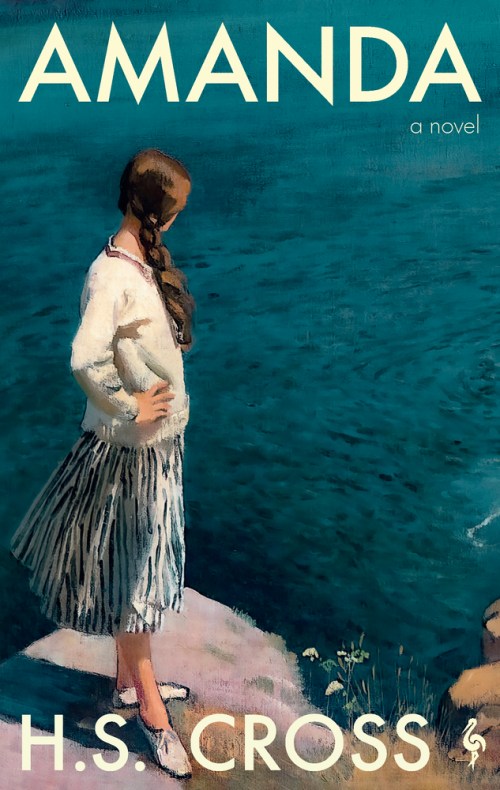
FICTION
by H. S. Cross
Europa Editions
Published on September 23, 2025


