


Each year, several hundred tons of unexploded bombs from both world wars are recovered from the areas around battlefields in France and Belgium. The récolte de fer (iron harvest) accounts for a mere fraction of the estimated 300 million duds, some containing poisonous gas, that failed to explode during the First World War alone. The remaining ordnance remains buried, leeching harmful chemicals into soil and water in places the French government has deemed too dangerous for agriculture and human habitation, forbidden zones that will take at least another three centuries to clear according to some experts.
Instead of centering around the soldiers who fought the war though, Michael Jerome Plunkett’s debut novel Zone Rouge follows the technicians responsible for cleaning it up. The collective attitude among the living is that, “It is a quintessentially human quality to create a mess and then feel the need to make it somehow better.” The discovery of a single unexploded shell sets in motion a series of narratives that alternate between Hugo LeFleur, the bumbling mayor of a town near the Verdun battlefield, academics involved with archiving the history of the battle, and the démineurs tasked with handling the bombs: “A démineur. A minesweeper, or explosive ordnance disposal tech as some refer to it.” While others look for ways to rebuild and regain what has been lost, the démineurs exist in a kind of negative space: “Déminage. To de-mine. A plumber plumbs. An electrician conducts electricity. But a démineur? It’s a life spent in a deficit. A life spent extracting and removing. A life spent disposing of as opposed to creating.”
Mutual praise and oblique criticism passes between “[t]he anthropologists, the archaeologists, the sociologists, all the Gists!” who “can’t dig for shit” on one hand, while on the other, “[t]he démineurs, roughnecks transformed into careful, gentle pairs of hands, move with the kind of reverence used to prepare a pyre.” When the démineurs discover part of a human skeleton, the dig expands, touching lives and memories beyond the present recovery efforts. As the team extracts more war matériel from the earth, Hugo exploits the dig for his own real estate deals, extramarital affairs, and a public relations event memorializing the war dead in his town’s ossuary. The small town drama holds together more serious ruminations about time, place, and nature spoiled by one deadly man-made object at a time. Repetition of statistical facts can feel tedious compared to the wry humor at the heart of Plunkett’s observations about how the living inherit the refuse and consequences of the past that they still live with today.
Plunkett, a United States Marine Corps veteran, co-hosts the LitWar Podcast where he interviews other artists about their lived experiences with war and the stories that shaped them. Unlike many of his contemporaries though, Plunkett has chosen to write a novel that is seemingly very far from his own lived experience. There are no American characters here. While Plunkett’s research clearly surpasses the requirements for what could have been a perfectly adequate historical novel about the battle of Verdun, Zone Rouge gets into such detail with local French politics, the bureaucratic logistics of a modern archaeological dig, and the interpersonal dynamics of everyone involved, that it’s hard to believe the author wasn’t there on the ground to démine right along with his characters.
At times, the seemingly endless index of facts about battle casualties and environmental pollutants that feel so immersive can also obstruct the pacing of smaller dramatic moments like one démineur’s battle with cancer (that may have been caused as a result of his job) and his memories of life before illness. Where Plunkett lists the French nicknames for different ordnance types (petit crapaud, foetus avorté, bébé chauve maléfique), their definitions (little toad, aborted fetus, and evil bald baby, respectively) are never spelled out in English. The use of this kind of lexicon throughout Zone Rouge presumes a certain level of collaboration with the story that makes it impossible to remain detached any more from the myths of Verdun than from the present struggle to interpret them. As the field notes of one fictional archaeologist puts it: “It is everyone’s, it is no one’s. Which is another way of saying, almost everyone has a piece of Verdun but there’s no one individual who knows everything about this battle.”
In the end, it is mythology that overtakes the history of any war. The search for meaning becomes as futile as digging up shrapnel from the craters created by weapons long-silenced, or rather, drowned out by the violence of more recent ones. With Zone Rouge, Plunkett dissolves the need to move between past and present, favoring instead the need to understand and interpret the coexistence, interdependence even, of stories that create culture of people and nations over time. In a moment of stunning clarity, the notes of one fictional historian observes: “It’s what is missing that adds the true enormity to the overall picture. There’s more truth in the missing than any story you can tell about this battle.” As any “gist” worth their weight in shrapnel knows, the omissions of history tell at least as much as the findings. The rest is for the living to interpret for themselves.
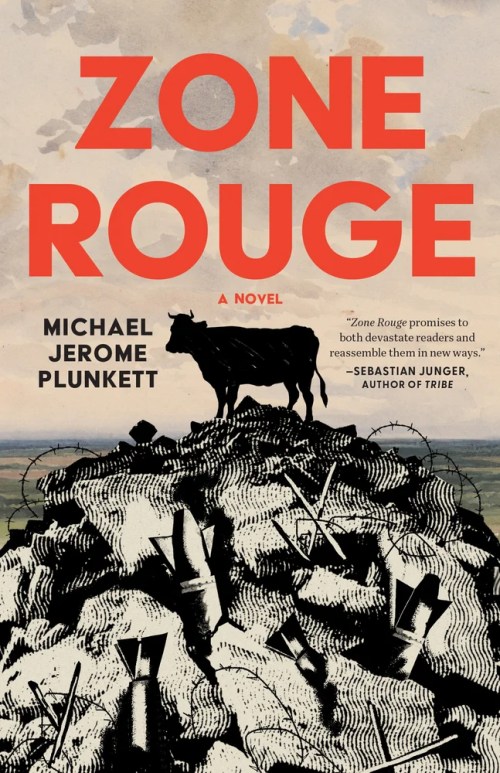
FICTION

by Michael Jerome Plunkett
Unnamed Press
Published on September 2, 2025


