


In 2020, one friend after another kept recommending Makenna Goodman’s The Shame. They remarked on Goodman’s radical honesty, how the concision of her insights felt new in subtle, gripping ways. After reading The Shame in two nights, I began recommending it as well. Goodman juxtaposes urban and rural realities with a sharp, understated sense of humor. Her attunement to the maddening aspects of heterodynamics is exceptional, too.
Her second novel, Helen of Nowhere, is even bolder, a vessel for the contradictions of the present moment unlike any recent novel I’ve read. In it, a disgraced former professor arrives in the countryside hoping to acquire a new home and a reset on his notions of himself. He’s struggling with a growing sense of irrelevance and a failing marriage. The realtor for the home and its spectral owner, Helen, pose questions to the Man while he considers the house and hears what Helen aspired to create on the property after she fled the city as well, years before.
It was thrilling to speak with Makenna about the striking theatrical structure she chose for this new novel and its irresolvable questions that lead to a rather funny surprise in the last act.

Idra Novey
Helen of Nowhere contains so many of the escalating incoherencies of our era. Earlier this year, you published a short prose piece about the psychic muck of feeling complicit, every day, in myriad hypocrisies and atrocities, yet still trusting in some “dormant goodness.” Can you talk about the desire to believe in “dormant goodness” and the enigmatic Helen you’ve created in this novel?
Makenna Goodman
Thank you, Idra, that’s such a wonderful thing to hear. And yes, I do believe in a dormant goodness. Although I don’t always find that belief easy to maintain. Obviously, since the beginning of time, the nature of humanity has been both violent and good, and this juxtaposition creates the very state of being human…and yet it is also an unthinkable state. Don’t you find it so hard to hold the concept of “both” in your mind and make any logic of it? I should say, at least for me, I often find myself struggling to balance the wonderful things that occur with the horror I see daily, either on the street where I live or on the news. But if we focus only on the horror, we miss out on the moments of beauty that do occur; and yet if we focus only on the beauty, we can’t ever really know its essence, because without the horror, the beauty doesn’t have a resonant meaning. Maybe a baby experiences beauty in purer terms, but they are coming right out of the trauma of birth. Perhaps it is only in art or comedy where one can access this duality with any real resonance. Maybe that’s the reason to make art.
There is a lot of light in the world, like when one is out among trees, or when hearing live music, or embracing a loved one, or being of service, or laughing, or in a flow state, etc. And it should not be a privilege to exist in such beauty, it is what everyone must do to stay alive—it is every human’s desire to exist in beauty and to create and to laugh and to be in love. But of course one can overdo it, I do believe one can hoard goodness. One can live in denial of horror, and one can become a perpetrator while living in the spirit of “good.” I wanted Helen to serve as an example of a person who is actively living in this juxtaposition but who is not quite able to see herself in it, despite thinking she can. Someone who is aware of these systemic and philosophical paradoxes, who wants to do good, and yet who is far from being enlightened (if there were such a thing). Someone who is close to understanding, but not really, and that’s a humorous position to uphold, but the joke is sort of on her. This is a place where many of us find ourselves—in an illusion where we seek to separate our own actions from the pain and badness of the world. But we are all a part of the good and the bad.
Idra Novey
The disgraced professor seeking to purchase Helen’s home is also seeking purchase of her way of living, of her vision for how to relieve the deep unease of being a lucky “golden egg.” A novel is also something we seek to purchase to relieve ourselves of the bewildering unease of being human. What questions about the limits of purchase shaped your creation of Helen and this blazing sui generis work of fiction?
Makenna Goodman
It’s very rare these days for people to make the things they consume. You can make bread, but you have to buy the flour. And probably you have to buy the cookbook. There are very few people growing their own grain, milling it, then making their own bread in bowls they made, with spoons they made, in ovens they constructed with firewood they harvested, using saws they welded themselves, with grandmother’s recipe, etc. And as such, our sense of personhood arises through the things we choose to purchase and then, how we use them. Here’s the beautiful bread I made, I hope it nourishes you; it was made with the intention of sharing nutrients and love, with a recipe from this famous bakery’s cookbook, etc. But if you think of the systems behind flour mills and the people who work there, and all the people who can’t eat bread at all, then the bread takes on a new meaning. There are people who make incredible bread with amazing flour, and then there are people who simply survive, finding any scrap of bread just to stay alive.
For those who are comfortable, there is often something attractive about the idea of just having to survive, even though if you extrapolate it too far, being without becomes horrible. But the idea of it can be compelling—to remove oneself from the alienation of consumption. It’s not compelling to enjoy being without to the point of real, terrifying lack. But there is a very human impulse to experience withoutness as a way to understand what it means to have. I’m thinking in particular of the back to the land movements of the 1930s and 1960s, where well-to-do intellectuals opted out of their lives of access into carefully constructed worlds of making and sharing in rural communities, stripping away the acts of purchasing so as to experience a greater “true”ness. This is not a judgement of those people, by the way. It’s an impulse I share. And Helen is a beacon of this kind of life, this way of being. She has the means to choose how to live. And as the failures of capitalism become more and more evident, as the promise of it for anyone other than the super rich fails to really deliver, the drive to live simply can become just as compelling as the drive to have more money so as to consume more things, because we see how things don’t actually hold the promise of real contentment. One can be just as happy in a small cabin with a small garden as someone with a huge mansion on a beach. One is just as human, just as longing for love. And both the cabin and the mansion will get flooded, no matter how happy or wealthy or loving we may be. So what are we to strive for, if we are not simply surviving and searching for scraps? And how do we know where to find it? What are we to do about the people who are dying of lack, either next door, or on the other side of the world? And how can we still laugh, while knowing all that is so terrible? These are hard questions I ask myself.
Idra Novey
I reread Helen of Nowhere last week while staying on a friend’s sheep farm in upstate New York. Their farm house has only one small mirror on the wall, in the bathroom. The realtor in the novel talks about Helen’s loathing of household mirrors and her refusal to make mirrors for anyone, only chairs and tables. When asked to make a mirror, Helen says “we are more than just our puny selves and mirrors are all about puniness.”
In my friends’ farmhouse, it’s easy to feel connected to more than one’s puny self, with every window opening onto fields and trees, the calls of birds. Helen, her unnamed husband, the realtor, all of them flee the limits of city buildings, airshafts where the only view is of other humans drifting through similar rooms. Do you see a connection between a desire for household mirrors and what exists outside the house?
Makenna Goodman
Mirrors are interesting to me. Because first of all, you are not seeing yourself as you are; you are seeing the flipside or yourself. What is left is actually right, and so forth. And we are constantly looking into mirrors to make sure we are still there. Am I myself? Who am I? Am I presentable? Will I be known? Phones are mirrors; selfies are mirrors. Was I here? Am I experiencing this?
If you look out all day at fields and rivers and animals crossing and eating and drinking, you start to see yourself as part of a much larger web of beings, not just “me” but everything else, too. You start to notice all the ways humans are a part of nature, and yet also how wild beings and the transition from grasses to seeds to frosts to snowfall will carry on with or without us. Humans and nature are not distinct entities. But when we are surrounded by human constructed worlds, like in cities, it’s easier to forget that we are animals. However, a window in the city acts as a mirror for our own humanness in the same way a window looking out onto fields and trees is a mirror to who we are. Because we are part of both things— the field was actually a forest before it was deforested and converted into a sheep pasture, and the city was actually a field or a wetland or a forest before it became a city. It’s easy to forget that, because we are not often educated in the trajectory of natural systems and ecological cycles. We learn about human history through things like wars and economic crises but if you study a field you can actually learn a lot about history through the lens of how the field was altered and utilized and abandoned over time. And if you study the apartment building you can understand that all the land underneath it was once something else and what it has been over time.
As far as “puniness”, that is a judgment Helen is placing on this human vs nature distinction. And it is a judgment that has been utilized (and weaponized) by well-intentioned intellectuals (like Helen) for a long time—this idea that those who seek to find their reflections in cities are less good than those who seek to find their reflections in natural settings. When there really is no difference – a human is interconnected with nature regardless if they live on a farm, in an apartment, in prison, taking the subway to work, or actively experiencing grasses in prairies for 8 hours a day quietly, surrounded by rabbits and butterflies, dunking into rivers when they get hot. The difference is not in one’s values or one’s essence, but in one’s access. And the distinction between those “in nature” and those “in cities” serves only to continue upholding beautiful nature as something for the few, and cities as cesspools for the working class. And Helen is playing into that. It’s not a secret that wonderful human ideas and expressions come from cities. But cities are also a part of nature.
Idra Novey
Various characters in the novel try to make sense of the people around them through categorical thinking, sorting people into either “doers” or “takers.” You generate a lot of humor through the inevitable leaks between these neat divisions, the difficulty of figuring out who is a “taker” pretending to be a “doer.”
The section in Helen’s voice juxtaposes the wife as “an anchor” who enables her husband to flit about and be “a kite.” TikTok and Instagram offer up endless memes for human sorting. I’m curious to hear what drew you to include these amusing sorting methods for characters fleeing the city for open land and what they hope will be a “simpler life.”
Makenna Goodman
It is a very human thing to make categories and sort things. It’s how we make sense of the world, it’s the way language is created. Sweet is inherently the opposite of salty; it is not embedded in the word, but the meaning of “not salty” is integral to “sweet.” A butterfly is not a moth, a grass is not a shrub. And this sorting can be useful as a way to make order out of chaos, to communicate, to interact. But sorting has also been a tool to create distinctions between people, and as a tool it has led to atrocities and genocides and continues to be the worst impulse of humanity, for people with power to sort others into groups and then decide who gets what, and who deserves what. The idea of “them”, that finger pointed out, sorted out against “me.” And isn’t “me” in that context always virtuous? Yes, no one says “I am villainous and you know, I should stop but I can’t, because I’m trapped in a system of projection and internalized hatred,” they say “I am correct, and you are incorrect, and my actions serve only to uphold my correctness.. The sorting is always couched in positive terms, no matter how villainous or virtuous the person saying it might be. Wars are always fought in the name of freedom.
Sorting is also a tool of storytelling: a wife is not a husband, a dog is not a cat, running is not meditating. These distinctions help us make sense of our world, help us to tell the story, but they can also trap us. The man in this book has a very clear understanding of who he is, but is he correct? Has he been misjudged? Is he worse than he claims? Can he change? Can he be redeemed? And if so, what kind of transformation of self has to occur to allow a re-casting, or re-sorting to take hold? It’s actually quite radical to re-sort. People get very upset about it. People do not like it when you say, a kite is actually an anchor. People will really fight you on that.

Idra Novey
Yes, people really do panic about any kind of re-sorting. Trying to re-cast the perception of a kite as an anchor is a daring endeavor.
Both of your novels disrupt the predictable sorting of noble characters and nefarious ones. In The Shame and now in Helen of Nowhere, you re-cast your characters in such meaningful, unexpected ways that ring true with how humans actually proceed through their lives. Without spoiling the sly re-casting that happens in the last section of this wondrous novel, I’d love to know whether these questions of changing roles influenced the form you chose for this novel, presenting the characters as figures in a play?
Makenna Goodman
I wanted to play with the idea that we are all existing in some constantly evolving truth, where we contribute to its remaking every minute of every day. I’m me, right, but how is that constructed, really? Through the stories I continue to tell myself about who “I” am. I had this image in my mind, of a set. Lit up by stage lights, surrounded by darkness, and only one or two people at a time in an empty wooden room. The world is not present—it is only the stories about the world that fill the room. And the more I edited, the more play-like it became. And yet literary forms are so “sorted,” aren’t they? Like, what is a “play” vs. a “novel”? They’re so arcane, really, these categories. I’m not sure readers need them as much as the industry does.
I don’t love books where the writer is dragging the reader around from point a to point b, pointing out every detail. I didn’t want to try and control a reader’s way of seeing, but I did want to play with the idea of how we see. I wanted to give a feeling, rather than a precise image. Everyone knows what it is to sit on a couch. But what does it feel like when you lay down on one? Things shift, we become vulnerable. It can be a very simple thing, I think, to convey that kind of power shift, from sitting to laying down, it doesn’t need to be too explicit.
I love theater, I love that you get to suspend disbelief in such a way as to say, okay, this cardboard is the house, fine, and this piece of wood right here is a couch. You make agreements to suspend ideas of what things look like or feel like, which frees up the mind in interesting ways. I wanted the reader to become so immersed that the set began to swallow them up, in mind and in body, where reality could be completely remade. And then in the end, it spits them out. But where are you? So far, people have had really different interpretations of the ending. Some see it as redemptive, some see it as punishing.
Idra Novey
I relished the unexpected humor of what you conjured for the last section. I didn’t think of the ending in a binary way, as either punishing or redemptive. I just enjoyed the inventiveness and it made me laugh. Did you have the humor of the ending in mind from early on, or did the last section occur to you as the novel evolved?
Makenna Goodman
I was actually talking to a friend of mine, an incredible writer, Caren Beilin, when the ending was eluding me. I was like, I wish I could just do this. And she goes, okay, you’re telling me you want to do it, so do it! For some reason I needed permission to play the game I wanted to play. I remember putting my phone down and rushing upstairs right then and there, and I wrote the ending word for word in my notebook. It poured out of me as it had been waiting all along. I sent it to my agent and she was like, this is it. Then I went back into the novel and saw all these clues, where I could see that my subconscious had made the plan from the get go, that the joke (if you can call it that) had already been set up, but the message to complete it hadn’t hit me until Caren gave me “permission.” She’s hilarious and we joke together a lot, through texts, so really the ending came to me while riffing with her.I love what the brilliant writer and comedian Jacqueline Novak said once when asked about her theory of comedy, that something has to be of burning interest to her, and she has to simultaneously want to say it and dread saying it. Her one woman show, Get On Your Knees, is a triumph. Jacqueline, if you’re reading this, call me. Anyway, she said that comedy is about going towards what’s uncomfortable, what you don’t want to talk about. It’s about playing into the contradictions. For the ending of Helen, it was clear to me that the man has to transform, but how? It had to be into the contradictions, otherwise it wouldn’t be true to life. That’s the joke, right? That he is both free and imprisoned, in his own contradictory self. That is the ending for us all, really.
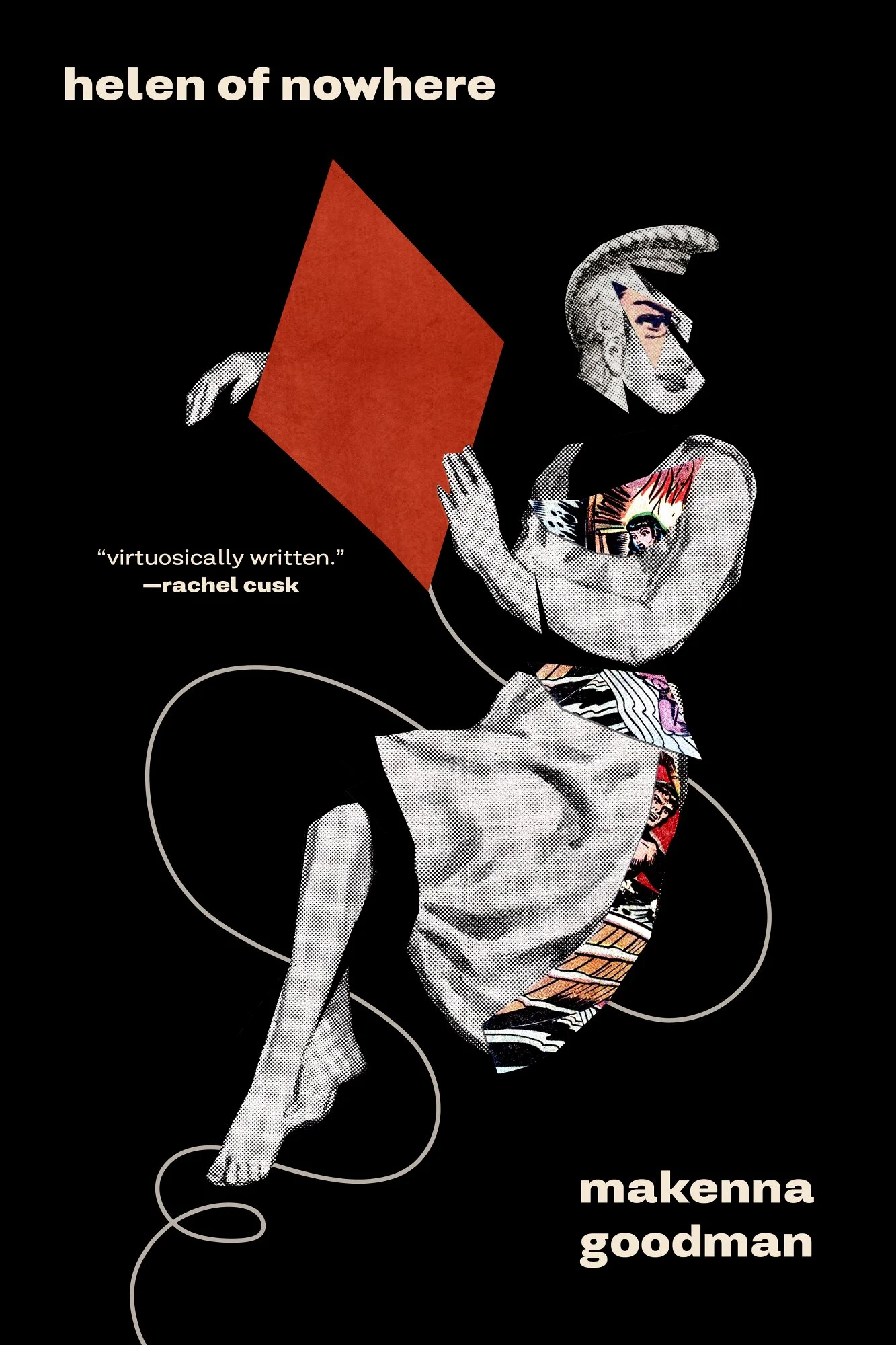
FICTION
Helen of Nowhere
By Makenna Goodman
Coffee House Press
Published September 9, 2025


